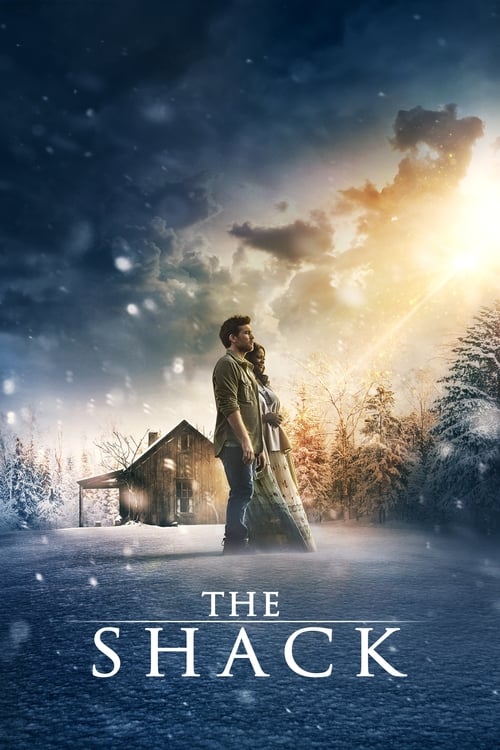
The Shack (2017)
Directed by Stuart Hazeldine
No — The Shack is not especially woke, scoring 28 out of 100 on our wokeness meter.
The Shack arrives as a sincere theological melodrama about a grieving father named Mack, whose young daughter is murdered, and who then receives a handwritten invitation to a wilderness shack signed by God.
Consciousness Markers
The Holy Trinity is deliberately rendered as a multi-ethnic trio — a Black woman as God the Father, a Middle Eastern man as Jesus, an Asian woman as the Holy Spirit, and later a Native American elder as Papa — an intentional, thematically loaded multicultural casting decision.
Critics widely described the film as 'an overly long church sermon' built on heavy-handed sermonizing, and it delivers its theology directly through lengthy didactic conversations — preaching, though of a devotional rather than social-justice kind.
Depicting God the Father and the Holy Spirit as women offers a mild feminine-divine gesture, but it is a theological device rather than a feminist statement and carries no gender-justice argument.
The multiracial Trinity implicitly gestures at racial inclusion, yet the film never engages racial consciousness as a theme or social concern.
No LGBTQ+ characters or themes appear at any point; the film's concern is entirely theological and familial.
No environmental or climate themes appear anywhere in the story.
No critique of capitalism, wealth, or economic hierarchy is present; the film's moral register is personal forgiveness, not economics.
No body-positivity themes or messaging are present.
No neurodivergence themes or characters are depicted.
The film is not a work of historical revisionism; its subject is contemporary spiritual fiction.
Why it received this score
The Shack arrives as a sincere theological melodrama about a grieving father named Mack, whose young daughter is murdered, and who then receives a handwritten invitation to a wilderness shack signed by God. The film's most discussed decision is its rendering of the Holy Trinity: a Black woman as the Father, a Middle Eastern man as Jesus, an Asian woman as the Holy Spirit, with a Native American elder later stepping in as Papa. This is a deliberate multicultural arrangement, loaded with thematic intent, and it supplies the film's only real claim to contemporary casting sensibilities. The choice functions as theology, not as social argument. The film cares about who God is, not about what the arrangement says to the world outside the cabin.
What the picture offers instead is conversation, and a great deal of it. Critics reached for the same phrase again and again, calling it an overly long church sermon, and the accusation lands. The Trinity sits with Mack in a sunlit kitchen and explains his pain back to him across long, patient exchanges that exist to instruct. The theology is delivered directly, in dialogue, without irony or subtext, which makes the whole enterprise feel less like storytelling and more like a devotional service with a runtime. Reviewers were unmoved, and the aggregate scores reflect that. Audiences, however, handed it an A, which tells us something about who was already in the pews.
Beyond the sermonizing, the film is remarkably free of contemporary preoccupations. There is no economic critique, no climate anxiety, no interrogation of the body, no neurodivergent reading, no queer presence of any kind. The feminine face of the divine is a gesture, not a program; nothing here argues for gender justice. Race sits in the casting and vanishes from the conversation. What remains is a film that wants to comfort, and largely does, for those inclined to be comforted. It is a gentle, well-meaning object, and it is not asking us to change anything except our grief.
Analysis generated by our Consciousness Algorithm
Part of


Synopsis
A grieving man receives a mysterious, personal invitation to meet with God at a place called 'The Shack'.
Questions about The Shack
Is The Shack woke?
No — The Shack is not especially woke, scoring 28 out of 100 on our wokeness meter. That earns it a verdict of Based.
Does The Shack have any woke elements?
2 of the 10 markers register at 30 or above, led by Representation Casting (50) and Lecture Energy (45). On Representation Casting: The Holy Trinity is deliberately rendered as a multi-ethnic trio — a Black woman as God the Father, a Middle Eastern man as Jesus, an Asian woman as the Holy Spirit, and later a Native American elder as Papa — an intentional, thematically loaded multicultural casting decision.
How does The Shack compare to other 2017 movies?
It ranks #67 of the 309 films from 2017 we've scored; their average is 19. The wokest is I Am Not Your Negro (92).
How is the Woke Score calculated?
An AI-assisted process researches the film and its reception, scores it 0–100 on ten markers, then combines those into one 0–100 Woke Score. It measures a specific set of 2020s cultural themes, not film quality.