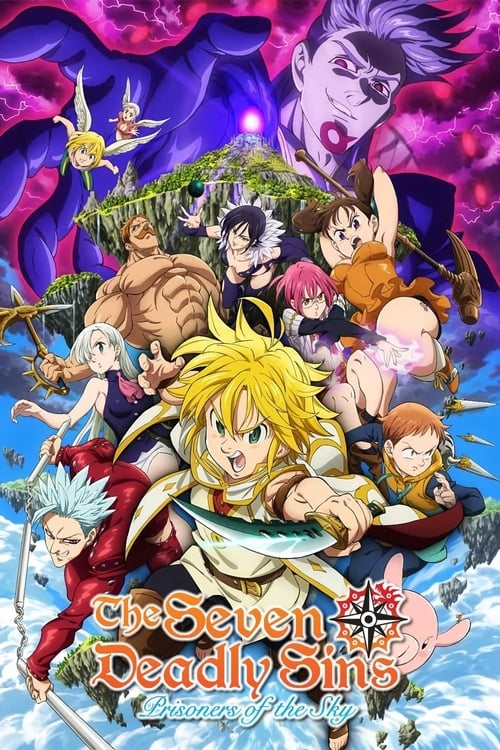
The Seven Deadly Sins: Prisoners of the Sky (2018)
Directed by Noriyuki Abe
No — The Seven Deadly Sins: Prisoners of the Sky is not woke, scoring 0 out of 100 on our wokeness meter.
Here is a film that asks nothing of its audience beyond a willingness to watch a talking pig fall through a well.
Consciousness Markers
The cast is entirely Japanese voice actors and the characters are fantasy races; there is no modern diversity casting agenda.
No LGBTQ+ characters, relationships, or themes appear in the film.
Female characters exist but the film does not advance a feminist agenda or critique patriarchy.
The conflict is between fantasy races (demons, goddesses, humans) and carries no real-world racial consciousness.
No environmental or climate themes are present.
No critique of capitalism or wealth inequality appears.
No body positivity themes or diverse body representation are present.
No neurodivergent characters or themes are present.
The film is a fantasy adventure with no historical revisionism.
The film is a straightforward shonen action adventure and does not lecture the audience on social issues.
Why it received this score
Here is a film that asks nothing of its audience beyond a willingness to watch a talking pig fall through a well. The Seven Deadly Sins: Prisoners of the Sky, a 2018 theatrical outing for the popular manga and anime property, sends its heroes above the clouds to a palace of winged Celestials, where a sealed demon awakens and must be put down again. There are swords. There are betrayals. There is a feast at the end. Nobody pauses to explain how we ought to feel about any of it.
That absence is the film's defining feature. We searched for a thesis and found only a treasure hunt for an ingredient called sky fish. The cast is uniformly voiced by Japanese performers, and the characters are fantasy races locked in a war between demons and goddesses, so questions of who is represented on screen never arise. Women fight and lead, yet the screenplay offers no argument about it. No one lectures us about the world outside the frame. The lone moral, that a boy should trust the strong yet terrible knights, could have been printed on a lunchbox in 1998.
Critics at the time called it serviceable popcorn, and that verdict holds. It is filler, cheerfully so, a feature-length episode with slightly better animation and a villain who exists to be defeated. We classify it, with a certain professional relief, as a film of no social consciousness whatsoever. It simply wants to entertain you for ninety minutes. In the current climate, that restraint feels almost avant-garde.
Analysis generated by our Consciousness Algorithm


Synopsis
Traveling in search of the rare ingredient, “sky fish” Meliodas and Hawk arrive at a palace that floats above the clouds. The people there are busy preparing a ceremony, meant to protect their home from a ferocious beast that awakens once every 3,000 years. But before the ritual is complete, the Six Knights of Black—a Demon Clan army—removes the seal on the beast, threatening the lives of everyone in the Sky Palace.
Questions about The Seven Deadly Sins: Prisoners of the Sky
Is The Seven Deadly Sins: Prisoners of the Sky woke?
No — The Seven Deadly Sins: Prisoners of the Sky is not woke, scoring 0 out of 100 on our wokeness meter. That earns it a verdict of Ultra Based.
Does The Seven Deadly Sins: Prisoners of the Sky have any woke elements?
No. All 10 markers score zero.
How does The Seven Deadly Sins: Prisoners of the Sky compare to other 2018 movies?
It ranks #291 of the 325 films from 2018 we've scored; their average is 20. The wokest is Return (92).
How is the Woke Score calculated?
An AI-assisted process researches the film and its reception, scores it 0–100 on ten markers, then combines those into one 0–100 Woke Score. It measures a specific set of 2020s cultural themes, not film quality.