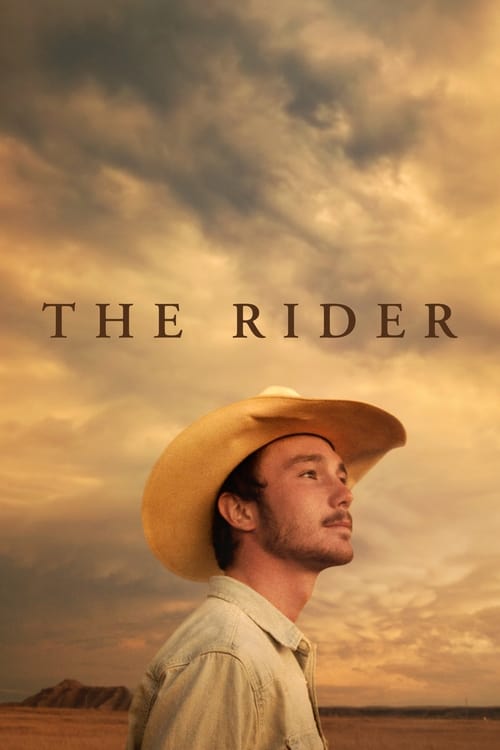
The Rider (2018)
Directed by Chloé Zhao
No — The Rider is not especially woke, scoring 35 out of 100 on our wokeness meter.
Chloé Zhao's The Rider arrives dressed as a western and behaves like an act of witness.
Consciousness Markers
The entire cast consists of non-professional Lakota Sioux actors from the Pine Ridge Reservation playing fictionalized versions of themselves, a deliberate authenticity-first casting choice.
The film is wholly immersed in Lakota life on the Pine Ridge Reservation, but it observes rather than argues, presenting Native experience as lived reality rather than racial commentary.
Brady's brain injury and seizures and his autistic sister Lilly are woven naturally into the story, though the film never lectures on neurodivergence.
Directed by a woman (Chloé Zhao) and quietly interrogating traditional cowboy masculinity, but the film offers no explicit feminist thesis or agenda.
Economic hardship and poverty are depicted, but as lived circumstance rather than as an anti-capitalist argument.
Disability is treated with dignity (Lane is shown doing a job, not as a victim), but this is not framed through the body-positivity movement.
The film is a quiet, observational character study that shows rather than tells, carrying almost no didactic or preachy energy.
No LGBTQ+ characters or themes appear anywhere in the film.
No environmental or climate themes are present.
A contemporary western with no historical revisionism; it depicts present-day reservation life rather than reinterpreting the past.
Why it received this score
Chloé Zhao's The Rider arrives dressed as a western and behaves like an act of witness. The cast is drawn entirely from the Pine Ridge Reservation, non-professional Lakota performers playing fictionalized versions of themselves, and the effect is a film that never has to announce its authenticity because it simply lives inside it. Brady Jandreau trains horses on camera with a patience that reads as documentary. The camera watches him gentle a wild animal and asks nothing of the audience beyond attention. This is representation as structural principle, not as gesture.
The film's quietest provocation is its treatment of masculinity. Here is a young man whose identity was built on riding and whose body has betrayed him, and Zhao observes the wreckage without prescribing a cure. That a woman directed it matters, though the film carries no thesis about gender, only a steady gaze at what men are permitted to grieve. Brady's seizures and his autistic sister Lilly are folded into the household like furniture, unremarked and untherapized. Lane, his injured friend, gets a scene of genuine labor, treated as a worker instead of a symbol. Dignity, yes. A campaign, no.
Poverty saturates the film, the trailer, the grocery job, the father's gambling, but it is weather, not argument. Nobody stands up to explain the economy. The same restraint governs everything: no speeches, no lessons, no character turning to the middle distance to summarize the theme. Zhao shot it cheap, on credit cards and natural light, and the modesty shows in the right ways. The result is a sad, precise portrait of a man deciding not to ride. The film earns its feeling honestly, which in this era of instruction is a small miracle and a large relief.
What we have, then, is a work of social consciousness that declines to raise its voice. It observes a Lakota family, a broken body, and a hard economy, and it lets all of them remain themselves. The classification is straightforward: sincere, humane, and almost entirely free of sermonizing. A rare vintage. We shall note it in the ledger and move along to the next bottle.
{"thematic_tags": ["true_story"]}
Analysis generated by our Consciousness Algorithm


Synopsis
Once a rising star of the rodeo circuit, and a gifted horse trainer, young cowboy Brady is warned that his riding days are over after a horse crushed his skull at a rodeo. In an attempt to regain control of his own fate, Brady undertakes a search for a new identity and what it means to be a man in the heartland of the United States.
Questions about The Rider
Is The Rider woke?
No — The Rider is not especially woke, scoring 35 out of 100 on our wokeness meter. That earns it a verdict of Based.
Does The Rider have any woke elements?
3 of the 10 markers register at 30 or above, led by Representation Casting (75), Racial Consciousness (55) and Neurodivergence (40). On Representation Casting: The entire cast consists of non-professional Lakota Sioux actors from the Pine Ridge Reservation playing fictionalized versions of themselves, a deliberate authenticity-first casting choice.
How does The Rider compare to other 2018 movies?
It ranks #61 of the 325 films from 2018 we've scored; their average is 20. The wokest is Return (92).
How is the Woke Score calculated?
An AI-assisted process researches the film and its reception, scores it 0–100 on ten markers, then combines those into one 0–100 Woke Score. It measures a specific set of 2020s cultural themes, not film quality.