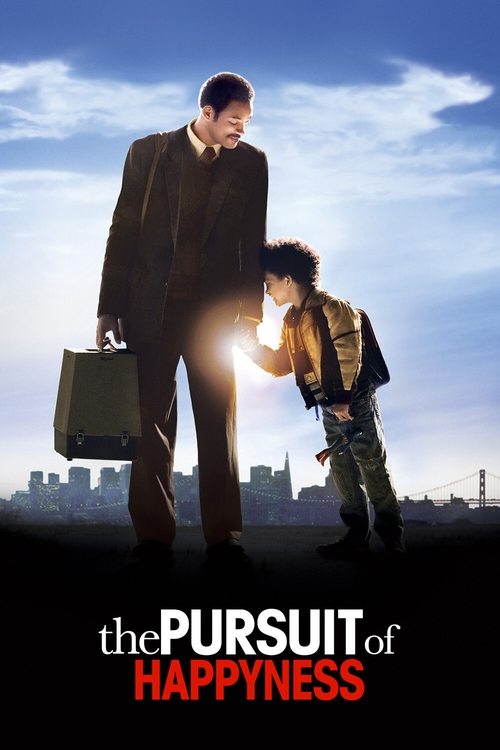
The Pursuit of Happyness (2006)
Directed by Gabriele Muccino
No — The Pursuit of Happyness is not woke, scoring 6 out of 100 on our wokeness meter.
Gabriele Muccino's The Pursuit of Happyness comes to us from 2006, a year when a film could still ask an audience to weep for a man selling bone-density scanners and expect full compliance.
Consciousness Markers
Features a Black lead and Black family, but this reflects the true story rather than a modern diversity casting initiative; minority characters exist naturally without commentary.
No LGBTQ+ themes or characters.
No feminist agenda; the wife is a peripheral figure who leaves, and the narrative centers on a father-son struggle.
Race is not examined; the film presents a bootstrap American dream narrative without systemic racial critique.
No climate or environmental themes.
Celebrates capitalist success and the stockbroker dream; National Review praised it as a conservative film.
No body positivity themes.
No neurodivergence themes.
Based on a true story with dramatic compression, but not a revisionist historical narrative in the woke sense.
Inspirational and earnest but does not deliver progressive social justice lectures.
Why it received this score
Gabriele Muccino's The Pursuit of Happyness comes to us from 2006, a year when a film could still ask an audience to weep for a man selling bone-density scanners and expect full compliance. Will Smith plays Chris Gardner, a San Francisco salesman who loses his apartment, his wife, and most of his dignity in roughly that order, then wins an unpaid internship at Dean Witter and a small hand to hold through the BART station restrooms. The film is sincere. It is also, by the standards of the present decade, remarkably unburdened.
What the film declines to do is instructive. Gardner is Black, his son is Black, and the screenplay never once frames their hardship as anything but bad luck and bad choices. The casting follows the memoir, not a studio initiative, and the characters simply exist inside their story without commentary. Linda, the wife, works as a hotel maid, leaves for New York, is told to her face that she cannot manage single parenthood, and exits the narrative so the camera can follow the father and son. No feminist reading survives contact with that scene. The antagonists are the Internal Revenue Service, unpaid parking tickets, and one damaged scanner. Capital is the prize, not the villain, which is why National Review placed the film seventh on its list of the best conservative movies.
There is no climate sermon here, no body-positive subplot, no neurodivergent arc, no closing speech about the structures that produce homelessness. The moral universe is tiny and it is stated plainly: a man sells his own blood to repair a medical device, then sells the device. The film admires him for it. We are left with a well-made, well-acted artifact of an earlier cultural moment, earnest to its bones and entirely at peace with the system it depicts. Classification is straightforward. It inspires. It does not instruct.
Analysis generated by our Consciousness Algorithm


Synopsis
A struggling salesman takes custody of his son as he's poised to begin a life-changing professional career.
Questions about The Pursuit of Happyness
Is The Pursuit of Happyness woke?
No — The Pursuit of Happyness is not woke, scoring 6 out of 100 on our wokeness meter. That earns it a verdict of Ultra Based.
Does The Pursuit of Happyness have any woke elements?
Very few. None of the 10 markers reaches 30, the level where a marker counts as present; the highest is Representation Casting at 15.
How does The Pursuit of Happyness compare to other 2006 movies?
It ranks #121 of the 211 films from 2006 we've scored; their average is 11. The wokest is An Inconvenient Truth (92).
How is the Woke Score calculated?
An AI-assisted process researches the film and its reception, scores it 0–100 on ten markers, then combines those into one 0–100 Woke Score. It measures a specific set of 2020s cultural themes, not film quality.