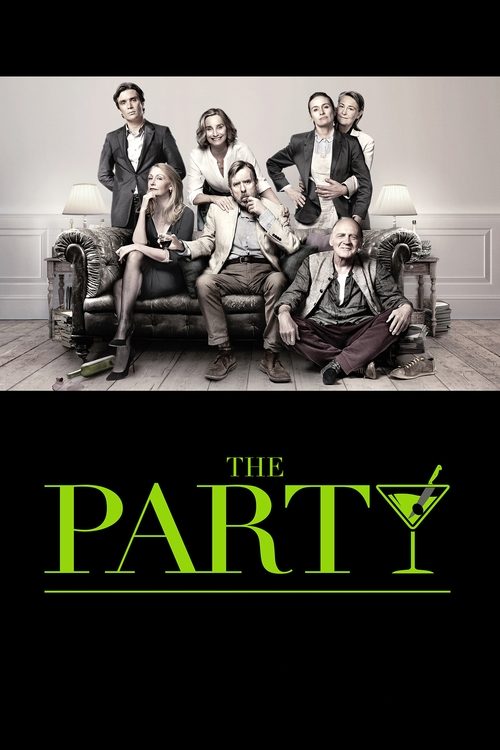
The Party (2017)
Directed by Sally Potter
No — The Party is not especially woke, scoring 37 out of 100 on our wokeness meter.
Sally Potter's The Party arrives as a black and white chamber piece, seven actors in a London townhouse, ninety minutes of escalating catastrophe.
Consciousness Markers
Martha and Jinny are a married lesbian couple, with Martha a women's studies professor and Jinny a pregnant chef; their relationship and parenting conflict are central to the plot.
Directed by Sally Potter with a female politician protagonist, a women's studies professor, and sharp commentary on the roles and compromises of women in power and partnership.
The film is a biting social satire with political and ideological banter (atheism, spirituality, politics), but it delivers its ideas through farce and character conflict rather than direct moralizing.
Tom is a cocaine-snorting, gun-brandishing banker 'in finance' who is mocked as a shallow opportunist, offering a mild swipe at finance capital, but it is incidental satire rather than a systemic critique.
The ensemble is almost entirely white British and European actors; the only diversity note is a same-sex couple, which is better captured under LGBTQ+ themes. No meaningful casting-for-representation effort.
No engagement with race or racial politics; the cast and concerns are uniformly white and class-based.
No environmental or climate themes appear in the film.
No body positivity themes; the film does not address body image or size acceptance.
No neurodivergence themes or characters are present.
No historical revisionism; the film is a contemporary chamber satire with no historical subject matter.
Why it received this score
Sally Potter's The Party arrives as a black and white chamber piece, seven actors in a London townhouse, ninety minutes of escalating catastrophe. Janet, a freshly appointed shadow health minister, has gathered her circle for canapes and congratulations. Her husband Bill sits in a chair, drinking, saying nothing. The guests include a women's studies professor, her pregnant chef partner, a self-styled spiritual healer, and a banker who spends the first act locked in a bathroom with cocaine and a handgun. It is a farce, tightly wound, and the doors keep opening onto worse news.
On the question of gender, the film has genuine interests. Potter directs, Kristin Scott Thomas anchors the frame as a woman navigating the compromises of political office, and the Martha and Jinny thread gives us a married lesbian couple whose parenting conflict carries real dramatic weight. Martha condescends, Jinny bristles, and the argument about who will raise the triplets lands with a sting. This is not decoration. It is structure. The film is less interested in race or class beyond the drawing room, and its concerns remain those of a comfortable, well-read, entirely white milieu.
Where the film resists sermonizing is in its delivery. Tom the financier gets his comeuppance as a snorting, gun-waving opportunist, a mild jab at the City that never hardens into an argument. The politics are debated, mocked, absorbed into the farce. A gun ends up in a bin, then in a bathroom, then in Janet's hand at the door. The final image is a woman aiming at a betrayer and screaming, which is a more honest ending than any lecture could manage.
Analysis generated by our Consciousness Algorithm


Synopsis
Various individuals think they’re coming together for a party in a private home, but a series of revelations results in a huge crisis that throws their belief systems – and their values – into total disarray.
Questions about The Party
Is The Party woke?
No — The Party is not especially woke, scoring 37 out of 100 on our wokeness meter. That earns it a verdict of Based.
Does The Party have any woke elements?
3 of the 10 markers register at 30 or above, led by LGBTQ+ Themes (60), Feminist Agenda (55) and Lecture Energy (30). On LGBTQ+ Themes: Martha and Jinny are a married lesbian couple, with Martha a women's studies professor and Jinny a pregnant chef; their relationship and parenting conflict are central to the plot.
How does The Party compare to other 2017 movies?
It ranks #54 of the 309 films from 2017 we've scored; their average is 19. The wokest is I Am Not Your Negro (92).
How is the Woke Score calculated?
An AI-assisted process researches the film and its reception, scores it 0–100 on ten markers, then combines those into one 0–100 Woke Score. It measures a specific set of 2020s cultural themes, not film quality.