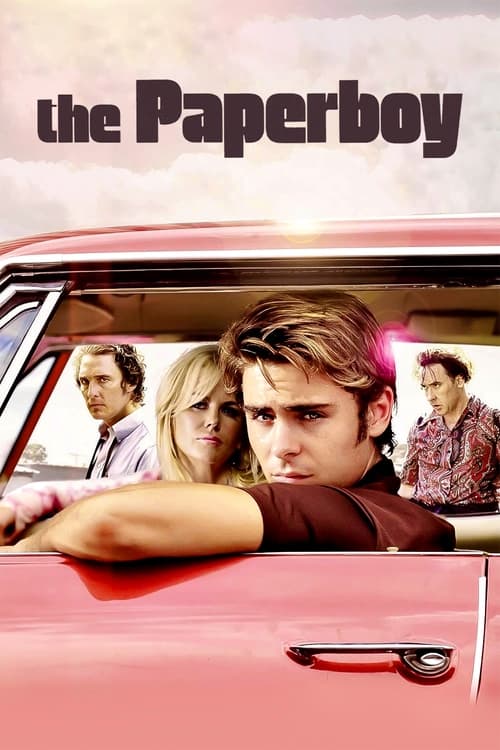
The Paperboy (2012)
Directed by Lee Daniels
No — The Paperboy is not especially woke, scoring 27 out of 100 on our wokeness meter.
Lee Daniels returns to the Sunshine State for a swamp-soaked melodrama that premiered at Cannes in 2012 and was greeted with what the festival program might charitably call a mixed response.
Consciousness Markers
Ward Jansen's concealed homosexuality is a genuine plot revelation, and the film carries an explicit 'gay theme' keyword, though it is framed as a shameful betrayal rather than a celebration of identity.
The cast is notably diverse for a 2012 Southern gothic, with Macy Gray as the Black narrator/maid Anita and David Oyelowo as Yardley, though their presence is largely organic to the period setting rather than a self-conscious diversity statement.
Race is present through Anita's narration, a pointed racial slur Jack hurls at Yardley, and the 1960s Florida milieu, but the film treats these as texture and friction rather than a thesis about systemic injustice.
Charlotte Bless is a vivid, sexually autonomous female character, but the film leers at her as much as it empowers her, and the Alliance of Women Film Journalists nominated Kidman for 'Actress Most in Need of a New Agent.'
The Paperboy is a lurid, sordid melodrama that revels in camp and sensation rather than preaching; it has no didactic agenda to impart.
The Everglades and swamp settings are atmospheric backdrop for a murder plot, not a vehicle for environmental messaging.
No economic critique or class-warfare theme is present; the film is preoccupied with lust, betrayal, and swamp noir.
No body-positivity themes or messaging appear in the film.
No neurodivergence themes or characters are present.
The film is a period piece set in 1969 but makes no revisionist claims about historical events; it is fiction adapted from a novel.
Why it received this score
Lee Daniels returns to the Sunshine State for a swamp-soaked melodrama that premiered at Cannes in 2012 and was greeted with what the festival program might charitably call a mixed response. Set in the summer of 1969, the film follows a Miami reporter, his English-accented colleague, and his paperboy brother as they chase a death row exoneration through the Everglades. It is lurid, humid, and entirely committed to its own bad taste. The cast is more integrated than the Southern gothic template usually permits: Macy Gray narrates as Anita, the family's former maid, and David Oyelowo plays the journalist Yardley. Their presence reads as period texture, not a casting statement, though the film does pause for a racial slur that lands with genuine ugliness and then moves on.
Sexual politics are messier still. Nicole Kidman's Charlotte Bless is a woman of frank appetites, and the camera rewards her with a leer every time. The picture grants her autonomy and then punishes her for it, which makes the whole arrangement difficult to file under empowerment. Ward's concealed homosexuality arrives late as a plot twist, framed as betrayal instead of identity, which lends the material an old-fashioned shame that no amount of swamp heat can dispel.
The film has no thesis to deliver. There is no environmental sermon in the Everglades, no class warfare in the sod theft, no body-positive or neurodivergent subplot, and no revisionist claim about the historical record. It is fiction adapted from Pete Dexter's novel, and it wants only to be a hot mess. It succeeds. The result is camp, sensation, and very little preaching, which is its own kind of honesty.
A note on provenance: the picture is a book adaptation and nothing else in the taxonomy applies. It won no Academy Awards, spawned no sequels, remade nothing, invented no superheroes, and never topped the domestic box office. Its legacy is a Cannes jeering, a Golden Globe nomination for its leading lady, and a place on at least one year-end worst list. The classification is complete. The swamp can keep it.
{"thematic_tags": ["book_adaptation"]}」} wrong format. Let me fix: output should be a single JSON object with review and thematic_tags. I'll output{
Analysis generated by our Consciousness Algorithm


Synopsis
A reporter returns to his Florida hometown to investigate a case involving a death row inmate.
Questions about The Paperboy
Is The Paperboy woke?
No — The Paperboy is not especially woke, scoring 27 out of 100 on our wokeness meter. That earns it a verdict of Based.
Does The Paperboy have any woke elements?
3 of the 10 markers register at 30 or above, led by LGBTQ+ Themes (50), Representation Casting (45) and Racial Consciousness (35). On LGBTQ+ Themes: Ward Jansen's concealed homosexuality is a genuine plot revelation, and the film carries an explicit 'gay theme' keyword, though it is framed as a shameful betrayal rather than a celebration of identity.
How does The Paperboy compare to other 2012 movies?
It ranks #29 of the 230 films from 2012 we've scored; their average is 12. The wokest is Killing Them Softly (92).
How is the Woke Score calculated?
An AI-assisted process researches the film and its reception, scores it 0–100 on ten markers, then combines those into one 0–100 Woke Score. It measures a specific set of 2020s cultural themes, not film quality.