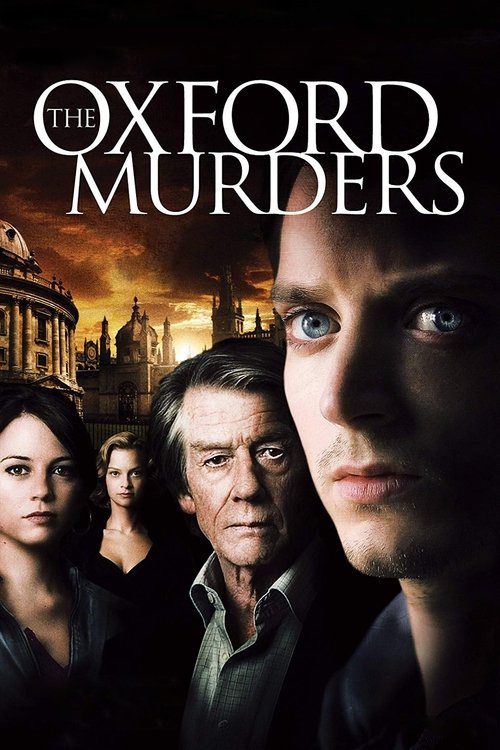
The Oxford Murders (2008)
Directed by Álex de la Iglesia
No — The Oxford Murders is not woke, scoring 4 out of 100 on our wokeness meter.
The Oxford Murders arrives from 2008, a Spanish-British co-production in which Elijah Wood plays an American graduate student who idolises a British logician played by John Hurt.
Consciousness Markers
The cast is overwhelmingly white British and Spanish, with only a single Black actor (Danny Sapani) in a minor supporting role and no emphasis on diverse or inclusive casting.
The film is heavily didactic about mathematics and philosophy (Wittgenstein, Gödel, Fermat), but this intellectual lecturing is not social-justice preaching.
Female characters (Beth, Lorna) exist as caregiver and love interest, but the film offers no feminist critique or agenda; Beth's resentment of caregiving is a plot device, not a statement.
There are no LGBTQ+ characters, relationships, or themes anywhere in the film.
The film engages no racial themes or commentary whatsoever.
No environmental or climate content appears in the film.
There is no economic critique or anti-capitalist messaging; the plot is a purely intellectual murder mystery.
No body positivity themes are present.
The film features a 'demented' mathematician and developmentally challenged children who are targeted for murder, but this is exploitative plot material rather than neurodivergence advocacy.
The film is a fictional mystery and makes no historical revisionist claims, though it does play loosely with real mathematical history (renaming Fermat's theorem).
Why it received this score
The Oxford Murders arrives from 2008, a Spanish-British co-production in which Elijah Wood plays an American graduate student who idolises a British logician played by John Hurt. Together they chase a killer who arranges his victims along a mathematical sequence. The film is verbose, chilly, and entirely convinced of its own cleverness. Wittgenstein, Gödel, Fermat, the tetractys, and the butterfly effect all receive their moment at the lectern. Rotten Tomatoes settled on seventeen percent. The classification desk is unmoved.
On the matter of modern social consciousness, the film is a desert. The cast is white and European, with a single Black performer in a minor role and no interest in correcting that. There is no LGBTQ content, no racial commentary, no environmental concern, no economic critique. The women exist as a caregiver and a nurse, and the caregiver's resentment of her mother is a plot mechanism, not a thesis. A demented mathematician and a busload of developmentally challenged children are deployed as murder material, which is grim but not advocacy. On every marker of contemporary progressive sensibility, the needle rests at zero.
Where the film does score is in lecture energy, though of a kind that predates the current fashion. It lectures constantly about mathematics and philosophy, and the lecturing has nothing to do with social justice. This is the older, colder form of sermonizing: a professor humiliating a student in a public hall, then explaining the perfect crime for two hours. The intellectual vanity is total. As a document of cultural awareness in the modern sense, the film is essentially inert, a period piece from a year that now feels distant. We file it accordingly.
Analysis generated by our Consciousness Algorithm


Synopsis
At Oxford University, a professor and a grad student work together to try and stop a potential series of murders seemingly linked by mathematical symbols.
Questions about The Oxford Murders
Is The Oxford Murders woke?
No — The Oxford Murders is not woke, scoring 4 out of 100 on our wokeness meter. That earns it a verdict of Ultra Based.
Does The Oxford Murders have any woke elements?
Very few. None of the 10 markers reaches 30, the level where a marker counts as present; the highest is Lecture Energy at 10.
How does The Oxford Murders compare to other 2008 movies?
It ranks #143 of the 212 films from 2008 we've scored; their average is 12. The wokest is Milk (68).
How is the Woke Score calculated?
An AI-assisted process researches the film and its reception, scores it 0–100 on ten markers, then combines those into one 0–100 Woke Score. It measures a specific set of 2020s cultural themes, not film quality.