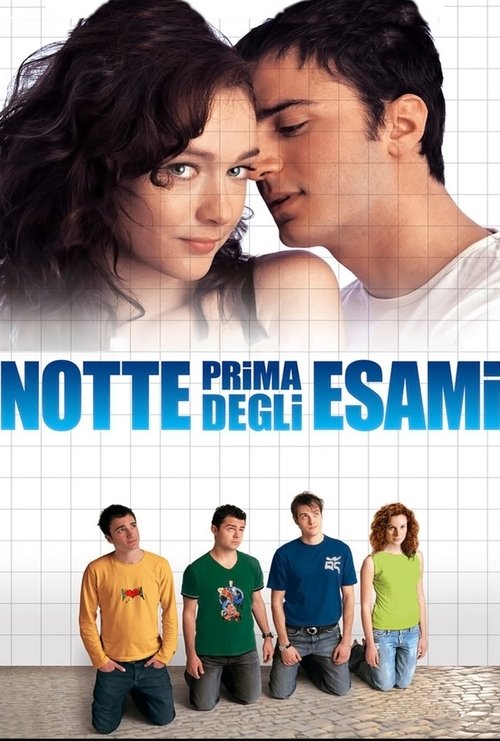
The Night Before the Exams (2006)
Directed by Fausto Brizzi
No — The Night Before the Exams is not woke, scoring 0 out of 100 on our wokeness meter.
The Night Before the Exams arrives from 2006, which is to say from a period when an Italian teen comedy could concern itself entirely with the terror of the esame di maturita and the logistics of a summer romance.
Consciousness Markers
The cast is entirely Italian and white, with no deliberate diversity casting or commentary on representation. Characters exist naturally within a 1989 Roman setting.
No LGBTQ+ characters, themes, or subtext appear anywhere in the film.
A female lead exists in a conventional teen-romance role, but the film advances no feminist argument or critique of gender structures.
No engagement with racial identity, racism, or racial justice themes.
No environmental or climate themes whatsoever.
No critique of capitalism, wealth inequality, or class-based economic structures.
No body-positivity themes or messaging about body image and acceptance.
No neurodivergent characters or themes of neurodiversity.
The film is a nostalgic period comedy set in 1989 and makes no revisionist claims about historical events.
A light teen comedy with no didactic messaging or moral lecturing to the audience.
Why it received this score
The Night Before the Exams arrives from 2006, which is to say from a period when an Italian teen comedy could concern itself entirely with the terror of the esame di maturita and the logistics of a summer romance. Luca insults his literature teacher, Martinelli, on the last day of school, then learns that Martinelli will sit on his examination board. Worse, the girl he pursues turns out to be Martinelli's daughter. The film follows this arrangement through a Roman summer of 1989, soundtracked by Duran Duran and Europe, and it resolves with the gentle inevitability of a beach holiday.
On the matter of modern social consciousness, the record is silent. The cast is Italian and white throughout, and the film offers no remark on this, because it is a film about Romans in Rome. The female lead serves as a romantic objective and little else, and the screenplay has no interest in interrogating that arrangement, or any other arrangement. There is no economic critique, no environmental conscience, no engagement with race, no LGBTQ presence, no meditation on body image, no neurodivergent characterization, and no correction of the historical record. The film treats 1989 as a place to visit for the songs, not as a site for moral instruction.
Which leaves the lecturing. There is none. The audience is never scolded, never instructed, never asked to examine its own complicity in anything. Luca learns that his teacher is a person, which is the oldest lesson in the genre and is delivered here without a single raised finger. This is a modest, warm, unambitious picture, and it demands nothing of the viewer beyond two hours of nostalgia. We can only report the findings. The glass is swirled, held to the light, and set down again with nothing in it.
Analysis generated by our Consciousness Algorithm
Synopsis
Rome, 1989. On his last day of high school, Luca gets in trouble when he takes it all out on hated literature teacher Martinelli, only to discover he's going to be heading the examination board for his finals. During a summer of fruitless study, he falls in love with a girl he met once at a party, unaware that she's Martinelli's daughter. The latter, strangely enough, has just offered Luca to prepare with him...
Questions about The Night Before the Exams
Is The Night Before the Exams woke?
No — The Night Before the Exams is not woke, scoring 0 out of 100 on our wokeness meter. That earns it a verdict of Ultra Based.
Does The Night Before the Exams have any woke elements?
No. All 10 markers score zero.
How does The Night Before the Exams compare to other 2006 movies?
It ranks #177 of the 211 films from 2006 we've scored; their average is 11. The wokest is An Inconvenient Truth (92).
How is the Woke Score calculated?
An AI-assisted process researches the film and its reception, scores it 0–100 on ten markers, then combines those into one 0–100 Woke Score. It measures a specific set of 2020s cultural themes, not film quality.