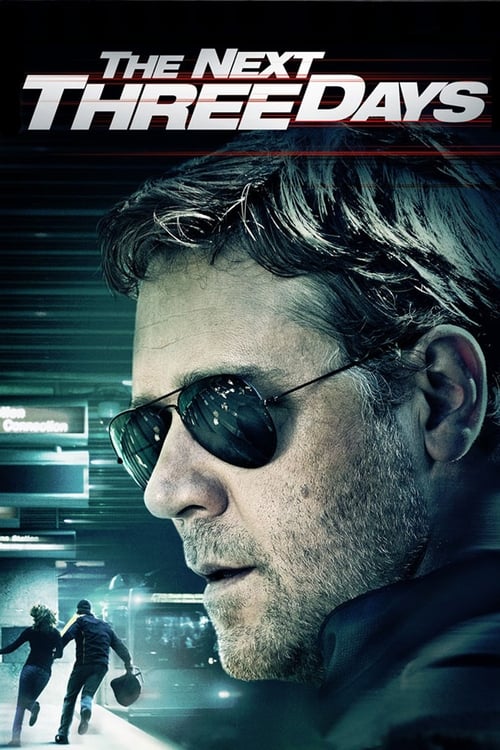
The Next Three Days (2010)
Directed by Paul Haggis
No — The Next Three Days is not woke, scoring 0 out of 100 on our wokeness meter.
Paul Haggis built his 2010 thriller The Next Three Days from a French original, Pour elle, and he kept the machinery intact: a Pittsburgh community college instructor named John Brennan watches his wife Lara take a life sentence for a murder she insists she did not commit, exhausts the appeals process, and then spends three months learning to break her out of Allegheny County Jail.
Consciousness Markers
Cast is predominantly white with one Black supporting character (Aisha Hinds) whose presence is natural and uncommented upon; no deliberate representational casting agenda.
No LGBTQ+ characters, themes, or subtext.
The wife is a wrongfully convicted victim and the husband is the active rescuer; the film does not advance a feminist agenda.
No exploration of race, racism, or racial identity.
No environmental or climate-related themes.
No critique of capitalism or wealth inequality; the protagonist's crimes are personal, not ideological.
No body positivity or body-image themes.
No neurodivergence themes; a deaf character appears briefly but deafness is not framed as neurodivergence.
No historical revisionism; the story is a contemporary fictional thriller.
No preachy or didactic messaging; the film is a straightforward suspense thriller.
Why it received this score
Paul Haggis built his 2010 thriller The Next Three Days from a French original, Pour elle, and he kept the machinery intact: a Pittsburgh community college instructor named John Brennan watches his wife Lara take a life sentence for a murder she insists she did not commit, exhausts the appeals process, and then spends three months learning to break her out of Allegheny County Jail. The film is a procedural of escalating competence, a man buying fake passports, testing bump keys, setting fire to a meth lab. It is also, by the standards of its decade, an unusually quiet piece of work. There is nothing in it to argue with, and nothing in it to argue about.
The supporting cast deserves a moment of professional attention. Aisha Hinds appears as a detective, competent and unremarked upon, her race never raised as a subject. A deaf motorcyclist sells John forged documents in a bar, and his deafness functions as a plot detail, a reason he operates outside the usual channels. Olivia Wilde drifts through a brief scene as a mother offering unsolicited advice. None of these presences carry a thesis. The film has no interest in the arrangements of power it depicts, no interest in the prison system as an institution, no interest in the wife as anything but a woman to be retrieved. Elizabeth Banks plays her with genuine desperation, and the screenplay gives that desperation nowhere to go.
The only ideology on offer is the one Haggis has described in interviews: Don Quixote, the romantic who ruins himself for an idea. John is an English teacher, and the film treats his self-destruction as an inheritance from literature, not politics. The result is a competent, slightly overlong suspense picture that opened at fifth place and vanished on schedule. As an object of cultural classification it is a blank page, and the honest verdict is that there is nothing here to grade. Some vintages are simply table wine. We note the year, we note the region, and we move on.
Analysis generated by our Consciousness Algorithm
Part of


Synopsis
Life seems perfect for John Brennan until his wife, Lara, is arrested for a murder she says she didn’t commit. Three years into her sentence, John is struggling to hold his family together, raising their son and teaching at college while he pursues every means available to prove her innocence. With the rejection of their final appeal, Lara becomes suicidal and John decides there is only one possible, bearable solution: to break his wife out of prison.
Questions about The Next Three Days
Is The Next Three Days woke?
No — The Next Three Days is not woke, scoring 0 out of 100 on our wokeness meter. That earns it a verdict of Ultra Based.
Does The Next Three Days have any woke elements?
No. All 10 markers score zero.
How does The Next Three Days compare to other 2010 movies?
It ranks #204 of the 238 films from 2010 we've scored; their average is 11. The wokest is My Name Is Khan (84).
How is the Woke Score calculated?
An AI-assisted process researches the film and its reception, scores it 0–100 on ten markers, then combines those into one 0–100 Woke Score. It measures a specific set of 2020s cultural themes, not film quality.