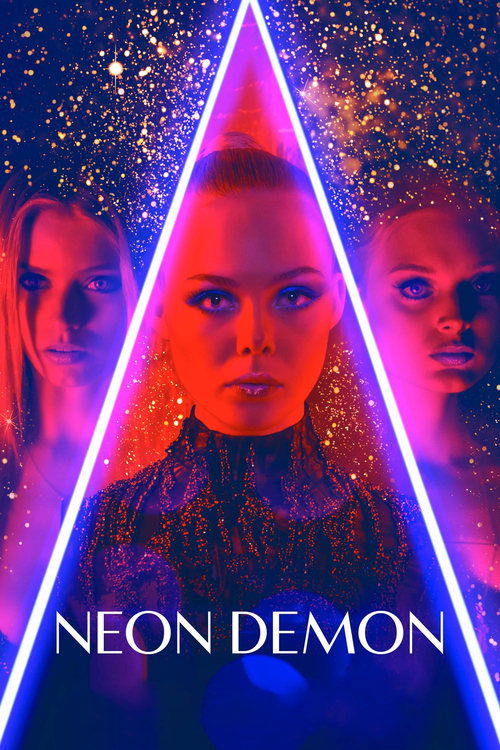
The Neon Demon (2016)
Directed by Nicolas Winding Refn
No — The Neon Demon is not woke, scoring 19 out of 100 on our wokeness meter.
Nicolas Winding Refn's The Neon Demon arrives in Los Angeles with a sixteen-year-old model named Jesse and a thesis about beauty, which it pursues with the patience of a perfume advertisement and the manners of a slaughterhouse.
Consciousness Markers
The all-female horror premise and critique of the beauty industry touch on feminist concerns, but the film's exploitative male gaze and monstrous female characters undercut a clear feminist agenda.
The fashion industry is depicted as a cannibalistic machine that commodifies youth and beauty, but the critique remains more aesthetic and allegorical than economic.
Ruby makes same-sex advances and engages in necrophilic acts with a female corpse, but these are framed as predatory and grotesque rather than as affirming LGBTQ+ themes.
The film features a female-led ensemble, but the cast is almost entirely white and lacks deliberate inclusive representation.
The film offers thematic critique through surreal horror imagery rather than direct preaching or lecture-style messaging.
No evidence of racial consciousness or engagement with racial issues.
No evidence of climate or environmental themes.
The film centers on body image and cosmetic surgery, but it does not promote body positivity or acceptance of diverse bodies.
No evidence of neurodivergence themes or representation.
No evidence of revisionist history or historical reinterpretation.
Why it received this score
Nicolas Winding Refn's The Neon Demon arrives in Los Angeles with a sixteen-year-old model named Jesse and a thesis about beauty, which it pursues with the patience of a perfume advertisement and the manners of a slaughterhouse. The cast is led by women, an ensemble of models, makeup artists, and agency handlers, though the faces on screen remain almost uniformly white. Any gesture toward inclusive representation was declined at the door. The film's treatment of same-sex desire lands in stranger territory still: Ruby's advances toward Jesse and her later encounter with a corpse in the morgue are staged as predation and pathology, not affirmation, which leaves that box conspicuously unchecked.
There is a feminist argument buried in the premise, an all-female horror about the machinery that consumes young women for their youth. The camera undermines it. Refn photographs his lead the way the industry he condemns photographs her, lingering on surfaces, and the women who surround her become monsters with appetites. Gigi vomits an eyeball. Sarah eats it. The film's interest in the body is anatomical, horror of the flesh instead of acceptance of it, and its swipe at the fashion business reads as atmosphere, an allegory of appetite without an economic argument attached.
The remaining categories are quiet. Race goes unmentioned. The climate does not appear. Nobody is diagnosed. History is not revised. And for a film with this much to say about beauty, it says almost none of it out loud, preferring neon, blood, and the occasional knife. The sermon is delivered in images, which is its only real courtesy. A gorgeous, airless provocation that confuses cruelty with insight.
Analysis generated by our Consciousness Algorithm


Synopsis
When aspiring model Jesse moves to Los Angeles, her youth and vitality are devoured by a group of beauty-obsessed women who will take any means necessary to get what she has.
Questions about The Neon Demon
Is The Neon Demon woke?
No — The Neon Demon is not woke, scoring 19 out of 100 on our wokeness meter. That earns it a verdict of Ultra Based.
Does The Neon Demon have any woke elements?
1 of the 10 markers register at 30 or above, led by Feminist Agenda (35). On Feminist Agenda: The all-female horror premise and critique of the beauty industry touch on feminist concerns, but the film's exploitative male gaze and monstrous female characters undercut a clear feminist agenda.
How does The Neon Demon compare to other 2016 movies?
It ranks #80 of the 285 films from 2016 we've scored; their average is 16. The wokest is 13th (92).
How is the Woke Score calculated?
An AI-assisted process researches the film and its reception, scores it 0–100 on ten markers, then combines those into one 0–100 Woke Score. It measures a specific set of 2020s cultural themes, not film quality.