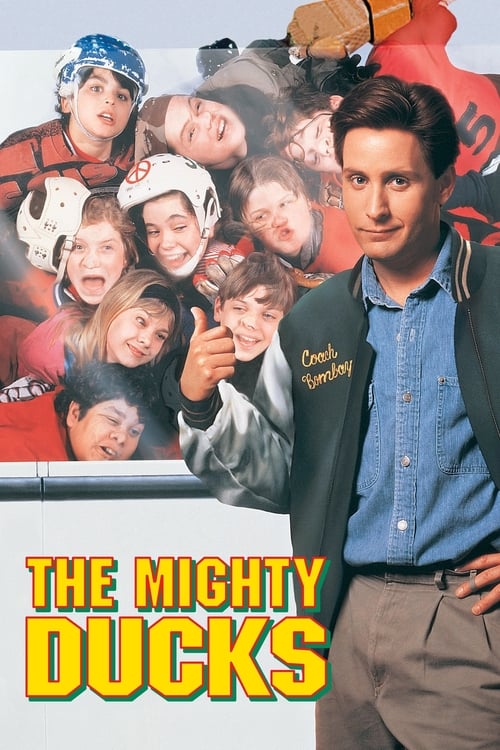
The Mighty Ducks (1992)
Directed by Stephen Herek
No — The Mighty Ducks is not woke, scoring 12 out of 100 on our wokeness meter.
The Mighty Ducks arrives from 1992 with a whistle, a hangdog Emilio Estevez, and a court-ordered community service sentence that turns a smug Minneapolis lawyer into a pee-wee hockey coach.
Consciousness Markers
The District 5 roster is notably integrated for 1992, including Black players Jesse and Terry Hall and girls Connie Moreau and Tammy Duncan, but their presence is unremarked-upon ensemble texture rather than a stated representational project.
Connie and Tammy are competent girls on a boys' team and the script briefly acknowledges their right to be there, but the arc remains squarely Gordon Bombay's redemption story.
The film delivers earnest lessons about teamwork, believing in yourself, and sportsmanship, but they arrive as standard kids'-sports uplift rather than preachy sermonizing.
Bombay refuses his boss's backroom deal to keep Adam Banks on the Hawks, choosing fair play over corporate convenience, but the film's target is one shady lawyer, not the economic order.
No LGBTQ+ characters, themes, or subtext of any kind appear in the film.
The team's racial diversity is presented without any commentary, conflict, or thematic engagement with race whatsoever.
No environmental or climate themes are present; the frozen pond is nostalgia, not ecology.
Goalie Goldberg's weight is played strictly for jokes; there is no body-positive framing.
No neurodivergent characters or themes are depicted or implied.
A wholly fictional underdog sports story with no historical revisionism.
Why it received this score
The Mighty Ducks arrives from 1992 with a whistle, a hangdog Emilio Estevez, and a court-ordered community service sentence that turns a smug Minneapolis lawyer into a pee-wee hockey coach. The District 5 roster is integrated in a way that was not common for the era. Black players Jesse and Terry Hall share the ice with girls Connie Moreau and Tammy Duncan. The film never stops to congratulate itself for this. The diversity is ensemble texture, not a stated representational project. Connie and Tammy are competent and briefly allowed to assert their right to play, but the emotional arc remains Gordon Bombay's redemption. The girls get a few good shifts. Then the camera returns to the sad lawyer.
Racial consciousness is absent. No scene asks what race means for these kids, and the script treats their presence as unremarkable. That is not a flaw in the filmmaking, but it is a low reading on the cultural meter. Climate concerns do not appear. The frozen pond is nostalgia, not ecology. LGBTQ themes are absent. Body positivity is absent as well, since goalie Goldberg's weight is played for easy laughs. Neurodivergence is not depicted. Revisionist history is not in play, because this is a wholly fictional underdog story. The one mild anti-capitalist gesture has Bombay refusing his boss's backroom deal to keep Adam Banks on the Hawks. He chooses fair play over corporate convenience. The target is a single shady lawyer, not the economic order itself.
The film's lecture energy is gentle. It delivers earnest lessons about teamwork, believing in yourself, and sportsmanship, but these arrive as standard kids' sports uplift. The tone is pep talk, not sermon. The final penalty shot is pure formula, and the formula still works. The Mighty Ducks is harmless, occasionally charming, and culturally lighter than its Disney pedigree might suggest. It registers as a faint progressive hum, mostly by accident of casting and one ethical refusal. The rest is hockey, montage, and a bus ride toward a minor-league tryout. A mild vintage, best served cold.
Analysis generated by our Consciousness Algorithm
Part of


Synopsis
After reckless young lawyer Gordon Bombay gets arrested for drunk driving, he must coach a kids hockey team for his community service. Gordon has experience on the ice, but isn't eager to return to hockey, a point hit home by his tense dealings with his own former coach, Jack Reilly. The reluctant Gordon eventually grows to appreciate his team, which includes promising young Charlie Conway, and leads them to take on Reilly's tough players.
Questions about The Mighty Ducks
Is The Mighty Ducks woke?
No — The Mighty Ducks is not woke, scoring 12 out of 100 on our wokeness meter. That earns it a verdict of Ultra Based.
Does The Mighty Ducks have any woke elements?
1 of the 10 markers register at 30 or above, led by Representation Casting (35). On Representation Casting: The District 5 roster is notably integrated for 1992, including Black players Jesse and Terry Hall and girls Connie Moreau and Tammy Duncan, but their presence is unremarked-upon ensemble texture rather than a stated representational project.
How does The Mighty Ducks compare to other 1992 movies?
It ranks #23 of the 74 films from 1992 we've scored; their average is 12. The wokest is The Crying Game (62).
How is the Woke Score calculated?
An AI-assisted process researches the film and its reception, scores it 0–100 on ten markers, then combines those into one 0–100 Woke Score. It measures a specific set of 2020s cultural themes, not film quality.