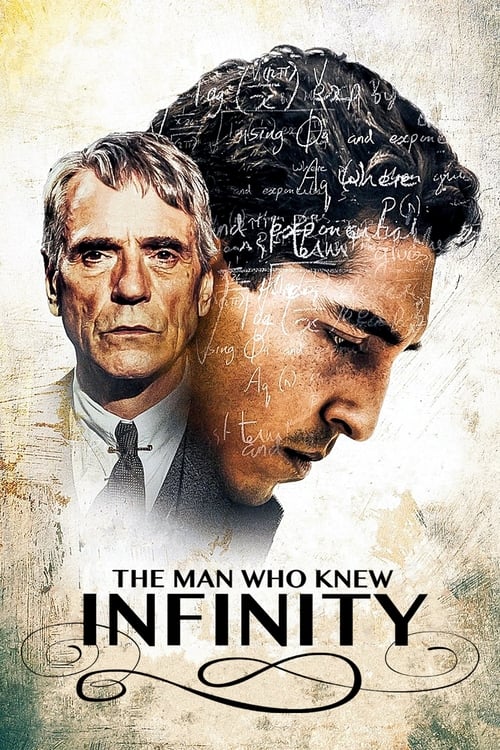
The Man Who Knew Infinity (2016)
Directed by Matt Brown
No — The Man Who Knew Infinity is not woke, scoring 19 out of 100 on our wokeness meter.
The Man Who Knew Infinity arrives as a biographical drama of the old school, adapted from Robert Kanigel's 1991 book, tracing Srinivasa Ramanujan from poverty in Madras to the cloisters of Trinity College, Cambridge, where G. H. Hardy waits with a chalkboard and a furrowed brow.
Consciousness Markers
Ramanujan faces explicit racial prejudice and discrimination at Cambridge, which is a significant plot element, though presented as historical rather than as modern social justice commentary.
The film features an Indian lead and supporting cast, but this is historically accurate for the true story of Srinivasa Ramanujan rather than a modern diversity casting choice.
The film has mild moral lessons about prejudice and perseverance but avoids preachy or lecture-like delivery.
No LGBTQ+ characters, themes, or subtext are present.
The film includes a wife character but does not advance a feminist agenda or critique patriarchal structures.
No environmental or climate change themes appear.
The film does not critique capitalism, wealth inequality, or class structures in a modern anti-capitalist sense.
No body positivity themes or diverse body representation are present.
Ramanujan's mathematical genius is not framed through a neurodivergence lens; no explicit neurodivergent identity or advocacy appears.
The film is a conventional biopic that does not reinterpret history through a modern progressive ideological lens.
Why it received this score
The Man Who Knew Infinity arrives as a biographical drama of the old school, adapted from Robert Kanigel's 1991 book, tracing Srinivasa Ramanujan from poverty in Madras to the cloisters of Trinity College, Cambridge, where G. H. Hardy waits with a chalkboard and a furrowed brow. It is a film about mathematics, tuberculosis, and the friction between an autodidact and an institution. Dev Patel plays Ramanujan, and the casting of an Indian actor in the role of an Indian man is a decision we can file under accuracy, not advocacy. The historical record did the work here, and nobody had to be congratulated for it.
The picture does engage with race, in its way. Ramanujan meets slights at Cambridge, a fellowship is denied for reasons of college politics and prejudice, and the chill of an English winter does what the plot requires. This is prejudice as period detail, part of the texture of 1914, not a lecture aimed at the audience. The film asks us to feel the injustice and then move along to the next theorem. There is a moral here about perseverance and the cost of being an outsider. It is delivered gently, almost apologetically, as though the filmmakers feared being caught making a point.
Elsewhere the film is a desert of contemporary signposting. No environmental lament, no assault on capital, no body positivity, no framing of Ramanujan's genius as neurodivergence. His wife waits in India and the film never converts her into a thesis about patriarchy. What remains is a sincere, slightly stodgy portrait of two men and a notebook. The result is respectable, conventional, and unlikely to trouble anyone's cultural priors, which may be the most radical thing a biopic can do in this decade.
Analysis generated by our Consciousness Algorithm


Synopsis
Growing up poor in Madras, India, Srinivasa Ramanujan Iyengar earns admittance to Cambridge University during WWI, where he becomes a pioneer in mathematical theories with the guidance of his professor, G.H. Hardy.
Questions about The Man Who Knew Infinity
Is The Man Who Knew Infinity woke?
No — The Man Who Knew Infinity is not woke, scoring 19 out of 100 on our wokeness meter. That earns it a verdict of Ultra Based.
Does The Man Who Knew Infinity have any woke elements?
1 of the 10 markers register at 30 or above, led by Racial Consciousness (40). On Racial Consciousness: Ramanujan faces explicit racial prejudice and discrimination at Cambridge, which is a significant plot element, though presented as historical rather than as modern social justice commentary.
How does The Man Who Knew Infinity compare to other 2016 movies?
It ranks #80 of the 285 films from 2016 we've scored; their average is 16. The wokest is 13th (92).
How is the Woke Score calculated?
An AI-assisted process researches the film and its reception, scores it 0–100 on ten markers, then combines those into one 0–100 Woke Score. It measures a specific set of 2020s cultural themes, not film quality.