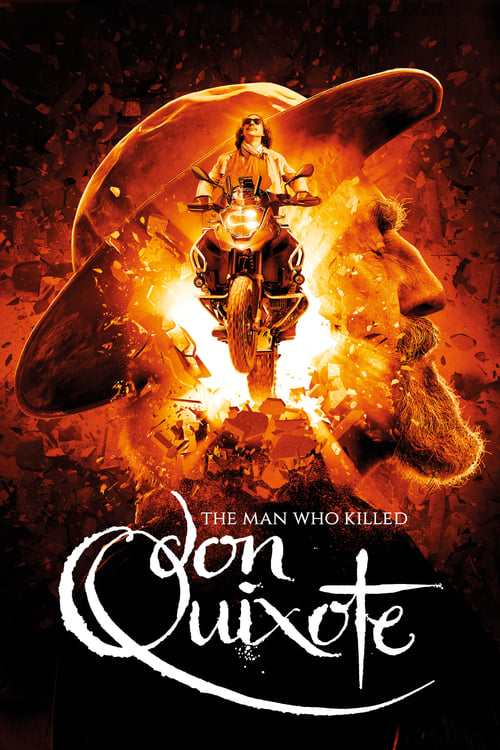
The Man Who Killed Don Quixote (2018)
Directed by Terry Gilliam
No — The Man Who Killed Don Quixote is not woke, scoring 13 out of 100 on our wokeness meter.
Twenty-nine years is a long time to chase a windmill.
Consciousness Markers
Toby's cynical commercial shoot and the cruel oligarch Miiskin skewer advertising and oligarchic wealth, echoing Gilliam's habitual individual-versus-society satire, though it is diffuse rather than a coherent economic polemic.
The cast is heavily Spanish and European, with a Romani street merchant and Morisco/immigrant characters, but these figures arise organically from Cervantes' source material rather than any modern representational mandate.
The Morisco sequence and the reveal that the 'terrorists' are fearful undocumented immigrants gesture at persecution, but the film treats this as surreal adventure texture rather than racial commentary.
The Inquisition-era Morisco vignette lightly reframes Spanish history, but it is a dreamlike interlude rather than a revisionist historical argument.
Gilliam is whimsical and chaotic rather than preachy; the film has little interest in delivering moral instruction to its audience.
Angelica is largely a damsel and escort passed between men as 'property,' and the film offers no feminist critique of this arrangement.
No LGBTQ+ characters, themes, or subtext appear anywhere in the film.
Windmills appear only as Quixote's imagined giants; there is no environmental or climate theme.
No body-positivity themes or messaging are present.
Quixote's delusion is a literary conceit of romantic madness, not a depiction or advocacy of neurodivergence.
Why it received this score
Twenty-nine years is a long time to chase a windmill. Terry Gilliam's The Man Who Killed Don Quixote arrives at last, battered by floods, lawsuits, and actors who died before they could play the part, and it wears the scars openly. Adam Driver is Toby, a commercials director who returns to the Spanish village where he once shot a student film and finds his elderly leading man, Javier, now sincerely convinced he is the knight errant. What follows is a shaggy, episodic picaresque through jousting matches, mistaken identities, and a Russian oligarch's costume party.
The film's social consciousness is present but faint, and mostly inherited from its source. The cast is Spanish and European by plain geography, with a Romani merchant and a village of undocumented immigrants who prove more frightened than dangerous. Gilliam treats their persecution as one more surreal texture in the adventure, not as an argument. Angelica, the young woman at the center of several men's appetites, is passed along like luggage, and the film never pauses to object. The sharpest edge belongs to the money satire: Toby's commercial shoot is a monument to cynicism, and Miiskin is a cartoon of oligarchic cruelty, which lands closer to personal vendetta than economic polemic.
Gilliam has never been a lecturer. His instincts run toward chaos, whimsy, and the individual flattened by institutions, and this picture would rather tumble into the next set piece than tell an audience how to feel. There is almost no instructional energy here, and no interest in contemporary grievance as such. It is messy, overlong, and occasionally sublime, which is roughly what 29 years of persistence buys. The windmills win, as they always did.
Analysis generated by our Consciousness Algorithm


Synopsis
Toby, a cynical film director finds himself trapped in the outrageous delusions of an old Spanish shoe-maker who believes himself to be Don Quixote. In the course of their comic and increasingly surreal adventures, Toby is forced to confront the tragic repercussions of a film he made in his idealistic youth.
Questions about The Man Who Killed Don Quixote
Is The Man Who Killed Don Quixote woke?
No — The Man Who Killed Don Quixote is not woke, scoring 13 out of 100 on our wokeness meter. That earns it a verdict of Ultra Based.
Does The Man Who Killed Don Quixote have any woke elements?
Very few. None of the 10 markers reaches 30, the level where a marker counts as present; the highest is Eat the Rich at 28.
How does The Man Who Killed Don Quixote compare to other 2018 movies?
It ranks #160 of the 325 films from 2018 we've scored; their average is 20. The wokest is Return (92).
How is the Woke Score calculated?
An AI-assisted process researches the film and its reception, scores it 0–100 on ten markers, then combines those into one 0–100 Woke Score. It measures a specific set of 2020s cultural themes, not film quality.