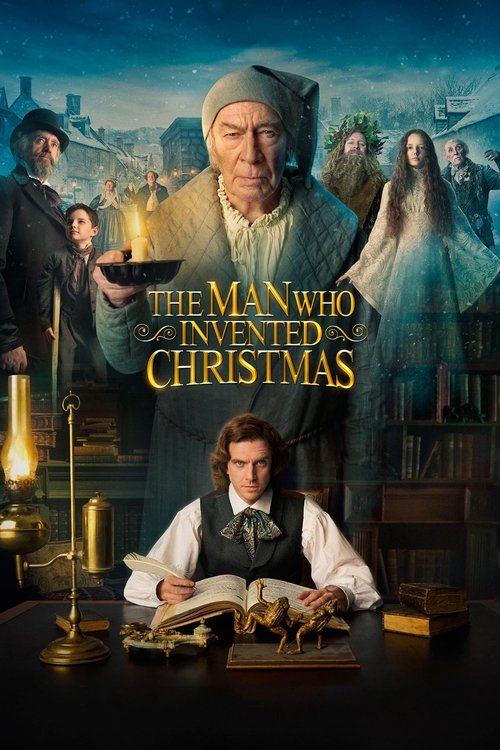
The Man Who Invented Christmas (2017)
Directed by Bharat Nalluri
No — The Man Who Invented Christmas is not woke, scoring 11 out of 100 on our wokeness meter.
Here is a period drama that conducts itself with the tidy restraint of a Victorian parlor, offering Dan Stevens as Charles Dickens wrestling with debt, publisher deadlines, and the apparition of Ebenezer Scrooge hovering about his study.
Consciousness Markers
The story touches on debt, child labor, slums, and the moral obligation of the wealthy toward the poor, echoing A Christmas Carol's social conscience, but it frames these as personal redemption rather than systemic critique.
Dickens is depicted as psychologically troubled, with his imagined characters manifesting as vivid presences and references to his depressive and manic swings, gesturing at mental-health themes without explicit neurodivergence framing.
The film delivers gentle moralizing about charity, redemption, and the true meaning of Christmas, but its sermonizing is traditional holiday sentiment rather than modern social-justice preaching.
Catherine Dickens confronts Charles about prioritizing his work over family, and the servant Tara influences the plot's moral resolution, but these are conventional domestic-drama beats rather than a feminist agenda.
The film takes acknowledged dramatic license with Dickens' life and the writing of A Christmas Carol, but its 'revisionism' is narrative invention rather than ideological reinterpretation of history.
The cast is almost entirely white British and Irish performers, with no deliberate color-conscious or diverse casting choices; the Victorian London setting is rendered in conventional period-drama fashion.
There are no LGBTQ+ characters, themes, or subtext anywhere in the film.
The film's social concern is class and poverty in Victorian England; race is entirely absent as a theme or lens.
No environmental or climate-related content of any kind.
No body-positivity themes or messaging are present.
Why it received this score
Here is a period drama that conducts itself with the tidy restraint of a Victorian parlor, offering Dan Stevens as Charles Dickens wrestling with debt, publisher deadlines, and the apparition of Ebenezer Scrooge hovering about his study. The film's social conscience is inherited wholesale from its subject: child labor in the blacking factories, debtors' prison, slum dwellers, the obligation of the comfortable toward the wretched. It frames all of this as a matter of one man's personal redemption, which is the safest possible harbor for a nineteenth-century story. The critique of capital stays safely in the past tense, where it can be admired without inconvenience.
The domestic material provides the film's mildest gestures toward contemporary sensibilities. Catherine Dickens confronts her husband about placing his work above his family, and the Irish nursemaid Tara proves instrumental in steering Scrooge toward mercy. These are sturdy domestic-drama beats, serviceable and unremarkable, the sort of thing Victorian literature has been doing since before it had a name. Dickens himself is rendered as a man of bleak depressions and manic creative surges, which gestures at mental-health themes without ever naming them outright. The cast is white, British, and Irish, and the film seems content to leave it at that.
What the film offers instead of modern sermonizing is old-fashioned sermonizing, the gentle holiday variety about charity and second chances. There is no preaching about the climate, no structural indictment of the economic order, no revisionist reading of history beyond the ordinary dramatic license of inventing scenes for a beloved author. The result is a handsomely upholstered, faintly saccharine entertainment that wants above all to be liked, and mostly succeeds. It is a Christmas film about Christmas films, which is to say it arrives bearing gifts rather than grievances.
Analysis generated by our Consciousness Algorithm


Synopsis
In 1843, despite the fact that Dickens is a successful writer, the failure of his latest book puts his career at a crossroads, until the moment when, struggling with inspiration and confronting reality with his childhood memories, a new character is born in the depths of his troubled mind; an old, lonely, embittered man, so vivid, so human, that a whole world grows around him, a story so inspiring that changed the meaning of Christmas forever.
Questions about The Man Who Invented Christmas
Is The Man Who Invented Christmas woke?
No — The Man Who Invented Christmas is not woke, scoring 11 out of 100 on our wokeness meter. That earns it a verdict of Ultra Based.
Does The Man Who Invented Christmas have any woke elements?
Very few. None of the 10 markers reaches 30, the level where a marker counts as present; the highest is Eat the Rich at 18.
How does The Man Who Invented Christmas compare to other 2017 movies?
It ranks #152 of the 309 films from 2017 we've scored; their average is 19. The wokest is I Am Not Your Negro (92).
How is the Woke Score calculated?
An AI-assisted process researches the film and its reception, scores it 0–100 on ten markers, then combines those into one 0–100 Woke Score. It measures a specific set of 2020s cultural themes, not film quality.