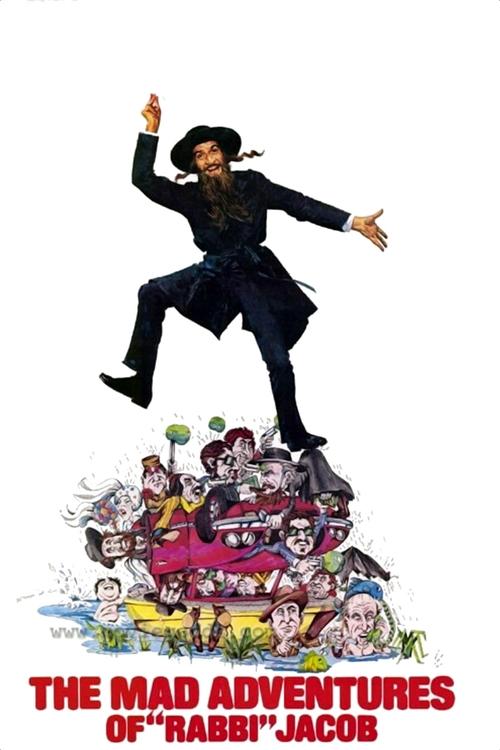
The Mad Adventures of Rabbi Jacob (1973)
Directed by Gérard Oury
No — The Mad Adventures of Rabbi Jacob is not woke, scoring 16 out of 100 on our wokeness meter.
The Mad Adventures of Rabbi Jacob, Gerard Oury's 1973 farce, stuffs a bigoted Normandy factory owner into the borrowed beard of a beloved New York rabbi and lets the confusion run downhill for ninety minutes.
Consciousness Markers
The film's central arc is a bigoted factory owner learning tolerance, and it explicitly stages Arab-Jewish reconciliation, making racial and ethnic prejudice a genuine, sustained subject rather than a passing detail.
The tolerance message is delivered through farce, mistaken identity, and physical comedy rather than sermonizing; the film shows rather than lectures, keeping didacticism low.
The film centers Arab and Jewish characters and casts several North African actors as Farès' bodyguards, but the lead Arab revolutionary is played by white French actor Claude Giraud, and the diverse cast exists naturally in the story rather than as a casting statement.
Pivert is a factory owner and a strike at his plant is mentioned as a plot complication, but the film treats this as background color rather than mounting any critique of capital.
Female characters (Germaine, Antoinette, Tzipé) exist as wives, mothers, and romantic interests; the daughter's flight from a dull fiancé is romantic wish-fulfillment, not a feminist statement.
No LGBTQ+ characters, themes, or subtext appear anywhere in the film.
No environmental themes or climate concerns appear in the film.
No body-positivity themes or messaging are present.
No neurodivergent characters or themes are depicted.
The film is a contemporary slapstick comedy with no historical revisionism or reframing of past events.
Why it received this score
The Mad Adventures of Rabbi Jacob, Gerard Oury's 1973 farce, stuffs a bigoted Normandy factory owner into the borrowed beard of a beloved New York rabbi and lets the confusion run downhill for ninety minutes. Louis de Funes sputters through the part with his customary velocity. The plot, all stolen identities, a bubble gum factory, a Hasidic dance of genuine lunatic energy, is engineered like a Swiss watch dropped down a staircase. The film wants to say something about Arabs and Jews. It says it while a car is upside down in a lake.
The central arc is a conversion narrative. Victor Pivert, a man who loathes foreigners, is dragged by circumstance into tolerance, and the picture stages Arab and Jewish reconciliation as an actual subject, sustained across the running time instead of decorating the margins. That is the film's real weight, and it arrives through slapstick. The cast is polyglot in a casual way, with North African actors filling out Colonel Fares' bodyguard detail while the revolutionary leader himself is a white Frenchman in a borrowed robe. The women are wives, mothers, and a bride who bolts from the altar. The strike at Pivert's plant is background color, nothing more.
Nothing here anticipates the vocabulary of the current decade, and the film seems untroubled by that. Its lesson lands as a pratfall, not a pamphlet, which keeps the preaching at a low simmer and the patience of the audience intact. A comedy capable of provoking an airborne hijacking on its release day, and then opening on schedule anyway, has earned a strange sort of permanence. The sommelier's note: bright, acidic, faintly sweet, with a long finish of collapsing furniture. A curiosity of its era, best served at room temperature.
Analysis generated by our Consciousness Algorithm


Synopsis
In this riot of frantic disguises and mistaken identities, Victor Pivert, a blustering, bigoted French factory owner, finds himself taken hostage by Slimane, an Arab rebel leader. The two dress up as rabbis as they try to elude not only assasins from Slimane's country, but also the police, who think Pivert is a murderer. Pivert ends up posing as Rabbi Jacob, a beloved figure who's returned to France for his first visit after 30 years in the United States. Adding to the confusion are Pivert's dentist-wife, who thinks her husband is leaving her for another woman, their daughter, who's about to get married, and a Parisian neighborhood filled with people eager to celebrate the return of Rabbi Jacob.
Questions about The Mad Adventures of Rabbi Jacob
Is The Mad Adventures of Rabbi Jacob woke?
No — The Mad Adventures of Rabbi Jacob is not woke, scoring 16 out of 100 on our wokeness meter. That earns it a verdict of Ultra Based.
Does The Mad Adventures of Rabbi Jacob have any woke elements?
1 of the 10 markers register at 30 or above, led by Racial Consciousness (45). On Racial Consciousness: The film's central arc is a bigoted factory owner learning tolerance, and it explicitly stages Arab-Jewish reconciliation, making racial and ethnic prejudice a genuine, sustained subject rather than a passing detail.
How does The Mad Adventures of Rabbi Jacob compare to other 1973 movies?
It ranks #10 of the 32 films from 1973 we've scored; their average is 11. The wokest is Soylent Green (39).
How is the Woke Score calculated?
An AI-assisted process researches the film and its reception, scores it 0–100 on ten markers, then combines those into one 0–100 Woke Score. It measures a specific set of 2020s cultural themes, not film quality.