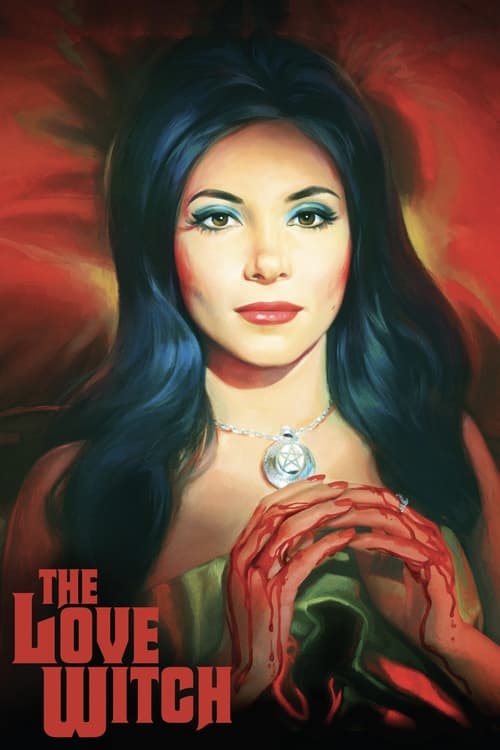
The Love Witch (2016)
Directed by Anna Biller
No — The Love Witch is not especially woke, scoring 29 out of 100 on our wokeness meter.
The Love Witch arrives in a 1966 that never existed, shot on 35 millimeter and printed from an original camera negative, with diffusion filters, rear projection, and a pentagram rug that took six months to make by hand.
Consciousness Markers
Written and directed by a self-identified feminist filmmaker, the film explicitly uses the witch as a metaphor for women and interrogates the femme fatale archetype and the battle of the sexes through feminist film theory.
The film operates as a darkly comic, visually stylized meditation rather than a preachy thesis; its feminist ideas are embedded in imagery and genre pastiche rather than delivered as direct sermonizing.
The cast is almost entirely white, with no evident effort toward diverse or inclusive casting; the film's concerns are gender rather than representation.
No LGBTQ+ characters, relationships, or themes appear in the narrative.
The film engages no racial themes or commentary; its critique is entirely gendered.
No environmental or climate themes are present.
There is no economic critique or anti-capitalist messaging in the film.
The film's stylized focus on glamour and costume is aesthetic rather than a body-positivity statement; no body-diversity themes are present.
No neurodivergence themes or characters are depicted.
The film is a stylized present-day fable, not a reworking of historical events or figures.
Why it received this score
The Love Witch arrives in a 1966 that never existed, shot on 35 millimeter and printed from an original camera negative, with diffusion filters, rear projection, and a pentagram rug that took six months to make by hand. Anna Biller wrote, directed, edited, produced, scored, and designed the thing, and the result is a comedy horror picture about a witch named Elaine who moves to Arcata, California, mixes love potions, and leaves a trail of dead men behind her. It is beautiful in a way that few contemporary films bother to be.
The feminist architecture here is deliberate and sustained. Biller is a self-described feminist filmmaker working from feminist film theory, and she uses the witch as a metaphor for women in general, both as the object of male fear and as a vessel of female intuition and power. Elaine is a study of the femme fatale, and the battle of the sexes is the film's entire subject. That subject is gendered, and only gendered. There is no racial commentary, no economic critique, no environmental concern, no body diversity agenda, no LGBTQ content, no neurodivergent character. The cast is uniformly white, and nobody involved appears to have given the matter a thought. The film's interests lie elsewhere, and they lie there completely.
What keeps the picture from becoming a lecture is its refusal to argue. The ideas live in the costumes, the color palette, and the presentational acting, not in speeches. Biller trusts the imagery to do the work, and it does. Critics have been kind, and Samantha Robinson's performance earned a place on a New Yorker list of the century's best. It is a dark, composed, brightly colored object with something unpleasant underneath. We classify it accordingly and move on.
Analysis generated by our Consciousness Algorithm


Synopsis
A modern-day witch uses spells and magic to get men to fall in love with her, with deadly consequences.
Questions about The Love Witch
Is The Love Witch woke?
No — The Love Witch is not especially woke, scoring 29 out of 100 on our wokeness meter. That earns it a verdict of Based.
Does The Love Witch have any woke elements?
1 of the 10 markers register at 30 or above, led by Feminist Agenda (78). On Feminist Agenda: Written and directed by a self-identified feminist filmmaker, the film explicitly uses the witch as a metaphor for women and interrogates the femme fatale archetype and the battle of the sexes through feminist film theory.
How does The Love Witch compare to other 2016 movies?
It ranks #41 of the 285 films from 2016 we've scored; their average is 16. The wokest is 13th (92).
How is the Woke Score calculated?
An AI-assisted process researches the film and its reception, scores it 0–100 on ten markers, then combines those into one 0–100 Woke Score. It measures a specific set of 2020s cultural themes, not film quality.