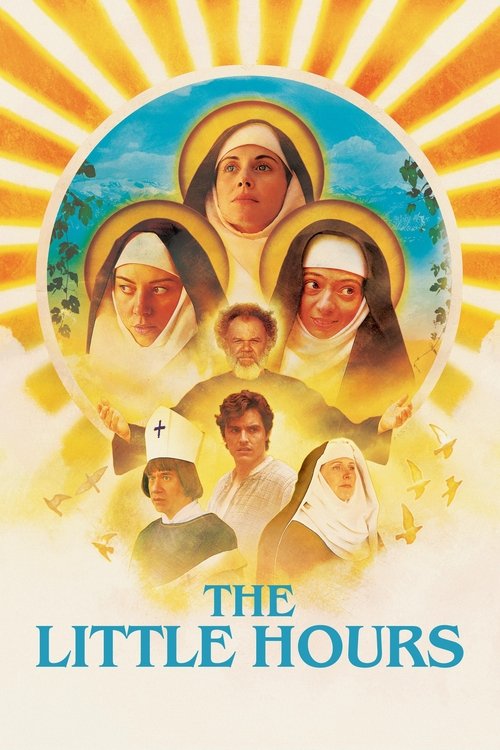
The Little Hours (2017)
Directed by Jeff Baena
No — The Little Hours is not woke, scoring 19 out of 100 on our wokeness meter.
Jeff Baena’s medieval farce, The Little Hours, arrives as a surprisingly sharp piece of cultural detritus.
Consciousness Markers
Genuine same-sex encounters occur (Fernanda and Marta, Fernanda and Ginevra), but they are staged as bawdy medieval farce rather than as a progressive statement of identity.
The film deliberately centers a cast of women pursuing their own carnal desires, and Baena consciously pivoted from his prior 'masculine energy' to foreground female characters, though without explicit feminist argument.
The ensemble is overwhelmingly white, with only local Italian extras in minor supporting roles; the film's diversity is generational rather than racial or ethnic.
The film uses anachronistic modern dialogue and behavior in a 1347 setting, but this is comedic license in the spirit of Boccaccio rather than ideological rewriting of history.
The film is a lighthearted, improvised sex comedy that makes no attempt to instruct or moralize its audience.
No engagement with race, racial identity, or racial justice whatsoever.
No environmental or climate themes present.
Dowry economics and a lord's cruelty appear as period texture, not as a critique of capitalism or class.
No body-positivity messaging; the film's sexual content is comedic rather than body-affirming advocacy.
Massetto's deaf-muteness is a deliberate deception to avoid the nuns' abuse, not a depiction of neurodivergence.
Why it received this score
Jeff Baena’s medieval farce, The Little Hours, arrives as a surprisingly sharp piece of cultural detritus. It is a film that trades deep historical immersion for a very modern sensibility. We find ourselves in 14th-century Garfagnana, Italy, a setting where the primary conflicts involve the carnal desires of three young nuns and a resourceful servant. The cast is overwhelmingly white, a demographic limitation that seems entirely secondary to the film’s comedic ambition. The narrative is less interested in the plight of the common person or the machinations of the feudal system, as in a traditional period piece. Instead, it operates through a highly stylized lens of contemporary language applied to a historical moment, a structural choice that serves the absurdity of the premise.
The film places its progressive sensibilities primarily on the level of personal freedom, rather than on any cohesive social critique. The central focus is the exploration of female impulse, a pursuit that sometimes brushes against contemporary progressive themes, even when it is presented through a bawdy, slapstick mechanism. While some character interactions touch upon queer themes, these moments are never afforded the space of an earnest ideological statement. They are instead packaged as a comedic flourish within a highly indulgent framework. The film offers no commentary on the global climate, nor does it engage with racial justice. The concerns of the characters are entirely localized to the convent walls and the immediate pursuit of pleasure.
This is a work that prioritizes comedic anarchy over ideological rigor. The anachronisms are not a subtle commentary on history, but a deliberate stylistic choice to make the period feel like a fever dream. The film makes no attempt to lecture its audience or offer any moral summation of its characters' chaotic lives. It exists purely as a vehicle for ensemble performance and sharp, improvised wit. It is a charming, if slightly indulgent, exercise in genre subversion.
Analysis generated by our Consciousness Algorithm


Synopsis
Garfagnana, Italy, 1347. The handsome servant Masseto, fleeing from his vindictive master, takes shelter in a nunnery where three young nuns, Sister Alessandra, Sister Ginevra and Sister Fernanda, try unsuccessfully to find out what their purpose in life is, a conundrum that each of them faces in different ways.
Questions about The Little Hours
Is The Little Hours woke?
No — The Little Hours is not woke, scoring 19 out of 100 on our wokeness meter. That earns it a verdict of Ultra Based.
Does The Little Hours have any woke elements?
2 of the 10 markers register at 30 or above, led by LGBTQ+ Themes (45) and Feminist Agenda (42). On LGBTQ+ Themes: Genuine same-sex encounters occur (Fernanda and Marta, Fernanda and Ginevra), but they are staged as bawdy medieval farce rather than as a progressive statement of identity.
How does The Little Hours compare to other 2017 movies?
It ranks #96 of the 309 films from 2017 we've scored; their average is 19. The wokest is I Am Not Your Negro (92).
How is the Woke Score calculated?
An AI-assisted process researches the film and its reception, scores it 0–100 on ten markers, then combines those into one 0–100 Woke Score. It measures a specific set of 2020s cultural themes, not film quality.