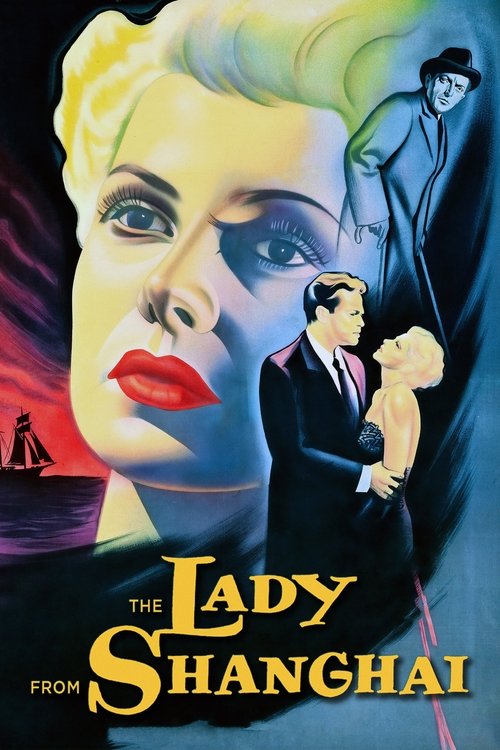
The Lady from Shanghai (1947)
Directed by Orson Welles
No — The Lady from Shanghai is not woke, scoring 0 out of 100 on our wokeness meter.
The Lady from Shanghai arrives in 1947 fully formed as a cautionary tale about studio interference, though nobody involved intended it that way.
Consciousness Markers
The cast is overwhelmingly white and the few Chinese characters function as atmospheric plot devices rather than as deliberate representation casting.
There are no LGBTQ+ themes, characters, or subtexts in the film.
Rita Hayworth's Elsa is a classic femme fatale, but the film offers no modern feminist critique or agenda.
The Chinatown setting and Chinese background characters are used for noir atmosphere and exoticism, not racial consciousness.
The film contains no environmental or climate-related themes.
Corrupt wealthy characters appear as noir archetypes, but the film does not advance an anti-capitalist or eat-the-rich message.
There is no body-positivity theme or messaging in the film.
The film does not address neurodivergence or feature neurodivergent representation.
The story is a fictional noir thriller and does not revise or reinterpret historical events.
The film is stylized and ironic rather than preachy or lecture-driven.
Why it received this score
The Lady from Shanghai arrives in 1947 fully formed as a cautionary tale about studio interference, though nobody involved intended it that way. Orson Welles owed Columbia a picture, grabbed a pulp novel he had never read, and delivered a cut that Harry Cohn found confusing and insufficiently flattering to Rita Hayworth's hair. What survives is a noir with real technical assurance and almost no thematic ambition beyond the fatalism the genre had been trading in for a decade. The Chinatown theater, the corrupt tycoon, the blonde with a plan: these are furnishings, not arguments.
The cast is white, and the Chinese figures drift through the frame as atmosphere. The film asks nothing of them and offers them nothing. Elsa Bannister is a femme fatale in the classical mold, punished by the plot in the classical manner, and no modern reading of her predicament is supplied or implied. Her husband's wealth is a source of menace, not a subject of critique. This picture is interested in greed the way it is interested in fog: as a texture. The courtroom farce, the yacht, the aquarium, all of it serves mood, and none of it serves a thesis.
The closing shootout in the hall of mirrors has since been borrowed by Bond, by Bruce Lee, by John Wick, which tells us where the film's reputation actually rests. On staging. Not on message. There is no environmental concern here, no representation agenda, no anti-capitalist sermon, no inquiry into the body or the mind. Welles aimed for irony and distance, and the result is a picture that lectures nobody about anything at all. On the classification sheet, every column sits empty. A rare and, in its own way, restful specimen: a great film with nothing to teach us.
Analysis generated by our Consciousness Algorithm


Synopsis
A romantic drifter gets caught between a corrupt tycoon and his voluptuous wife.
Questions about The Lady from Shanghai
Is The Lady from Shanghai woke?
No — The Lady from Shanghai is not woke, scoring 0 out of 100 on our wokeness meter. That earns it a verdict of Ultra Based.
Does The Lady from Shanghai have any woke elements?
No. All 10 markers score zero.
How does The Lady from Shanghai compare to other 1947 movies?
It ranks #5 of the 6 films from 1947 we've scored; their average is 3. The wokest is Black Narcissus (9).
How is the Woke Score calculated?
An AI-assisted process researches the film and its reception, scores it 0–100 on ten markers, then combines those into one 0–100 Woke Score. It measures a specific set of 2020s cultural themes, not film quality.