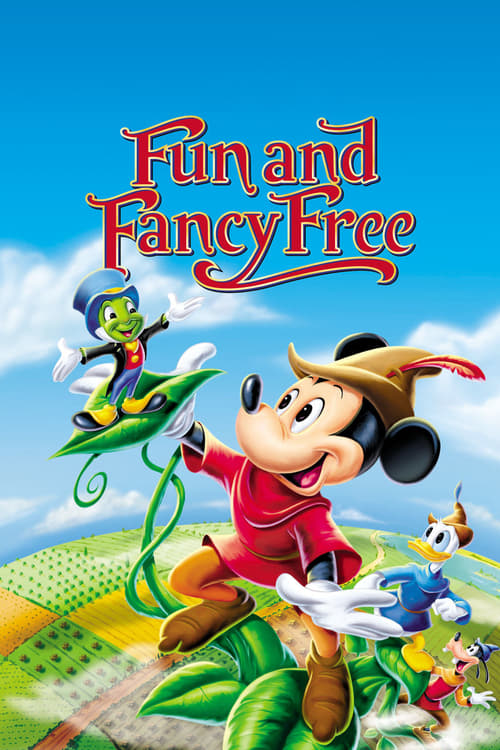
Fun and Fancy Free (1947)
Directed by Jack Kinney
No · Ultra Based
How we score movies →Consciousness Markers
Luana Patten appears in the film, and Dinah Shore provides vocals, but their roles are not feminist in nature and are incidental to the main narratives.
Jiminy Cricket provides some framing and moralizing typical of the era, but this is minimal and not ideologically charged.
All major voice actors are white. No meaningful representation of any kind.
No LGBTQ themes or characters present.
No racial consciousness or commentary. The film operates without awareness of such issues.
No climate messaging whatsoever.
No critique of capitalism or wealth. The giant's treasure is simply plot device.
No body positivity messaging. Characters are drawn in conventional mid-century Disney style.
No representation or discussion of neurodivergence.
No historical revision. Bongo and Mickey stories are not based on historical events.

Synopsis
Jiminy Cricket hosts two Disney animated shorts: Bongo about a circus bear escaping to the wild, and Mickey and the Beanstalk, a take on the famous fairy tale.
Why it received this score
Fun and Fancy Free exists in that peculiar pre-conscious era when entertainment simply entertained without the burden of social awareness. This 1947 package film, hosting two animated shorts under Jiminy Cricket's genial supervision, contains nothing that would remotely register on the scale of modern progressive sensibilities. The Bongo segment concerns itself with a circus bear's liberation into the wild, a narrative that operates entirely within the logic of animal fables, untethered from any contemporary social commentary. Mickey and the Beanstalk remains a straightforward adaptation of the fairy tale, featuring the expected castle and giant, rendered in the clean lines of mid-century Disney animation.
The cast is uniformly white and the characters exist without irony or pedagogical intent. There are no discussions of systemic inequality, no LGBTQ representation, no climate consciousness lurking in the narrative subtext, and certainly no neurodivergent characters presented as vehicles for cultural education. The film belongs to an era before such considerations colonized entertainment. Dinah Shore's presence as a vocalist adds period charm but no progressive credential whatsoever.
What we have here is cultural artifact in its purest form: entertainment from a time when entertainment had not yet been conscripted into the service of social messaging. This is not a criticism of the film itself, merely an observation that it predates the entire constellation of markers by which we now measure cultural consciousness. One watches it as one might examine a fossil, interesting precisely because it reflects an extinct worldview.
Analysis generated by our Consciousness Algorithm
Critic Reviews
“...a hit-and-miss yet mostly watchable anthology film...”
“Fun And Fancy Free is a mixed bag with more than enough interesting material to make it worth seeing, even if it falls short of Disney's shameless self-praise.”
“While the emphasis is more on the first part than on the second part of that compound, it's okay.”
“The whole picture peters out and becomes as oddly off-balance and inconsequential as its title.”