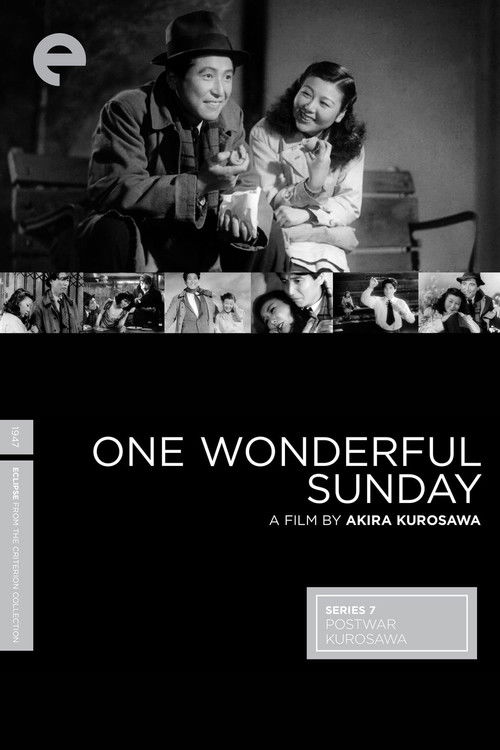
One Wonderful Sunday (1947)
Directed by Akira Kurosawa
No · Ultra Based
How we score movies →Consciousness Markers
The film depicts economic hardship and the struggle of the poor in post-war Tokyo, but frames this as romantic and humanistic rather than as systemic critique of capitalism itself.
The female lead is portrayed as an equal partner in the couple's adventure, though the film does not explicitly engage with feminist ideology or critique of gender relations.
The film features an all-Japanese cast in a Japanese setting, with no indication of deliberate inclusive casting practices or commentary on representation.
No evidence of LGBTQ+ themes, characters, or subtext in this heterosexual romance centered on a young couple.
The film contains no apparent racial consciousness or commentary, being set in post-war Japan with no racial themes.
No environmental or climate-related themes are present in this intimate character study of urban poverty.
No body positivity messaging or commentary is evident in this 1947 film.
There is no representation of or engagement with neurodivergence in this narrative.
While set in post-war Tokyo, the film does not reframe or revisit historical events with contemporary progressive reinterpretation.
The film is a gentle, observational character study that does not employ preachy or preachy tone to convey social messages.

Synopsis
Two broke sweethearts wander war-scarred Tokyo on a single Sunday, stretching 35 yen as they chase housing, small pleasures, and a little hope.
Why it received this score
One Wonderful Sunday stands as one of Akira Kurosawa's least examined works, a modest romantic drama that follows a young couple through a single Sunday in post-war Tokyo as they navigate poverty with a determination that wobbles between touching and maudlin. The film captures the material deprivation of the era without transforming that deprivation into a platform for contemporary moral instruction. It is fundamentally a humanist work, interested in the interior lives and small joys of ordinary people rather than in the systematic critique of structures or ideologies. The couple's struggles are presented as conditions of their moment, not as evidence requiring immediate ideological remediation from the audience.
What distinguishes this film from modern progressive cinema is its refusal to weaponize suffering. Poverty here is not a teaching moment. The female character participates actively in their day, but her agency emerges from the narrative itself rather than from explicit feminist positioning. Similarly, the film's implicit critique of economic hardship never graduates into anti-capitalist polemic. Kurosawa shows us the world as it is for these characters, trusts us to respond with empathy, and then moves on. There is no hectoring, no framework imposed upon the viewer, no sense that the film is trying to correct our thinking.
The modest woke score reflects the film's pre-ideological nature. It is a work of a different cultural moment, one before the constellation of progressive social consciousness markers became the lingua franca of serious cinema. By contemporary standards, it barely registers on the scale. This is not a criticism of the film, which remains quietly affecting on its own terms. It is simply a recognition that moral seriousness and contemporary cultural progressivism are not the same thing, and that a 1947 work about the poor of Tokyo need not apologize for its refusal to sound like a 2020s social justice statement.
Analysis generated by our Consciousness Algorithm