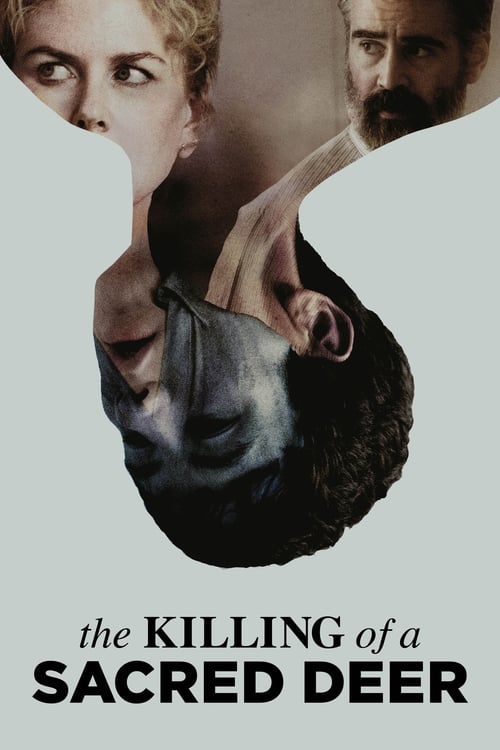
The Killing of a Sacred Deer (2017)
Directed by Yorgos Lanthimos
No — The Killing of a Sacred Deer is not woke, scoring 0 out of 100 on our wokeness meter.
Yorgos Lanthimos's The Killing of a Sacred Deer is a clinical moral fable, set in Cincinnati and drained of ordinary warmth.
Consciousness Markers
The cast is uniformly white (Farrell, Kidman, Keoghan, Cassidy, Suljic, Camp, Silverstone) with no diverse casting choices made or commented upon.
No LGBTQ+ characters, themes, or subtext appear anywhere in the film.
Anna is a passive figure who offers herself to spare her life and encourages her husband to kill a child rather than her; the film offers no feminist critique or agenda.
Race is entirely absent as a theme; the film concerns a white suburban family and a curse of retributive justice.
No environmental or climate themes whatsoever.
While the Murphys are a comfortable bourgeois household, the film is an absurdist moral fable about guilt and retribution, not a critique of wealth or capitalism.
No body-positivity themes; the film's bodily horror concerns paralysis and bleeding, not body acceptance.
No neurodivergent characters or themes are present or framed as such.
The film draws on the Greek myth of Iphigenia in Aulis but is a modern fictional fable, not a revisionist account of historical events.
Lanthimos deliberately favors aesthetic estrangement and deadpan ambiguity over moral messaging; the film pointedly refuses to lecture its audience.
Why it received this score
Yorgos Lanthimos's The Killing of a Sacred Deer is a clinical moral fable, set in Cincinnati and drained of ordinary warmth. Colin Farrell plays a cardiac surgeon with a spotless household, Nicole Kidman his wife, Barry Keoghan the fatherless teenager who arrives like a symptom. The film takes the bones of Iphigenia in Aulis and transplants them into a modern hospital corridor. The cast is uniformly white. The movie makes no effort to comment on that fact, and no effort to diversify it. This is not an oversight. It is the film's chosen register: cold, hermetic, and allergic to contemporary pieties.
The plot is a curse. A boy's father died on the surgeon's table. Now the surgeon must kill one member of his family, or all will suffer paralysis, starvation, and bleeding from the eyes. Anna offers her children as substitutes. Kim offers her life. Bob bleeds. None of this is shaped into a feminist argument, a racial reckoning, a climate parable, or an economic critique. The Murphy house is comfortable, but the target is not capital. It is guilt, fate, and the awful arithmetic of retribution. The body horror is about paralysis and blood, not acceptance. Martin's strangeness is not framed as neurodivergence. The Greek myth is scaffolding, not revisionist history.
Lanthimos refuses to lecture. The dialogue is stilted. The performances are deadpan. The score scrapes. The camera stays wide and indifferent while a family tears itself apart. This is aesthetic estrangement, not sermonizing. The film does not tell us how to behave, whom to vote for, or which consumption habits to repent. It offers a void and a rifle and a spinning circle. By the standards of modern social consciousness, the ledger is blank. The deer is killed. The lesson is withheld. The film remains a nasty, immaculate exercise in style, and it asks for nothing but our discomfort.
Analysis generated by our Consciousness Algorithm


Synopsis
Dr. Steven Murphy is a renowned cardiovascular surgeon who presides over a spotless household with his wife and two children. Lurking at the margins of his idyllic suburban existence is Martin, a fatherless teen who insinuates himself into the doctor's life in gradually unsettling ways.
Questions about The Killing of a Sacred Deer
Is The Killing of a Sacred Deer woke?
No — The Killing of a Sacred Deer is not woke, scoring 0 out of 100 on our wokeness meter. That earns it a verdict of Ultra Based.
Does The Killing of a Sacred Deer have any woke elements?
No. All 10 markers score zero.
How does The Killing of a Sacred Deer compare to other 2017 movies?
It ranks #281 of the 309 films from 2017 we've scored; their average is 19. The wokest is I Am Not Your Negro (92).
How is the Woke Score calculated?
An AI-assisted process researches the film and its reception, scores it 0–100 on ten markers, then combines those into one 0–100 Woke Score. It measures a specific set of 2020s cultural themes, not film quality.