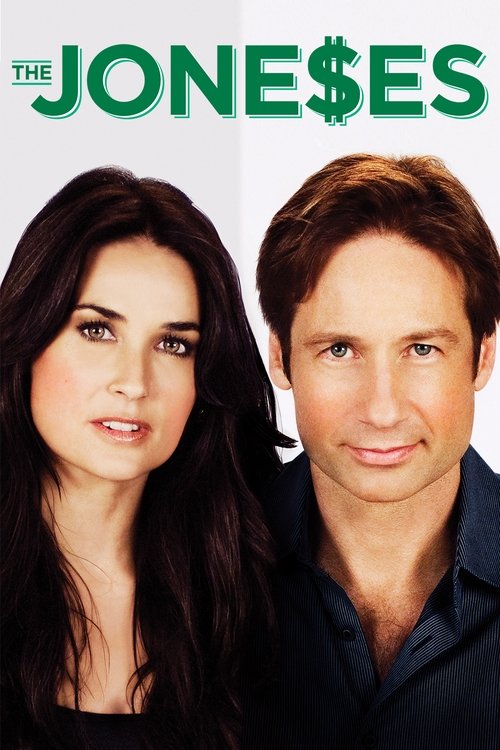
The Joneses (2010)
Directed by Derrick Borte
No — The Joneses is not especially woke, scoring 39 out of 100 on our wokeness meter.
The Joneses arrives with a premise that any marketing department would recognize as a threat: a family of stealth marketers planted in an upscale subdivision, their marriage fictional, their children rented, their kitchen stocked by vendors who expect a return.
Consciousness Markers
The entire premise is a savage satire of stealth marketing, consumerism, and manufactured desire, culminating in a neighbor's suicide over debt — a pointed indictment of the consumer economy.
The film carries an unmistakable thesis about the emptiness of consumer culture and delivers it through escalating satire, though it stays more darkly comic than preachy.
Demi Moore's Kate is a competent team leader, but the film offers no feminist critique or commentary; her authority is simply a plot function.
The cast is overwhelmingly white with no deliberate diverse casting; the ensemble is a conventional Hollywood lineup of the era.
There are no LGBTQ+ characters or themes; the subplot involving Mick's pass at Naomi's brother is played as a humiliating gag, not representation.
Race is entirely absent as a subject; the suburban milieu is uniformly white and the film never engages with it.
No environmental or climate themes appear anywhere in the film.
No body-positivity themes; the film's aesthetic is built on aspirational, conventional attractiveness.
No neurodivergent characters or themes are present.
The film is a contemporary fictional satire with no historical subject matter to revise.
Why it received this score
The Joneses arrives with a premise that any marketing department would recognize as a threat: a family of stealth marketers planted in an upscale subdivision, their marriage fictional, their children rented, their kitchen stocked by vendors who expect a return. Derrick Borte, making his debut, keeps the tone dry and the frame tidy. David Duchovny plays Steve, the newest member of the unit, a man hired to be likable and discovering he is rather good at it. Demi Moore's Kate runs the operation with a clipboard and an unreadable expression. The suburban lawns are immaculate. The product placement is the plot.
Credit where it is due. The film understands that the consumer economy runs on dissatisfaction, and it builds its escalation on that insight. Steve learns to sell boredom back to bored men. The neighbors begin restocking their lives around whatever the Joneses happen to own. When Larry, Steve's closest friend in the community, kills himself over credit card debt, the satire stops smirking and lands a punch. It is a bleak and effective beat, and it carries the film's whole argument in a single image.
The surrounding ledger, however, is close to empty. The cast is uniformly white, the women are decorative or managerial by turns, and the film has no interest in anything beyond the cul-de-sac. Kate's authority is a job description, not a statement. A gag involving Mick's pass at a male classmate earns him a black eye and the audience a shrug. There is no environment to save, no history to rewrite, no body that is not aspirational. The result is a lean, chilly satire of appetite, effective within its narrow lane and incurious about everything outside it.
Analysis generated by our Consciousness Algorithm


Synopsis
A seemingly perfect family moves into a suburban neighborhood, but when it comes to the truth as to why they're living there, they don't exactly come clean with their neighbors.
Questions about The Joneses
Is The Joneses woke?
No — The Joneses is not especially woke, scoring 39 out of 100 on our wokeness meter. That earns it a verdict of Based.
Does The Joneses have any woke elements?
2 of the 10 markers register at 30 or above, led by Eat the Rich (72) and Lecture Energy (42). On Eat the Rich: The entire premise is a savage satire of stealth marketing, consumerism, and manufactured desire, culminating in a neighbor's suicide over debt — a pointed indictment of the consumer economy.
How does The Joneses compare to other 2010 movies?
It ranks #12 of the 238 films from 2010 we've scored; their average is 11. The wokest is My Name Is Khan (84).
How is the Woke Score calculated?
An AI-assisted process researches the film and its reception, scores it 0–100 on ten markers, then combines those into one 0–100 Woke Score. It measures a specific set of 2020s cultural themes, not film quality.