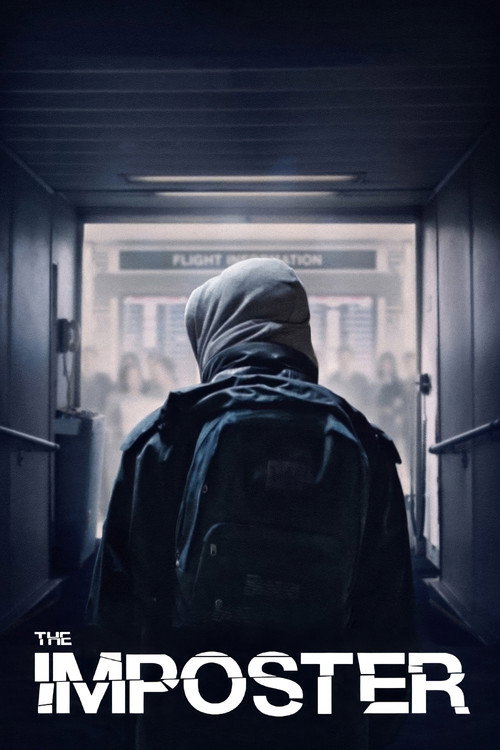
The Imposter (2012)
Directed by Bart Layton
No — The Imposter is not woke, scoring 0 out of 100 on our wokeness meter.
The Imposter arrives from 2012, a year crowded with films eager to instruct us, and it declines every invitation.
Consciousness Markers
The cast consists of the real French, American, and Spanish individuals involved in the case; there is no deliberate diverse or color-conscious casting effort.
No LGBTQ+ characters, themes, or subtext appear anywhere in the documentary.
The film is a true-crime mystery about identity fraud and does not engage with feminist themes or gender politics.
Race is not a subject of the film; the story concerns a French con man impersonating a white American boy.
No environmental or climate themes are present.
The film has no economic critique or anti-capitalist messaging.
No body positivity themes; the impostor's physical mismatch is treated as a clue, not a subject of affirmation.
Bourdin's behavior is presented as criminal deception, not framed through a neurodivergence or mental-health advocacy lens.
The film recounts a documented 1997 case without reinterpreting or revising established history for ideological purposes.
The documentary is constructed as a gripping, ambiguous thriller that withholds moral judgment rather than delivering a social lecture.
Why it received this score
The Imposter arrives from 2012, a year crowded with films eager to instruct us, and it declines every invitation. Bart Layton's documentary concerns Frédéric Bourdin, a Frenchman in his twenties who convinced authorities and a grieving Texas family that he was Nicholas Barclay, a boy missing since 1994. The evidence against the claim was abundant. Bourdin was seven years too old, spoke with a French accent, and had brown eyes where the real boy had blue. He was believed anyway. Layton assembles interviews, archive news footage, and reenactments, and the result is a mystery that tightens instead of loosening.
No social instruction is offered here. The interviewees are the actual people involved, seated in their own chairs, recounting what they did. No casting director went hunting through a census. The story concerns a white American family and a European fraud, and race never enters the frame because the case never raised it. Nor does the film reach for gender politics, environmental alarm, or economic grievance. Bourdin's deception is treated as a crime and a puzzle, not as a case study in anything larger. The mother's willingness to accept a stranger as her son is the film's darkest thread, and Layton lets it hang there without telling us how to feel. That restraint is the whole achievement.
Bourdin himself is charming and repellent in alternating measures, and the film refuses to resolve him into a lesson. A private investigator and an FBI agent do the resolving, professionally and without sermon. It would have been easy to close on a moral about institutional failure or a family's denial. Layton closes on ambiguity instead. We are left to classify what we have seen. A gripping, morally agnostic thriller about a liar, made by people who trusted the story to speak for itself. Nothing more is offered, and nothing more is required. The cellar is empty, and the sommelier shrugs. A true story, told straight, with no message attached to it whatsoever. This is a documentary that respects its audience enough to leave them unsettled and unpersuaded of anything except the facts of a very strange case. We file it accordingly and reach for the next bottle.
Thematic tags: true_story.
{"thematic_tags": ["true_story"]}
Analysis generated by our Consciousness Algorithm


Synopsis
In 1994, a 13-year-old boy disappeared without a trace from his home in San Antonio, Texas. Three-and-a-half years later, he is found alive in a village in southern Spain with a horrifying story of kidnap and torture. His family is overjoyed to bring him home. But all is not quite as it seems.
Questions about The Imposter
Is The Imposter woke?
No — The Imposter is not woke, scoring 0 out of 100 on our wokeness meter. That earns it a verdict of Ultra Based.
Does The Imposter have any woke elements?
No. All 10 markers score zero.
How does The Imposter compare to other 2012 movies?
It ranks #193 of the 230 films from 2012 we've scored; their average is 12. The wokest is Killing Them Softly (92).
How is the Woke Score calculated?
An AI-assisted process researches the film and its reception, scores it 0–100 on ten markers, then combines those into one 0–100 Woke Score. It measures a specific set of 2020s cultural themes, not film quality.