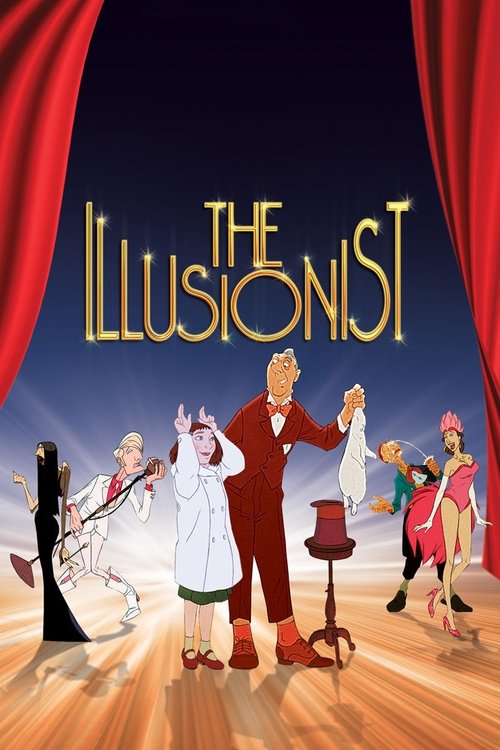
The Illusionist (2010)
Directed by Sylvain Chomet
No — The Illusionist is not woke, scoring 0 out of 100 on our wokeness meter.
The Illusionist presents itself as a tender animated period piece, but upon closer examination, it functions as a beautifully constructed cultural vacuum.
Consciousness Markers
The film's cast and characters are almost entirely white European/Scottish, with no deliberate modern representation casting.
No LGBTQ+ characters, themes, or subtext appear in the film.
Alice is portrayed in a traditional, dependent, domestic role; the film does not advance a feminist agenda.
Race and racial politics are absent from the story and its themes.
There is no environmental or climate-change message.
The film laments the decline of music-hall entertainment but offers no anti-capitalist or eat-the-rich critique.
No body-positivity themes or body-diverse messaging are present.
No neurodivergent characters or themes are depicted.
The film is a fictional period piece set in the late 1950s, not a revisionist historical narrative.
The film is a quiet, melancholic character study with no preachy or lecture-like messaging.
Why it received this score
The Illusionist presents itself as a tender animated period piece, but upon closer examination, it functions as a beautifully constructed cultural vacuum. This 2010 effort operates entirely within the confines of a mid-century European melancholy, a charming era that exists without the contemporary pressure of progressive signaling. The film’s central narrative, a quiet exploration of disillusionment and paternal regret, offers zero engagement with modern social consciousness. We find no attempts at reimagining the traditional domestic roles or injecting any element of contemporary social awareness into its setting in 1959 Scotland. The entire production is a masterclass in observational detachment from the 21st-century cultural flashpoints.
Its aesthetic achievements are undeniable, though the lack of progressive sensibilities is equally striking. The cast remains strictly monochromatic in its portrayal, providing no sense of contemporary diversity or challenging the audience with diverse representation. The plot is a wistful footnote about a performer losing his edge, a story that refuses to engage with climate anxiety, economic stratification, or gender dynamics beyond the most basic, traditional framework. It is a film concerned with the internal lives of its characters, not with the external cultural mandates we now find so pervasive in cinema.
This is a deliberate escape from the insistent demands of the current era. It is a meticulously rendered study of a fading craft. While the film succeeds as a visually rich fable, its complete lack of social commentary makes it a zero on every measurable scale of progressive cultural commentary. It is, in a way, quite refreshingly irrelevant to the current cultural climate.
Analysis generated by our Consciousness Algorithm


Synopsis
A French illusionist travels to Scotland to work. He meets a young woman in a small village. Their ensuing adventure in Edinburgh changes both their lives forever.
Questions about The Illusionist
Is The Illusionist woke?
No — The Illusionist is not woke, scoring 0 out of 100 on our wokeness meter. That earns it a verdict of Ultra Based.
Does The Illusionist have any woke elements?
No. All 10 markers score zero.
How does The Illusionist compare to other 2010 movies?
It ranks #204 of the 238 films from 2010 we've scored; their average is 11. The wokest is My Name Is Khan (84).
How is the Woke Score calculated?
An AI-assisted process researches the film and its reception, scores it 0–100 on ten markers, then combines those into one 0–100 Woke Score. It measures a specific set of 2020s cultural themes, not film quality.