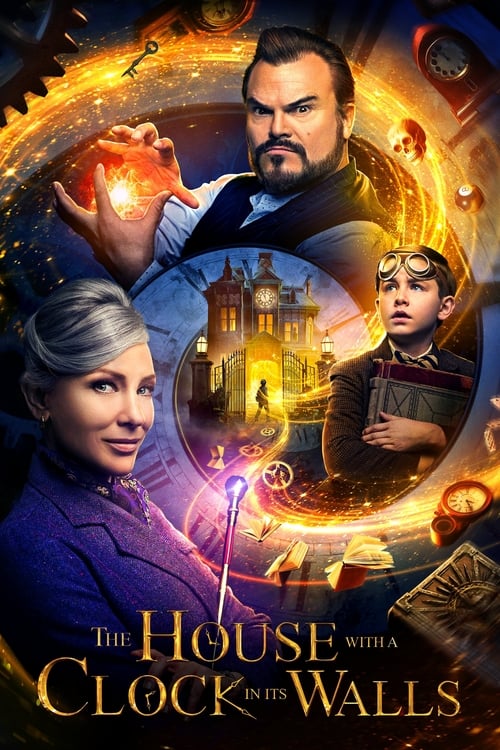
The House with a Clock in Its Walls (2018)
Directed by Eli Roth
No — The House with a Clock in Its Walls is not woke, scoring 13 out of 100 on our wokeness meter.
Eli Roth, a filmmaker whose earlier reputation rested on the enthusiastic deployment of viscera, here directs a PG-rated adaptation of John Bellairs's 1973 novel, and the result is a curious artifact: a Halloween-season Amblin pastiche about an orphaned boy, a warlock uncle, and a house that ticks.
Consciousness Markers
The cast includes Black actors in supporting roles, but the film does not foreground diversity as a theme or make casting choices a point of commentary.
Cate Blanchett's Florence is a capable witch and partner in the adventure, but the film does not advance a feminist argument or critique patriarchy.
The film is a family-friendly fantasy entertainment and does not pause to deliver social or political lessons.
There are no LGBTQ+ characters, relationships, or themes in the film.
The story is a 1950s-set fantasy adventure with no engagement with race, racism, or racial identity.
There is no environmental or climate-related theme; the villain's plot concerns reversing history, not ecological collapse.
The film has no economic critique or anti-wealth messaging.
There is no body-positive messaging or challenge to conventional beauty standards.
Lewis is portrayed as an awkward, grieving child, but the film does not frame him as neurodivergent or explore neurodiversity.
The 1950s setting and WWII backstory are used for atmosphere and villain motivation, not historical revisionism.
Why it received this score
Eli Roth, a filmmaker whose earlier reputation rested on the enthusiastic deployment of viscera, here directs a PG-rated adaptation of John Bellairs's 1973 novel, and the result is a curious artifact: a Halloween-season Amblin pastiche about an orphaned boy, a warlock uncle, and a house that ticks. The year is 1955. The setting is New Zebedee, Michigan. The stakes are the end of all human history, which the film treats with the breezy confidence of a Saturday matinee. It is competently assembled, warmly performed, and almost entirely devoid of the cultural preoccupations that define the current moment. This is not a criticism. It is a classification.
The cast places Renee Elise Goldsberry and Vanessa Anne Williams in supporting roles, and both are good, but the film makes no argument about their presence and asks the audience to make none either. Cate Blanchett's Florence is a witch of genuine competence who fights, casts, and solves problems alongside her male counterparts, though the screenplay never pauses to congratulate itself for the arrangement. Lewis grieves, flails socially, and finds his power by releasing his pain, a psychological arc the film presents as ordinary childhood difficulty and not as a clinical condition requiring a label. The villain's motivations are rooted in the horrors he witnessed during the Second World War, which supplies atmosphere and a reason for his misanthropy, not a revisionist reading of the conflict. There is no economic grievance here, no ecological anxiety, no interrogation of beauty standards, and no romantic subplot beyond a schoolyard crush.
We are left with a film about a clock, a boy, and the modest business of growing up in a creaky house. It opened at number one, charmed audiences to the tune of a B+ CinemaScore, and has since settled into the comfortable obscurity of the streaming catalog. The progressive sensibilities are faint, arriving mostly in the form of capable women and a diverse supporting cast who are simply present. The sermon is never delivered because no sermon was written. A gentle, unremarkable vintage.
Analysis generated by our Consciousness Algorithm


Synopsis
When ten-year-old Lewis is suddenly orphaned, he is sent to live with his Uncle Jonathan in a creaky (and creepy) old mansion with a mysterious ticking noise that emanates from the walls. Upon discovering that his uncle is a warlock, Lewis begins learning magic, but when he rebelliously resurrects an evil warlock he must find the secret of the house and save the world from destruction.
Questions about The House with a Clock in Its Walls
Is The House with a Clock in Its Walls woke?
No — The House with a Clock in Its Walls is not woke, scoring 13 out of 100 on our wokeness meter. That earns it a verdict of Ultra Based.
Does The House with a Clock in Its Walls have any woke elements?
Very few. None of the 10 markers reaches 30, the level where a marker counts as present; the highest is Representation Casting at 25.
How does The House with a Clock in Its Walls compare to other 2018 movies?
It ranks #160 of the 325 films from 2018 we've scored; their average is 20. The wokest is Return (92).
How is the Woke Score calculated?
An AI-assisted process researches the film and its reception, scores it 0–100 on ten markers, then combines those into one 0–100 Woke Score. It measures a specific set of 2020s cultural themes, not film quality.