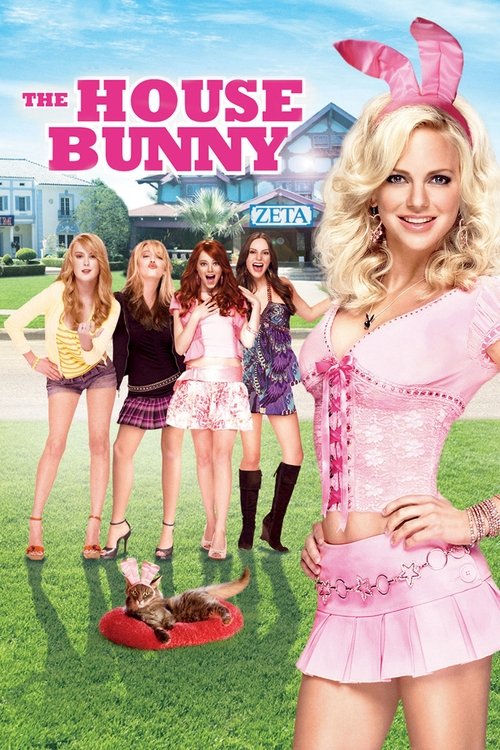
The House Bunny (2008)
Directed by Fred Wolf
No — The House Bunny is not woke, scoring 15 out of 100 on our wokeness meter.
The House Bunny arrives from 2008 with a premise that could only have been assembled in a Hollywood development meeting: a Playboy Bunny, evicted from the Mansion by a forged note, becomes house mother to seven socially hopeless sorority sisters who need thirty pledges to keep their house.
Consciousness Markers
A female-driven comedy written by two women with a 'sisterhood' and self-acceptance arc, but its engine is still teaching dowdy girls to attract men via makeovers, so the feminist content is mild and pre-2015 in flavor.
The climax hinges on a heartfelt speech about love and acceptance that saves the sorority, delivering a gentle moral, though the tone stays comedic rather than preachy.
The ensemble is a mostly white female cast, with Kiely Williams providing the lone prominent Black presence; diversity is incidental rather than a stated casting priority.
Lilly is explicitly described as having social anxiety, giving a minor, non-diagnostic nod to a neurodivergent-coded character, though it is played for comedy rather than explored.
There is a faint 'be yourself' thread and the Zetas blend their own style into their second makeovers, but the film largely reinforces conventional beauty standards rather than challenging them.
Race is never addressed or thematized; the sorority's diversity is purely cosmetic background.
No LGBTQ+ characters, relationships, or themes appear anywhere in the film.
No environmental or climate content of any kind.
The film celebrates the Playboy Mansion's luxury and consumer makeover culture rather than critiquing wealth or class.
No historical events or figures are reinterpreted; the film is a contemporary fictional comedy.
Why it received this score
The House Bunny arrives from 2008 with a premise that could only have been assembled in a Hollywood development meeting: a Playboy Bunny, evicted from the Mansion by a forged note, becomes house mother to seven socially hopeless sorority sisters who need thirty pledges to keep their house. Anna Faris plays Shelley with a guileless energy that the film mistakes for a thesis. The picture was written by two women and produced as the first female-driven comedy out of Happy Madison, which grants it a certain pedigree. The arc is sisterhood and self-acceptance. The mechanism, however, is a makeover montage in which awkward girls are taught to attract men through better hair and shorter skirts. The gender politics sit comfortably in the pre-2015 register: a female ensemble, a female lead, and a moral about being yourself that arrives after ninety minutes of instruction on how not to be.
On representation, the ensemble is largely white, with Kiely Williams supplying the only significant Black presence in a cast that treats diversity as set dressing. Race is never raised as a subject, and the film shows no interest in raising it. There are no LGBTQ characters, no relationships, no themes of any kind. The body positivity thread is thin to the point of transparency: the Zetas are permitted to blend their own style into a second round of makeovers, but the camera's standards never budge. Lilly's social anxiety is named outright, played for a laugh, and then set aside.
The closing act turns on a speech. Shelley crashes the Panhellenic Council meeting and delivers a heartfelt plea about love and acceptance, which saves the sorority and supplies the film's gentle moral. It is earnest, it is warm, and it lasts just long enough to register. Elsewhere the film has no interest in wealth, class, or the environment; the Playboy Mansion is presented as a paradise of consumption, not a target. No history is revised, no systems are indicted. A formula comedy with a soft center and a pink coat of paint, and not much else.
Analysis generated by our Consciousness Algorithm


Synopsis
Shelley is living a carefree life until a rival gets her tossed out of the Playboy Mansion. With nowhere to go, fate delivers her to the sorority girls from Zeta Alpha Zeta. Unless they can sign a new pledge class, the seven socially clueless women will lose their house to the scheming girls of Phi Iota Mu. In order to accomplish their goal, they need Shelley to teach them the ways of makeup and men; at the same time, Shelley needs some of what the Zetas have - a sense of individuality. The combination leads all the girls to learn how to stop pretending and start being themselves.
Questions about The House Bunny
Is The House Bunny woke?
No — The House Bunny is not woke, scoring 15 out of 100 on our wokeness meter. That earns it a verdict of Ultra Based.
Does The House Bunny have any woke elements?
Very few. None of the 10 markers reaches 30, the level where a marker counts as present; the highest is Feminist Agenda at 28.
How does The House Bunny compare to other 2008 movies?
It ranks #56 of the 212 films from 2008 we've scored; their average is 12. The wokest is Milk (68).
How is the Woke Score calculated?
An AI-assisted process researches the film and its reception, scores it 0–100 on ten markers, then combines those into one 0–100 Woke Score. It measures a specific set of 2020s cultural themes, not film quality.