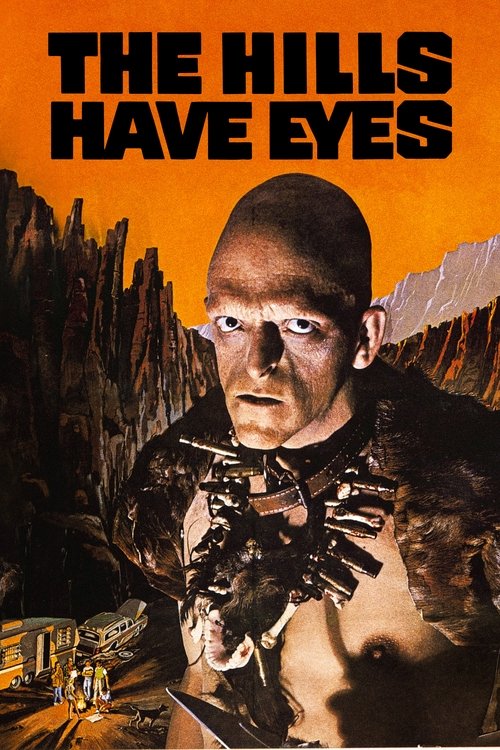
The Hills Have Eyes (1977)
Directed by Wes Craven
No — The Hills Have Eyes is not woke, scoring 3 out of 100 on our wokeness meter.
The film arrives from 1977, a lean exploitation shocker in which a suburban family towing a trailer through the Mojave is set upon by a cannibal clan living in the rocks.
Consciousness Markers
The cast is overwhelmingly white; Janus Blythe (Black) appears as Ruby, but her race is never remarked upon and the role is incidental rather than a statement of representation.
Craven's 'mirror image' families gesture at class and civilization-versus-savagery themes, but there is no explicit anti-capitalist or eat-the-rich message.
No LGBTQ+ characters, themes, or subtext of any kind.
Women are largely victims here, including a graphic rape and the abduction of an infant; the film offers no feminist critique or agency-driven framing.
The conflict is between a white suburban family and a degenerate cannibal clan; race is not a subject of the film or its commentary.
The Mojave Desert is a hostile setting, not an environmentalist statement; no climate themes are present.
Michael Berryman's genetic condition is exploited precisely as monstrous spectacle, the opposite of body positivity.
No neurodivergent themes or characters framed as such.
The film is a fictional horror story loosely inspired by the Sawney Bean legend; it makes no historical revisionist claims.
A lean 1977 exploitation shocker with no preachy messaging or moralizing monologues.
Why it received this score
The film arrives from 1977, a lean exploitation shocker in which a suburban family towing a trailer through the Mojave is set upon by a cannibal clan living in the rocks. Craven, working from the Sawney Bean legend and the recent wreckage of The Texas Chain Saw Massacre, has no interest in instructing anyone. He wants to frighten them, and he does, with tire irons, a crucified patriarch, a ransacked camper, and a baby carried off to a cave. It is a mean piece of work, and it knows it.
On the ledger of social consciousness, the account is nearly empty. The cast is white, with Janus Blythe as Ruby, a part whose significance is never spoken and never intended. The women suffer graphically, including a rape and the abduction of an infant, and no framework is offered for reading any of it as critique. Race, climate, and neurodivergence are simply not subjects here. A villain is played by a man whose genetic condition is presented as the monster itself, the precise inverse of any contemporary body-positive instinct. There is a faint class tremor in Craven's insistence that the two families mirror each other, civilization and savagery trading places across the same desert, but it never hardens into a message. The film is too busy to moralize.
The picture leaves us with craft and appetite. It is nasty, efficient, and entirely uninterested in improving its audience, which is why it endures as a cult object and why it scans, by the standards of a later era, as almost aggressively innocent of the sermon. A relic of a time when horror wanted only to hurt you. We classify it, file it, and move on.
Analysis generated by our Consciousness Algorithm

Synopsis
Taking an ill-advised detour en-route to California, the Carter family soon run into trouble when their RV breaks down in the middle of the desert. Stranded, they find themselves at the mercy of monstrous cannibals lurking in the surrounding hills.
Questions about The Hills Have Eyes
Is The Hills Have Eyes woke?
No — The Hills Have Eyes is not woke, scoring 3 out of 100 on our wokeness meter. That earns it a verdict of Ultra Based.
Does The Hills Have Eyes have any woke elements?
Very few. None of the 10 markers reaches 30, the level where a marker counts as present; the highest is Eat the Rich at 5.
How does The Hills Have Eyes compare to other 1977 movies?
It ranks #20 of the 27 films from 1977 we've scored; their average is 8. The wokest is A Special Day (60).
How is the Woke Score calculated?
An AI-assisted process researches the film and its reception, scores it 0–100 on ten markers, then combines those into one 0–100 Woke Score. It measures a specific set of 2020s cultural themes, not film quality.