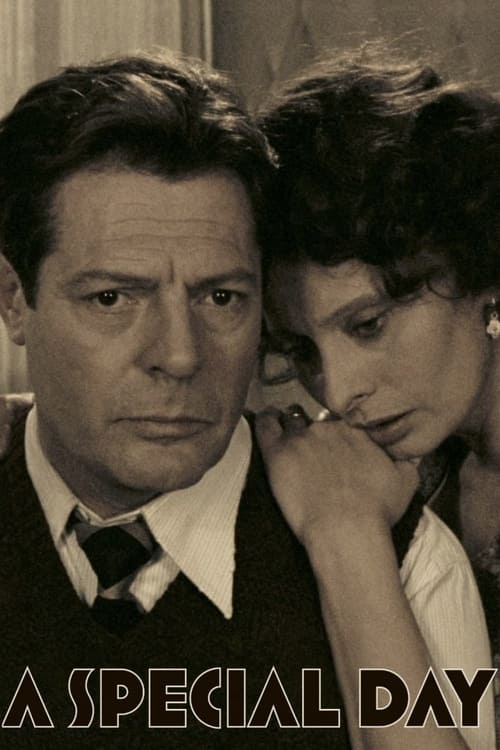
A Special Day (1977)
Directed by Ettore Scola
Yes — A Special Day is woke, scoring 60 out of 100 on our wokeness meter.
Ettore Scola's A Special Day arrives from 1977 wearing the muted sepia of a photograph left too long in a drawer, and it concerns a single afternoon in Rome when the city emptied itself to cheer Adolf Hitler down a boulevard.
Consciousness Markers
A central character is a gay man persecuted under Mussolini's regime, and his homosexuality drives the plot and themes.
The film explicitly critiques fascist gender roles, the cult of motherhood, and the patriarchal expectations placed on a housewife.
The film recovers the suppressed history of homosexual persecution under Italian fascism, though it remains a fictional character drama rather than a direct historical revision.
Themes emerge through character interaction and domestic drama rather than explicit preaching or direct address to the audience.
The cast is entirely Italian and appropriate to the period setting; no deliberate diversity casting or color-conscious choices are present.
No racial themes or racial consciousness are present in the narrative.
There is no environmental or climate-related content.
The film critiques fascism and social oppression, but not capitalism or economic class in any explicit way.
No body positivity themes or body-diverse representation are present.
No neurodivergence themes or characters are present.
Why it received this score
Ettore Scola's A Special Day arrives from 1977 wearing the muted sepia of a photograph left too long in a drawer, and it concerns a single afternoon in Rome when the city emptied itself to cheer Adolf Hitler down a boulevard. Antonietta, a housewife with six children and a seventh requested by a husband who never looks up from his newspaper, stays behind to scrub floors. Across the courtyard, Gabriele, a dismissed radio broadcaster, stays behind to die. A runaway myna bird brings them together, and the film settles into a long, patient conversation between two people the regime has no use for.
The man's homosexuality is not a garnish here. It is the mechanism of his destruction. He has been fired, taxed as a bachelor, and marked for deportation to Sardinia, because the state equates his desires with depopulation and treason. The woman's oppression runs parallel and quieter. Scola frames fascism as a machine that assigns women the role of the donna madre, prizes the seventh child with a cash bonus, and calls this love. The screenplay treats both conditions as products of the same conditioning, and lets the two characters discover it in each other without a single speech to the camera. That restraint is the film's finest quality. The politics arrive through a dance, a shared meal, and an awkward seduction, not through declarations.
Where the film reaches toward recovered history, it does so gently. The persecution of homosexuals under Mussolini is a chapter Italian cinema had largely left alone, and Scola restores it through fiction instead of documentary. The result is a modest act of memory, not a manifesto. Loren and Mastroianni were cast against their glamorous types, and the choice pays off in the closing image: a woman reading The Three Musketeers by the window while policemen lead her neighbor away. Her husband waits in the bedroom to father Adolfo. The camera does not editorialize. It watches the door close. A quiet, humane, durable piece of work, and one of the few period dramas of its era that trusts an audience to draw its own conclusions.
Analysis generated by our Consciousness Algorithm


Synopsis
Two neighbours — a persecuted journalist and a resigned housewife — forge a strong bond on the day of Adolf Hitler's historic 1938 visit to Rome.
Questions about A Special Day
Is A Special Day woke?
Yes — A Special Day is woke, scoring 60 out of 100 on our wokeness meter. That earns it a verdict of Woke.
What makes A Special Day woke?
3 of the 10 markers register at 30 or above, led by LGBTQ+ Themes (80), Feminist Agenda (65) and Revisionist History (35). On LGBTQ+ Themes: A central character is a gay man persecuted under Mussolini's regime, and his homosexuality drives the plot and themes.
How does A Special Day compare to other 1977 movies?
It is the wokest of the 27 films from 1977 we've scored; their average is 8.
How is the Woke Score calculated?
An AI-assisted process researches the film and its reception, scores it 0–100 on ten markers, then combines those into one 0–100 Woke Score. It measures a specific set of 2020s cultural themes, not film quality.