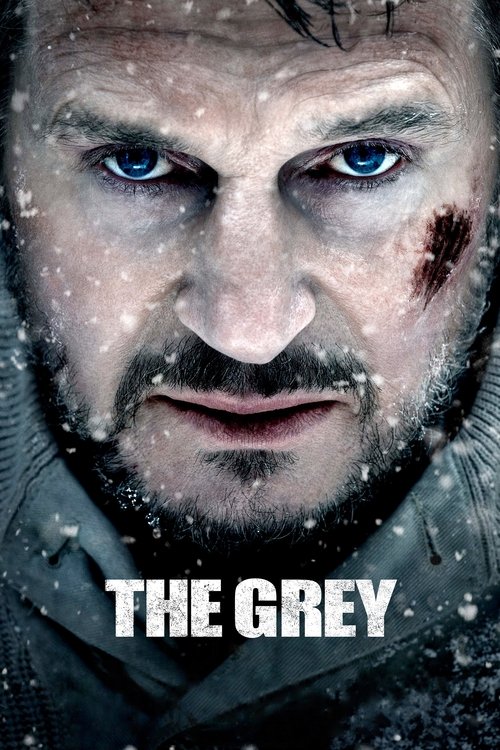
The Grey (2012)
Directed by Joe Carnahan
No — The Grey is not woke, scoring 9 out of 100 on our wokeness meter.
The Grey strands a planeload of oil men in the Alaskan wilderness and then sets wolves upon them.
Consciousness Markers
The ensemble is overwhelmingly white men, with Nonso Anozie as the lone Black survivor who exists naturally in the group without any commentary on his race. Diversity is incidental rather than a stated aim.
The campfire debates on atheism, faith, and the indifference of nature carry a philosophical agenda that some critics found preachy, but it is existential rather than a social-justice sermon.
No LGBTQ+ characters, themes, or subtext appear anywhere in the film.
The only woman of note is Ottway's dying wife in brief flashbacks, serving as a grief motif rather than any feminist statement. The film is a study in male camaraderie and survival.
Race is never addressed, examined, or thematized; the survivors are defined by their jobs and their fear, not their identities.
The oil-rig setting is pure backdrop for a survival thriller, with no environmentalist message or climate commentary attached.
The oil workers are sympathetic everymen, not targets of class critique; the film has no economic or anti-corporate agenda.
No body-positivity themes; the film is about physical attrition and death, not body acceptance.
No neurodivergent characters or themes are present.
The film is a fictional survival story with no historical subject matter to revise.
Why it received this score
The Grey strands a planeload of oil men in the Alaskan wilderness and then sets wolves upon them. It is a film about attrition, cold, and grief, and it proceeds with the patience of something that knows it has nowhere to be. The survivors are white men almost without exception, with Nonso Anozie's Jackson Burke moving among them as a fact of the cast list rather than a statement. No character remarks on it. Nobody learns anything from it. That is the entirety of the film's engagement with representation, and it suffices, because there is other business to attend to: hypothermia, drowning, and the slow arithmetic of who dies next.
The oil rig is a place of employment, not a metaphor. Nobody here delivers a speech about carbon or extraction. The facility exists so that men with jobs can board a plane, and the film never asks the setting to mean more than that. The same restraint holds elsewhere. There is no romantic subplot, no arc of self-actualization through a partner, no lecture on class or capital. These are sympathetic working men, and the film declines to convert them into a thesis. A wife appears in flashbacks as grief, not as a cause. The wolves, for their part, are wolves.
Where the film does reach for a sermon, it reaches for the oldest one available. Around campfires, the survivors argue about God, atheism, and the indifference of the natural world, and the screenplay lets those debates run long enough that some critics found the philosophizing pretentious. That is a spiritual agenda, and a bleak one, but it is not a social one. The Grey wants to know whether a man can face a universe that does not care about him. It does not want to know anything about his identity, his politics, or his carbon footprint. A lean, cold piece of work, and largely uninterested in being anything else.
Analysis generated by our Consciousness Algorithm


Synopsis
After their plane crashes in Alaska, six oil workers are led by a skilled huntsman to survival, but a pack of merciless wolves haunts their every step.
Questions about The Grey
Is The Grey woke?
No — The Grey is not woke, scoring 9 out of 100 on our wokeness meter. That earns it a verdict of Ultra Based.
Does The Grey have any woke elements?
Very few. None of the 10 markers reaches 30, the level where a marker counts as present; the highest is Representation Casting at 18.
How does The Grey compare to other 2012 movies?
It ranks #86 of the 230 films from 2012 we've scored; their average is 12. The wokest is Killing Them Softly (92).
How is the Woke Score calculated?
An AI-assisted process researches the film and its reception, scores it 0–100 on ten markers, then combines those into one 0–100 Woke Score. It measures a specific set of 2020s cultural themes, not film quality.