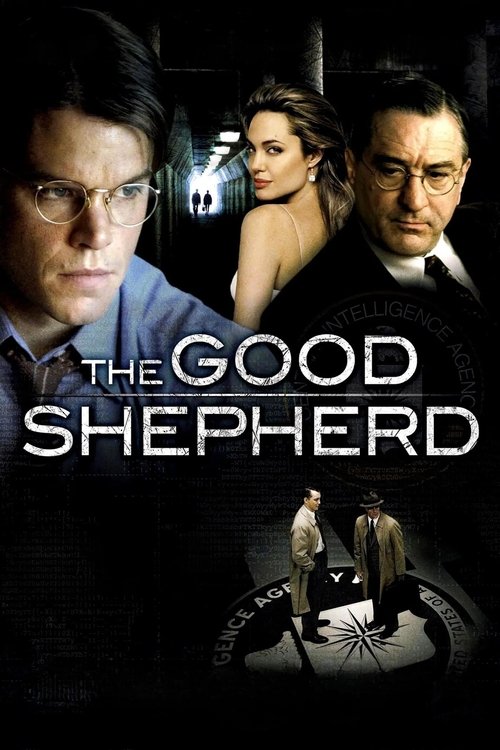
The Good Shepherd (2006)
Directed by Robert De Niro
No — The Good Shepherd is not woke, scoring 7 out of 100 on our wokeness meter.
The Good Shepherd arrives from 2006, a year when a studio could still spend ninety million dollars on a cold, gray meditation about the founding of the Central Intelligence Agency.
Consciousness Markers
The film is famously self-serious and moralizing about the corrupting nature of secret power, though its sermonizing is about institutional ethics rather than social justice.
The cast is overwhelmingly white and male, with the notable exception of Liya Kebede as a Soviet operative and a deaf supporting character; diversity is incidental rather than a stated aim.
Angelina Jolie's Clover is a frustrated, sidelined wife, but the film treats her as a casualty of her husband's career rather than advancing any feminist critique of patriarchy.
The film critiques the corruption and overreach of intelligence institutions, but its target is state power and moral compromise, not capitalism or class.
The film dramatizes real CIA history through fictionalized composites, but it is a conventional historical spy drama rather than a progressive reinterpretation of the past.
The film touches on Cuba and the Congo as Cold War theaters, but race is never a thematic concern and no racial consciousness is articulated.
No LGBTQ+ characters, themes, or subtext appear anywhere in the film's Cold War narrative.
Environmental concerns are entirely absent from this espionage drama.
No body-positive themes or messaging are present.
A deaf character appears, but deafness is not framed as neurodivergence and no neurodivergent themes are explored.
Why it received this score
The Good Shepherd arrives from 2006, a year when a studio could still spend ninety million dollars on a cold, gray meditation about the founding of the Central Intelligence Agency. Robert De Niro directs with the patience of a man who has read all the books and intends to prove it. Matt Damon plays Edward Wilson, a Yale poet turned counterintelligence officer who marries a woman he does not love and then spends three decades not speaking to her. The film is long, hushed, and committed to the proposition that secrecy corrodes the soul. That proposition is old. It is also not a social justice argument, which leaves the picture standing quietly in the corner at the modern cultural gathering.
On the matter of representation, the cast is a wall of white men in gray suits, relieved by Angelina Jolie as the neglected wife and by Liya Kebede as a Soviet operative who does not survive the third act. A deaf character, Laura, drifts through the early reels, treated with courtesy and never asked to carry a theme. Jolie's Clover gets one good scene of public humiliation and otherwise exists to demonstrate what the job costs a marriage. The film is not interested in patriarchy as a system, only in one man's specific neglect. Cuba and the Congo flicker past as Cold War chess squares. Nobody on screen has a thought about race, and the film does not supply one.
The sermonizing, when it comes, concerns institutions. De Niro and screenwriter Eric Roth want us to understand that absolute power corrupts decent men, a thesis delivered with the solemnity of a church bell. There is no climate anxiety here, no body politics, no neurodivergent interiority, no whisper of queer subtext in the smoky Berlin corridors. What remains is a period piece about moral compromise, handsomely mounted and faintly exhausting. It believes in sin, not in systems of identity. In the current taxonomy, that makes it a relic: serious, well-tailored, and entirely prelapsarian. The film was made before the culture decided that a spy drama owed anyone an argument about anything beyond the human cost of secrets, and it shows in every frame that does not feature a single identity category being interrogated. It simply is what it is, and what it is happens to be a museum exhibit behind glass, admired but untouched by the questions we now insist every story answer. The shepherds here guard nothing but their own consciences, and even those are treated as a private matter, which is the most unfashionable position a film can now take. We are left to classify it accordingly, with a sigh and a clean conscience of our own.
That sigh is the whole review. The film is competent, joyless, and almost aggressively uninterested in the conversation the rest of us are having. It wants to be about betrayal. It succeeds. It does not want to be about anything else, and it is not, and in the end there is something almost admirable about a movie that refuses to pander to a single contemporary appetite. Almost. Mostly it is just long. The Good Shepherd asks its audience to sit with a man who cannot connect to anyone, and it does so for nearly three hours, with impeccable production design and no interest whatsoever in whether any of us recognize ourselves in him. It assumes we do. It assumes we are all complicit. That is its one genuine provocation, and it lands, softly, like a file folder dropped on a desk in an empty office at midnight.
I have watched it twice. I will not watch it a third time, but I respect it, the way one respects a difficult vintage that was never meant to be enjoyed. It is a monument to a kind of filmmaking that has mostly vanished, and a monument, by definition, does not care whether you visit. Classify it and move along. There is nothing here for the culture wars but a long, cold silence, and the silence, to be fair, is the point. The film is about the cost of keeping secrets, and it keeps its own.
Robert De Niro, as director, has made a film that is essentially a very expensive, very slow episode of a prestige television series that never got made. It is meticulous. It is inert. It contains a Joe Pesci performance that is worth the price of admission and a Matt Damon performance that is worth a shrug. The ensemble is deep and uniformly excellent, which is the problem: everyone is excellent in the same muted register, and after two hours the whole thing achieves a kind of handsome monotony, like watching a very expensive wallpaper dry. The film's thesis, that the men who built the intelligence apparatus traded their souls for security, is delivered without irony and without a single moment of levity to leaven it. It is earnest to the point of suffocation. It is also, I will admit, occasionally magnificent, in the way that a cathedral is magnificent: cold, vast, and built to make you feel small. When it ends, the credits roll over footage of the real agency's origins, and the audience is left with the distinct impression that they have just been lectured by a very well-read uncle at a very long Thanksgiving dinner. There is no dessert. There is only the bill, and the drive home, and the quiet sense that something was being said, and that it was probably true, and that it did not need to take this long to say it. The Good Shepherd is a film about patience. It requires a great deal of it.
Analysis generated by our Consciousness Algorithm
Part of


Synopsis
Edward Wilson, the only witness to his father's suicide and member of the Skull and Bones Society while a student at Yale, is a morally upright young man who values honor and discretion, qualities that help him to be recruited for a career in the newly founded OSS. His dedication to his work does not come without a price though, leading him to sacrifice his ideals and eventually his family.
Questions about The Good Shepherd
Is The Good Shepherd woke?
No — The Good Shepherd is not woke, scoring 7 out of 100 on our wokeness meter. That earns it a verdict of Ultra Based.
Does The Good Shepherd have any woke elements?
Very few. None of the 10 markers reaches 30, the level where a marker counts as present; the highest is Lecture Energy at 20.
How does The Good Shepherd compare to other 2006 movies?
It ranks #111 of the 211 films from 2006 we've scored; their average is 11. The wokest is An Inconvenient Truth (92).
How is the Woke Score calculated?
An AI-assisted process researches the film and its reception, scores it 0–100 on ten markers, then combines those into one 0–100 Woke Score. It measures a specific set of 2020s cultural themes, not film quality.