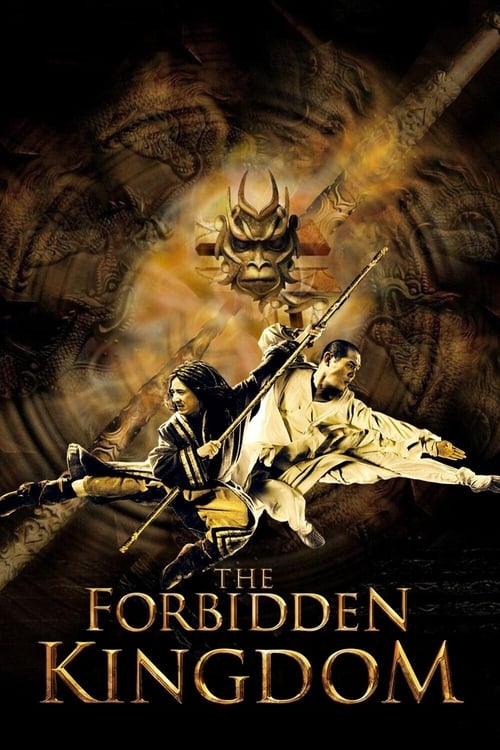
The Forbidden Kingdom (2008)
Directed by Rob Minkoff
No — The Forbidden Kingdom is not woke, scoring 8 out of 100 on our wokeness meter.
The Forbidden Kingdom arrives in 2008 as the first primarily English-language wuxia production set in ancient China and steered by an American director, a distinction it carries the way a tourist carries a souvenir.
Consciousness Markers
The cast is overwhelmingly of East Asian descent, but this is the natural, unremarkable consequence of a wuxia tale set in ancient China rather than a deliberate diversity initiative. The actual protagonist is a white American teenager, which undercuts any representation-casting reading.
Golden Sparrow and the White-Haired Witch are capable female warriors, but this is standard wuxia convention rather than a feminist statement, and the narrative remains anchored to a male hero.
The film has been noted for its American-centrism and white-savior framing, centering a Boston teenager as the prophesied 'Seeker' in a Chinese mythic world. This is the opposite of racial consciousness.
There is mild kung-fu wisdom and Buddhist-flavored aphorism, but the film is an action-adventure romp rather than a preachy message vehicle.
No LGBTQ+ characters, themes, or subtext of any kind appear in the film.
No environmental or climate themes are present.
No critique of capitalism, wealth, or class structures appears in the story.
No body-positivity themes or messaging are present.
No neurodivergence themes or characters are present.
The film is a fantasy loosely drawing on Journey to the West and Chinese myth; it makes no historical revisionist claims.
Why it received this score
The Forbidden Kingdom arrives in 2008 as the first primarily English-language wuxia production set in ancient China and steered by an American director, a distinction it carries the way a tourist carries a souvenir. The film's principal attraction is the long-promised pairing of Jackie Chan and Jet Li, and the fight choreography by Yuen Woo-ping delivers on that promise with efficiency and good humor. Everything else in the picture is furniture.
The cultural ledger is thin. The cast is almost entirely of East Asian descent, though that is the plain arithmetic of a story set in a mythic China, not the product of any deliberate design, and the narrative hands its prophecy to a South Boston teenager who wanders in from a Chinatown pawnshop. Golden Sparrow and the White-Haired Witch fight with competence and no small menace, a convention of the genre that predates this century by several decades, and the film still orbits its young male visitor. Critics at the time noted the production's open American-centrism, a useful reminder that placing a Western outsider at the center of an Eastern legend is not a gesture toward racial understanding. It is the reverse.
Other categories register nothing at all. There is no queer content, no environmental alarm, no indictment of wealth, no meditation on body image, no attention to neurodivergence, and no revisionist claim about the historical record, since the source material is a sixteenth-century novel and a great deal of pleasant nonsense. The philosophizing amounts to a few aphorisms about inner peace, tossed off between brawls and never allowed to slow the proceedings. The result is a genial, well-mannered adventure that asks nothing of its audience beyond two hours and a fondness for flying fists.
Analysis generated by our Consciousness Algorithm
Part of


Synopsis
An American teenager who is obsessed with Hong Kong cinema and kung-fu classics makes an extraordinary discovery in a Chinatown pawnshop: the legendary stick weapon of the Chinese sage and warrior, the Monkey King. With the lost relic in hand, the teenager unexpectedly finds himself travelling back to ancient China to join a crew of warriors from martial arts lore on a dangerous quest to free the imprisoned Monkey King.
Questions about The Forbidden Kingdom
Is The Forbidden Kingdom woke?
No — The Forbidden Kingdom is not woke, scoring 8 out of 100 on our wokeness meter. That earns it a verdict of Ultra Based.
Does The Forbidden Kingdom have any woke elements?
1 of the 10 markers register at 30 or above, led by Representation Casting (30). On Representation Casting: The cast is overwhelmingly of East Asian descent, but this is the natural, unremarkable consequence of a wuxia tale set in ancient China rather than a deliberate diversity initiative.
How does The Forbidden Kingdom compare to other 2008 movies?
It ranks #110 of the 212 films from 2008 we've scored; their average is 12. The wokest is Milk (68).
How is the Woke Score calculated?
An AI-assisted process researches the film and its reception, scores it 0–100 on ten markers, then combines those into one 0–100 Woke Score. It measures a specific set of 2020s cultural themes, not film quality.