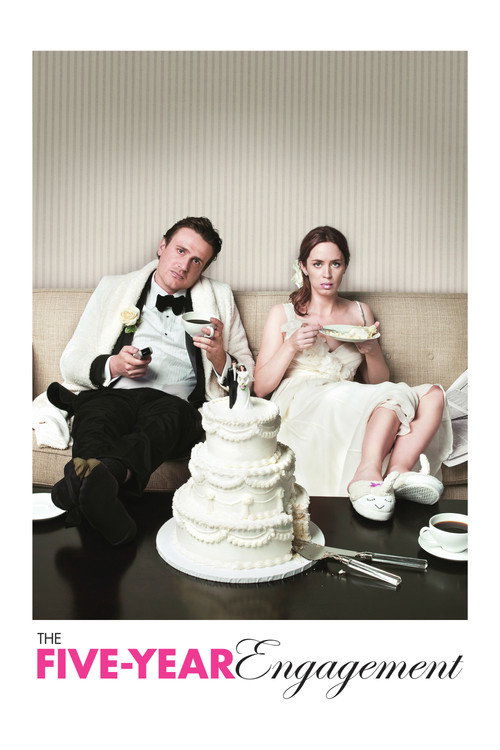
The Five-Year Engagement (2012)
Directed by Nicholas Stoller
No — The Five-Year Engagement is not woke, scoring 18 out of 100 on our wokeness meter.
The Five-Year Engagement arrives from 2012, a romantic comedy with Apatow fingerprints and a running time that tests the patience of even the most devoted sommelier of relationship banter.
Consciousness Markers
Violet is a driven academic whose career dictates the couple's relocation, inverting the traditional trailing-spouse dynamic, but the film treats this as relationship comedy rather than a feminist thesis.
The supporting cast includes Mindy Kaling, Randall Park, and Dakota Johnson, giving the film a modestly diverse ensemble, though the leads and emotional core remain squarely white.
The stale-donut experiment functions as a light running metaphor for the relationship, but the film delivers its themes through comedy rather than preaching.
No LGBTQ+ characters, relationships, or themes appear anywhere in the film.
Race is never a subject of the film; minority characters exist in the story without any commentary or thematic weight.
No environmental or climate themes are present.
The film's resolution celebrates Tom's entrepreneurial taco truck, an unambiguously pro-small-business ending with no critique of wealth or capital.
No body-positivity themes or messaging appear in the film.
No neurodivergent characters or themes are present.
The film is a contemporary romantic comedy with no historical subject matter to revise.
Why it received this score
The Five-Year Engagement arrives from 2012, a romantic comedy with Apatow fingerprints and a running time that tests the patience of even the most devoted sommelier of relationship banter. Tom, a sous-chef, and Violet, a psychology postdoc, spend five years failing to marry. The film's supporting ensemble includes Mindy Kaling, Randall Park, and Dakota Johnson, which gives the proceedings a modestly diverse texture. The leads and the emotional architecture remain white, and race never becomes a subject. That is not a failing of the film. It is simply a classification detail. The minority performers exist naturally inside the story, without commentary or thematic weight. For our purposes, that registers as a faint signal, not a sustained argument.
The film's gender dynamics have a gentle modern tilt. Violet's academic career dictates the couple's move to Michigan, inverting the traditional trailing-spouse arrangement. Tom sulks, hunts, and eats a stale donut. The film treats this as relationship comedy, not as a feminist thesis. The stale donut experiment functions as a light running metaphor, but the themes arrive through jokes, not sermons. It does not reach for the cultural flashpoints of sexuality, environment, wealth, body image, neurodiversity, or historical memory. The ending celebrates Tom's taco truck, an entrepreneurial triumph that is warmly pro-small-business. Any reading of the film as an anti-capitalist tract would require a different movie entirely.
The film leaves us with a mild, period-appropriate cultural awareness. It is the sort of comedy that believes in therapy, career compromise, and the redemptive power of a well-timed apology. It does not lecture. It does not crusade. It wants to make us laugh at the long, stupid slog of intimacy, and it mostly succeeds on the easy chemistry of its leads. The social consciousness here is structural and incidental, a matter of who gets cast and which spouse gets to move for whose job. That is a low-to-moderate vintage, pleasant enough, but hardly a bottle to cellar.
Analysis generated by our Consciousness Algorithm
Part of


Synopsis
Exactly one year after Tom meets Violet, he surprises her with a wedding ring. By all accounts, Tom and Violet are destined for their happily ever after. However, this engaged couple just keep getting tripped up on the long walk down the aisle.
Questions about The Five-Year Engagement
Is The Five-Year Engagement woke?
No — The Five-Year Engagement is not woke, scoring 18 out of 100 on our wokeness meter. That earns it a verdict of Ultra Based.
Does The Five-Year Engagement have any woke elements?
1 of the 10 markers register at 30 or above, led by Feminist Agenda (30). On Feminist Agenda: Violet is a driven academic whose career dictates the couple's relocation, inverting the traditional trailing-spouse dynamic, but the film treats this as relationship comedy rather than a feminist thesis.
How does The Five-Year Engagement compare to other 2012 movies?
It ranks #46 of the 230 films from 2012 we've scored; their average is 12. The wokest is Killing Them Softly (92).
How is the Woke Score calculated?
An AI-assisted process researches the film and its reception, scores it 0–100 on ten markers, then combines those into one 0–100 Woke Score. It measures a specific set of 2020s cultural themes, not film quality.