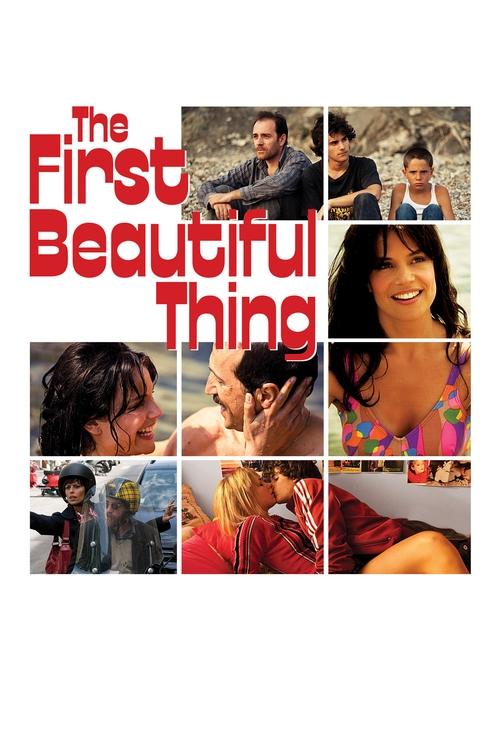
The First Beautiful Thing (2010)
Directed by Paolo Virzì
No — The First Beautiful Thing is not woke, scoring 6 out of 100 on our wokeness meter.
Paolo Virzì's 2010 family chronicle arrives with eighteen David di Donatello nominations and a shelf of Silver Ribbons, which tells us the Italian industry found it exquisite.
Consciousness Markers
The film centers on a woman's life, but frames her primarily through beauty, motherhood, and the jealousy she provokes rather than any feminist critique or agenda.
A warm, character-driven family drama that observes rather than preaches; no didactic messaging.
The cast is entirely white Italian actors; no diversity-conscious casting choices are present.
No LGBTQ+ characters or themes appear in this family drama.
No engagement with racial themes or consciousness; the story is a white Italian family narrative.
No environmental or climate themes are present.
No critique of capitalism or wealth; the film is a personal family melodrama.
The film is built around a beauty pageant and a 'stunningly beautiful' protagonist, the opposite of body-positivity messaging.
No neurodivergent characters or themes are depicted.
A fictional family story with no historical revisionism.
Why it received this score
Paolo Virzì's 2010 family chronicle arrives with eighteen David di Donatello nominations and a shelf of Silver Ribbons, which tells us the Italian industry found it exquisite. It concerns Anna, a woman of remarkable beauty, crowned Most Beautiful Mother at a Livorno bathing establishment in 1971, an honor that detonates her husband's jealousy and scatters the family across three decades. Her son Bruno, a Milanese high school teacher, returns to sit with her as she dies, and the film unfolds in flashbacks. The structure is patient and warm. The performances, particularly Micaela Ramazzotti and Stefania Sandrelli sharing the same woman at different ages, are genuinely fine.
For our purposes, the ledger is nearly blank. The cast is uniformly white and Italian, so representation concerns do not arise. No LGBTQ characters appear, no racial themes are engaged, no climate anxieties intrude, and no critique of capital disturbs the melodrama. The film is, in fact, constructed around a beauty pageant and a protagonist repeatedly described as stunning, which places it at some distance from contemporary body-acceptance messaging. Neurodivergence is absent. The history is domestic and invented, so there is nothing to revise. What remains is a modest feminist sliver: the story orbits a woman's life, yet it examines her through beauty, motherhood, and the resentment she provokes, offering observation where a thesis might have gone.
That observational habit is the film's saving grace. It watches its people instead of instructing us about them, and the sermonizing impulse never arrives. A viewer seeking moral instruction will leave empty-handed. A viewer seeking a well-made Italian drama about a difficult mother will leave satisfied. The classification, therefore, records a near-total absence of contemporary social programming, which in this instance is not a failing but simply a description.
Analysis generated by our Consciousness Algorithm
Synopsis
The film tells the story of the Michelucci family, from the nineteen-seventies to the present day: the central character is the stunningly beautiful Anna, the lively, frivolous and sometimes embarrassing mother of Bruno and Valeria. Everything begins in the Summer of 1971, at the annual Summer beauty pageant held at Livorno’s most popular bathing establishment. Anna is unexpectedly crowned “Most Beautiful Mother”, unwittingly stirring the violent jealousy of her husband. From then on, chaos strikes the family and for Anna, Bruno and his sister Valeria, it is the start of an adventure that will only end thirty years later.
Questions about The First Beautiful Thing
Is The First Beautiful Thing woke?
No — The First Beautiful Thing is not woke, scoring 6 out of 100 on our wokeness meter. That earns it a verdict of Ultra Based.
Does The First Beautiful Thing have any woke elements?
Very few. None of the 10 markers reaches 30, the level where a marker counts as present; the highest is Feminist Agenda at 10.
How does The First Beautiful Thing compare to other 2010 movies?
It ranks #138 of the 238 films from 2010 we've scored; their average is 11. The wokest is My Name Is Khan (84).
How is the Woke Score calculated?
An AI-assisted process researches the film and its reception, scores it 0–100 on ten markers, then combines those into one 0–100 Woke Score. It measures a specific set of 2020s cultural themes, not film quality.