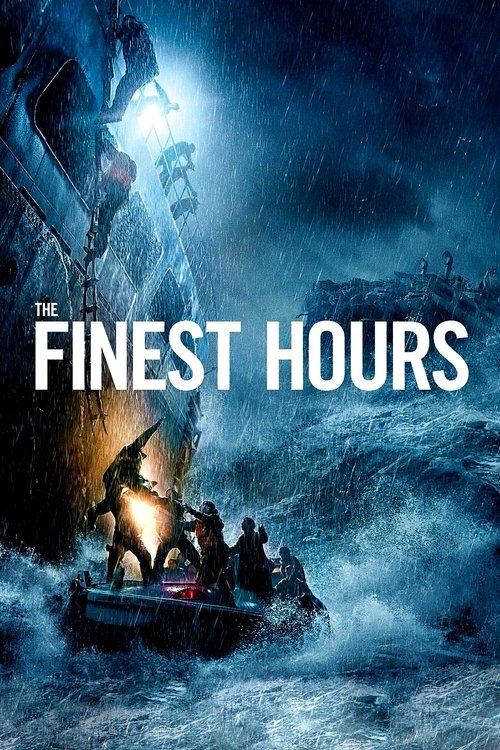
The Finest Hours (2016)
Directed by Craig Gillespie
No — The Finest Hours is not woke, scoring 8 out of 100 on our wokeness meter.
There is something almost archaeological about The Finest Hours, a Disney rescue drama so committed to the mid-century template that it could be carbon-dated to 1955.
Consciousness Markers
Miriam is given a modestly proactive role, confronting the commanding officer and rallying townspeople to guide the boat home, but the film remains a traditional male-led rescue drama.
The cast is overwhelmingly white, reflecting the 1952 New England Coast Guard setting; John Ortiz appears as a crewman but without any representational commentary.
An old-fashioned, earnest rescue drama that aims to inspire rather than preach; no overt messaging or moralizing.
No LGBTQ+ characters or themes appear anywhere in the film.
The film contains no engagement with racial themes or racial consciousness whatsoever.
The nor'easter is a plot device for the rescue, not a vehicle for climate commentary.
No critique of capitalism or class dynamics; the oil tankers are simply the setting of the disaster.
No body positivity themes present.
No neurodivergent characters or themes.
The film faithfully adapts a documented 1952 rescue without reinterpreting or revising historical events for ideological purposes.
Why it received this score
There is something almost archaeological about The Finest Hours, a Disney rescue drama so committed to the mid-century template that it could be carbon-dated to 1955. Craig Gillespie directs the 1952 Pendleton disaster with a straight back and a stiff upper lip: a nor'easter, a split tanker, a small boat with a twelve-man capacity taking on thirty-two souls. Chris Pine plays Bernie Webber with the quiet stoicism of a man who has never once considered his own interiority. The film wants nothing from us but our admiration, and it receives it, politely, like a hat passed at church.
The cultural markers here are faint and largely incidental. John Ortiz appears among the crew, a presence noted and then moved past, which is the correct behavior for a film whose setting is a 1952 New England Coast Guard station. Holliday Grainger's Miriam gets the most generous treatment, confronting the commanding officer and organizing the townspeople to aim their headlights at the harbor, a gesture that is warmly human and only lightly modern. The nor'easter is weather, not a sermon. The tankers are a workplace hazard, not a metaphor for extraction. Nobody in this film is asked to learn a lesson about themselves, which is a relief and also, commercially speaking, a catastrophe.
The result is an old-fashioned picture that inspires without instructing, a rare specimen in the current ecosystem. It is earnest, it is white, it is heterosexual, and it lost Disney roughly seventy-five million dollars. We classify it accordingly, with the mild melancholy of a sommelier presented a perfectly decent bottle of milk.
Analysis generated by our Consciousness Algorithm
Part of


Synopsis
The Coast Guard makes a daring rescue attempt off the coast of Cape Cod after a pair of oil tankers are destroyed during a blizzard in 1952.
Questions about The Finest Hours
Is The Finest Hours woke?
No — The Finest Hours is not woke, scoring 8 out of 100 on our wokeness meter. That earns it a verdict of Ultra Based.
Does The Finest Hours have any woke elements?
Very few. None of the 10 markers reaches 30, the level where a marker counts as present; the highest is Feminist Agenda at 18.
How does The Finest Hours compare to other 2016 movies?
It ranks #170 of the 285 films from 2016 we've scored; their average is 16. The wokest is 13th (92).
How is the Woke Score calculated?
An AI-assisted process researches the film and its reception, scores it 0–100 on ten markers, then combines those into one 0–100 Woke Score. It measures a specific set of 2020s cultural themes, not film quality.