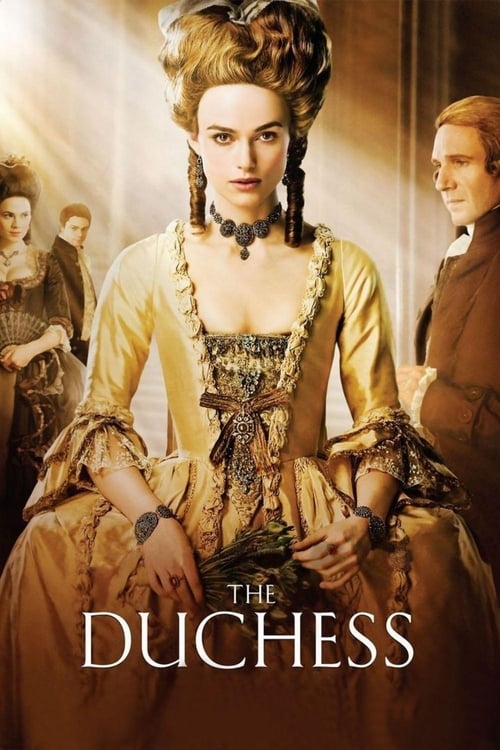
The Duchess (2008)
Directed by Saul Dibb
No — The Duchess is not woke, scoring 11 out of 100 on our wokeness meter.
The Duchess arrives dressed in the finest silk and carrying a well-worn grievance.
Consciousness Markers
The film sympathetically depicts a woman denied autonomy, subjected to marital rape, and stripped of her children by a patriarchal system, and critics explicitly labeled it a 'subtly feminist' period drama. The feminism is historical and character-driven rather than a modern agenda.
The film is a restrained costume drama that dramatizes rather than preaches; its social critique emerges through character and circumstance rather than explicit messaging.
The cast is a uniformly white British ensemble, which is historically appropriate for 18th-century English aristocracy rather than a deliberate diversity statement. No notable representation casting choices.
The film critiques aristocratic privilege and the constraints of nobility, but this is a historical portrait of the gentry, not a modern anti-capitalist or 'eat the rich' polemic.
No LGBTQ+ characters or themes appear in the narrative.
No engagement with racial themes or racial consciousness.
No environmental or climate content.
No body positivity themes in the film itself. A marketing controversy over digitally enlarging Knightley's breasts occurred off-screen and is not part of the narrative.
No neurodivergent characters or themes.
The film is a faithful adaptation of Amanda Foreman's biography of Georgiana Cavendish, presenting the historical record rather than revising it for ideological purposes.
Why it received this score
The Duchess arrives dressed in the finest silk and carrying a well-worn grievance. Saul Dibb's 2008 drama follows Georgiana Cavendish, married at seventeen to a duke who regards her as breeding stock, and it treats her long captivity with the patience of a museum curator. She is denied a son's worth, denied her friend, denied her lover, and finally denied her children. The film observes all of this without shouting. Its social criticism rises from circumstance, from the closed door and the muffled scream, from a husband who considers his obligations discharged. Critics at the time called it subtly feminist, and that adverb is doing honest work: the argument lives in the furniture, not in a speech.
On the question of casting, the ensemble is uniformly white and British, which is what an eighteenth-century aristocratic household looked like. No modern statement is being made, and none is needed. There is no queer subtext, no racial reckoning, no environmental lament, no celebration of the body, no neurodivergent character. The film is a biography of one woman and a system, adapted from Amanda Foreman's book, and it keeps its gaze there. It won an Academy Award for costume design, which is the most accurate thing about it.
The promotional apparatus around the release provides the only modern friction: executives sought to enlarge Keira Knightley's bust for the posters, and she objected, and the altered images were shelved. The film itself contains no such cynicism. It critiques aristocratic privilege as a historical fact, not as a contemporary slogan. The result is a handsome, sorrowful, faintly airless chamber piece that trusts its audience to draw the conclusion. A restrained vintage. It will not convert anyone, and it is not trying.
Analysis generated by our Consciousness Algorithm


Synopsis
A chronicle of the life of 18th century aristocrat Georgiana, Duchess of Devonshire, who was reviled for her extravagant political and personal life.
Questions about The Duchess
Is The Duchess woke?
No — The Duchess is not woke, scoring 11 out of 100 on our wokeness meter. That earns it a verdict of Ultra Based.
Does The Duchess have any woke elements?
1 of the 10 markers register at 30 or above, led by Feminist Agenda (38). On Feminist Agenda: The film sympathetically depicts a woman denied autonomy, subjected to marital rape, and stripped of her children by a patriarchal system, and critics explicitly labeled it a 'subtly feminist' period drama.
How does The Duchess compare to other 2008 movies?
It ranks #83 of the 212 films from 2008 we've scored; their average is 12. The wokest is Milk (68).
How is the Woke Score calculated?
An AI-assisted process researches the film and its reception, scores it 0–100 on ten markers, then combines those into one 0–100 Woke Score. It measures a specific set of 2020s cultural themes, not film quality.