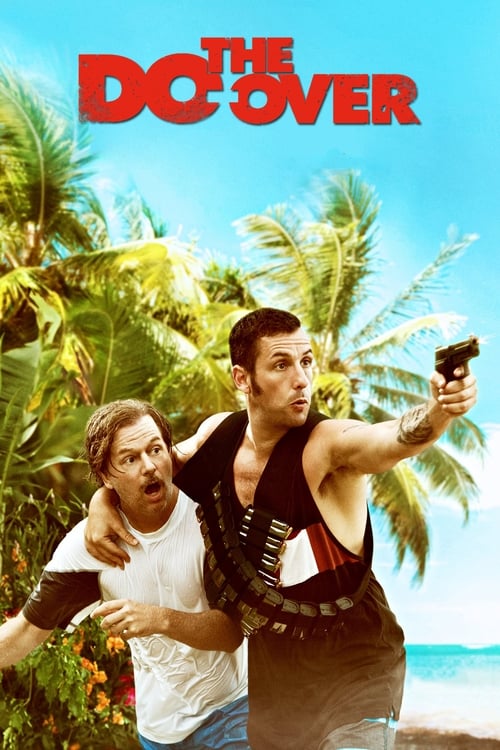
The Do-Over (2016)
Directed by Steven Brill
No — The Do-Over is not woke, scoring 14 out of 100 on our wokeness meter.
Adam Sandler and David Spade fake their own deaths and steal two cadavers' identities, which is the sort of premise that once passed for a pitch in a Hollywood conference room and now passes for a Tuesday on Netflix.
Consciousness Markers
The central conspiracy involves Trojgaard, the world's largest chemotherapy company, suppressing a cancer cure to protect profits, a clear 'evil big pharma' anti-corporate thread.
The cast includes Paula Patton, Luis Guzmán, and Kathryn Hahn in prominent roles, but they exist as standard genre archetypes (villain, biker, ex) without any commentary on their inclusion.
A late reveal establishes that the deceased Ronald and Butch had a romantic affair, but it functions purely as a plot twist rather than an exploration of LGBTQ+ themes.
The big-pharma conspiracy carries a faint moral, but the film is a lowbrow buddy comedy that never stops to preach.
The Puerto Rico setting and Latino supporting players are incidental backdrop, with no engagement of racial themes or consciousness.
Female characters are largely defined by materialism (Nikki), villainy (Heather), or as romantic/sexual conquests; no feminist framework is present.
No environmental or climate content whatsoever.
No body positivity themes; the humor frequently trades on crude physical gags instead.
No neurodivergence representation or themes.
No historical revisionism; the plot is entirely fictional.
Why it received this score
Adam Sandler and David Spade fake their own deaths and steal two cadavers' identities, which is the sort of premise that once passed for a pitch in a Hollywood conference room and now passes for a Tuesday on Netflix. Steven Brill directs with the enthusiasm of a man who has already booked the return flight. The Puerto Rico mansion, the Ferrari, the orgy with the neighbors: these are not plot points so much as expense reports. The film's cultural register is similarly casual, which is to say it mostly does not have one.
There is, buried in the third act, a genuine thread of corporate villainy. Trojgaard, the world's largest chemotherapy company, has hired assassins to steal a cancer cure and bury it, because a cure would ruin the quarterly earnings. This is the closest the film comes to a thesis, and it arrives without a lecture attached, which we can credit. Elsewhere the casting of Paula Patton, Luis Guzmán, and Kathryn Hahn supplies a pleasingly varied ensemble that the screenplay then hands nothing to do beyond villain, biker, and widow. A late revelation that the dead men were lovers is deployed as a twist, not a theme. The women are materialistic, murderous, or available, in roughly that rotation.
The result is a buddy comedy that never stops to preach and rarely stops to think. Its progressive content amounts to a pharmaceutical conspiracy and an affair revealed for shock value, both of which the film treats as scenery. We have sat through worse sermons. We have rarely sat through a sermon this indifferent to its own congregation.
Analysis generated by our Consciousness Algorithm


Synopsis
The life of a bank manager is turned upside down when a friend from his past manipulates him into faking his own death and taking off on an adventure.
Questions about The Do-Over
Is The Do-Over woke?
No — The Do-Over is not woke, scoring 14 out of 100 on our wokeness meter. That earns it a verdict of Ultra Based.
Does The Do-Over have any woke elements?
1 of the 10 markers register at 30 or above, led by Eat the Rich (42). On Eat the Rich: The central conspiracy involves Trojgaard, the world's largest chemotherapy company, suppressing a cancer cure to protect profits, a clear 'evil big pharma' anti-corporate thread.
How does The Do-Over compare to other 2016 movies?
It ranks #120 of the 285 films from 2016 we've scored; their average is 16. The wokest is 13th (92).
How is the Woke Score calculated?
An AI-assisted process researches the film and its reception, scores it 0–100 on ten markers, then combines those into one 0–100 Woke Score. It measures a specific set of 2020s cultural themes, not film quality.