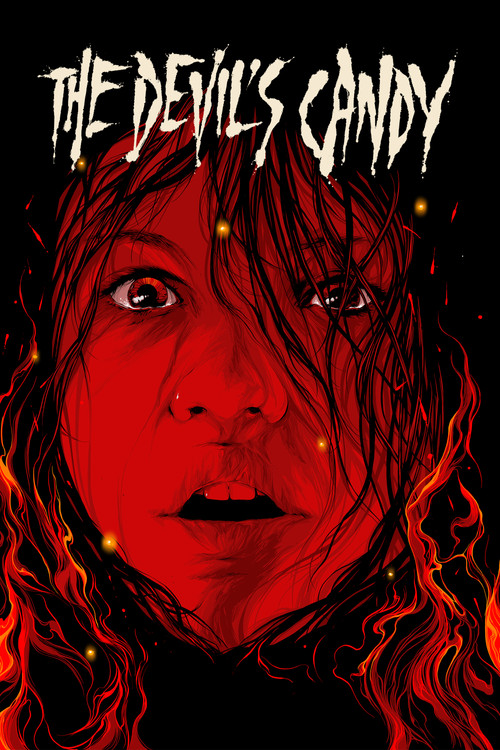
The Devil's Candy (2016)
Directed by Sean Byrne
No — The Devil's Candy is not woke, scoring 5 out of 100 on our wokeness meter.
There is a house in rural Texas, and inside it a red Flying V guitar that a young man named Ray plays at volume to drown out a voice.
Consciousness Markers
Astrid and Zooey are competent and Zooey frees herself from captivity, but the film makes no feminist argument or commentary; these are standard survival-horror beats.
The cast is almost entirely white with no deliberate diversity casting; characters exist as written for a rural Texas horror setting without comment.
The art-gallery patron subplot gestures at the commercialization of art, but it functions as plot mechanism rather than an eat-the-rich critique.
Ray is characterized via mental-hospital backstory and hearing voices, but this is deployed as demonic-possession horror trope, not neurodivergent advocacy or representation.
The film is a visceral, style-driven horror piece about heavy metal and Satan; it makes no preachy moral arguments or audience lectures.
No LGBTQ+ characters, themes, or subtext appear anywhere in the film.
Race is entirely unaddressed; the film engages no racial themes or commentary whatsoever.
No environmental or climate content is present.
No body-positivity themes or messaging appear in the film.
The film is a fictional supernatural horror with no historical subject matter to revise.
Why it received this score
There is a house in rural Texas, and inside it a red Flying V guitar that a young man named Ray plays at volume to drown out a voice. Sean Byrne's second feature concerns itself with possession, heavy metal, and the collapse of a family's fresh start. The film is loud, stylish, and committed to the visceral. It has no interest in instructing anyone about anything, which is its own kind of integrity.
Consider the ledger. The cast is white, the setting is white, and the screenplay treats this as a matter of geography, not oversight. Race never enters the frame as a subject. Neither does queerness, the environment, or the politics of the body. Astrid and Zooey are capable people who survive and escape, but the film frames their competence as survival-horror mechanics, not as argument. Ray hears voices and carries a mental hospital in his past, and the movie uses this as demonic shorthand. A gallery owner dangles patronage before Jesse, and the art market gets a brief sneer on its way to being a plot device. None of it amounts to a thesis. A viewer scanning for a message will find the screen empty of one.
Byrne wants to make a nasty, heartfelt metal record of a movie, and he does. The result is a film that respects its audience enough to skip the sermon. For those of us who maintain a careful index of contemporary moral instruction, the picture registers as an absence, a clean sheet. Nothing is taught. Something is screamed. It is a lean piece of genre craft, and it never once mistakes itself for a lecture. We log it accordingly and move to the next screening.
Analysis generated by our Consciousness Algorithm


Synopsis
A struggling painter is possessed by satanic forces after he and his young family move into their dream home in rural Texas.
Questions about The Devil's Candy
Is The Devil's Candy woke?
No — The Devil's Candy is not woke, scoring 5 out of 100 on our wokeness meter. That earns it a verdict of Ultra Based.
Does The Devil's Candy have any woke elements?
Very few. None of the 10 markers reaches 30, the level where a marker counts as present; the highest is Feminist Agenda at 12.
How does The Devil's Candy compare to other 2016 movies?
It ranks #221 of the 285 films from 2016 we've scored; their average is 16. The wokest is 13th (92).
How is the Woke Score calculated?
An AI-assisted process researches the film and its reception, scores it 0–100 on ten markers, then combines those into one 0–100 Woke Score. It measures a specific set of 2020s cultural themes, not film quality.