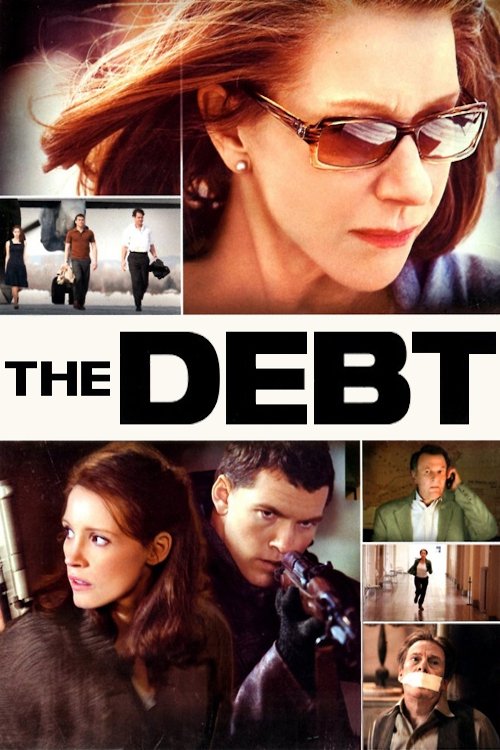
The Debt (2010)
Directed by John Madden
No — The Debt is not woke, scoring 15 out of 100 on our wokeness meter.
John Madden's The Debt arrives with the sober bearing of a film that knows it is about Important Things, and to its credit it mostly declines to announce them.
Consciousness Markers
Rachel Singer is a capable female Mossad agent and the emotional center of the narrative, and the film grants her agency and moral weight. However, this is a conventional female-lead thriller dynamic rather than an explicitly feminist thesis.
The film engages with Jewish identity, the Holocaust, and the persecution of Jews by a Nazi war criminal, giving it ethnic-historical weight. This is serious historical subject matter rather than modern racial-consciousness framing.
The cast is predominantly white and largely British/Israeli, with no notable emphasis on ethnic or racial diversity casting. The female lead is prominent, but that is a feminist consideration rather than a representation-casting one.
The film's central premise is that the heroic official account of the 1965 mission is a lie, and it interrogates the myth of Jewish passivity during the Holocaust. This is historical narrative revision of a sort, though not the modern ideological variety.
The film is chiefly a time-shifting espionage thriller and rarely pauses to lecture the audience, though the villain's Nazi ideology and the theme of confronting buried truth carry some rhetorical weight.
There are no LGBTQ+ characters or themes anywhere in the film.
There is no environmental or climate theme in the film.
No critique of capitalism, class, or wealth appears in the story.
Body image and body positivity are not addressed.
No neurodivergent characters or themes are present; the asylum setting is a plot location, not a portrait of neurodivergence.
Why it received this score
John Madden's The Debt arrives with the sober bearing of a film that knows it is about Important Things, and to its credit it mostly declines to announce them. Helen Mirren and Jessica Chastain share the role of Rachel Singer, a Mossad agent whose celebrated 1965 capture of a Nazi obstetrician named Vogel turns out to have been a fabrication. The narrative shuttles between East Berlin and a 1997 Tel Aviv book party, and it handles the mechanics of espionage with a craftsman's patience: the pelvic exam used as an ambush, the stalled extraction, the prisoner chained to a radiator. There is no environmental sermon here, no critique of capital, no inquiry into body image. The villains are Nazis. The heroes are spies. The film has other business.
Rachel is a capable woman at the center of an operation run by two men, and the film grants her guilt, desire, and moral weight without editorializing about it. This is a female-lead thriller of the old school, competent and unsentimental. The Jewish identity of the characters is central, though it is the identity of history and persecution, not the identity of a contemporary cultural argument. The casting is white and European, as the material demands, and no argument is made about it. A mental asylum appears as a plot location and not as a portrait of anyone's inner life.
Where the film earns its modest friction is in its premise. The heroic account is a lie, and everyone has retired on it. That inversion of official memory, and the way it glances at the myth of Jewish passivity, gives the thriller a conscience. But the film lectures sparingly. It prefers to let a Nazi explain Jewish weakness over a bowl of soup, and to let us draw our own uncomfortable conclusions. The result is a well-tailored, slightly overlong genre piece that flatters the audience a little and scolds it almost never.
Analysis generated by our Consciousness Algorithm


Synopsis
Rachel Singer is a former Mossad agent who tried to capture a notorious Nazi war criminal – the Surgeon of Birkenau – in a secret Israeli mission that ended with his death on the streets of East Berlin. Now, 30 years later, a man claiming to be the doctor has surfaced, and Rachel must return to Eastern Europe to uncover the truth. Overwhelmed by haunting memories of her younger self and her two fellow agents, the still-celebrated heroine must relive the trauma of those events and confront the debt she has incurred.
Questions about The Debt
Is The Debt woke?
No — The Debt is not woke, scoring 15 out of 100 on our wokeness meter. That earns it a verdict of Ultra Based.
Does The Debt have any woke elements?
1 of the 10 markers register at 30 or above, led by Feminist Agenda (30). On Feminist Agenda: Rachel Singer is a capable female Mossad agent and the emotional center of the narrative, and the film grants her agency and moral weight.
How does The Debt compare to other 2010 movies?
It ranks #53 of the 238 films from 2010 we've scored; their average is 11. The wokest is My Name Is Khan (84).
How is the Woke Score calculated?
An AI-assisted process researches the film and its reception, scores it 0–100 on ten markers, then combines those into one 0–100 Woke Score. It measures a specific set of 2020s cultural themes, not film quality.