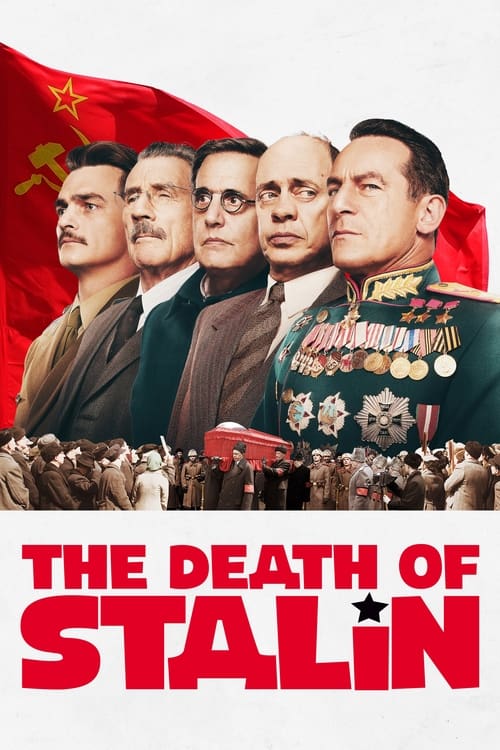
The Death of Stalin (2017)
Directed by Armando Iannucci
No — The Death of Stalin is not woke, scoring 5 out of 100 on our wokeness meter.
The Death of Stalin is a scabrous farce about men in bad suits deciding who owns the wreckage.
Consciousness Markers
The film plays fast and loose with historical record for comedic effect, but its distortions serve absurdist satire rather than a modern ideological rewriting of the past.
Iannucci's scabrous farce aims to provoke laughter and discomfort rather than deliver moral instruction; it is satire, not sermon.
Maria Yudina and Svetlana exist as figures within a male-dominated power struggle, but the film advances no feminist thesis or gendered critique.
The target is totalitarian Soviet power and bureaucratic self-preservation, not capitalism or wealth inequality; the satire is anti-authoritarian rather than eat-the-rich.
The ensemble is overwhelmingly white British and American actors playing Russian figures, with no deliberate diversity casting or commentary on representation.
No LGBTQ+ characters or themes appear; Beria's accused crimes are framed as predation, not queer identity.
The film concerns Soviet apparatchiks and contains no engagement with race or racial consciousness.
No environmental or climate themes are present in this political satire.
No body-positive themes or messaging appear.
Vasily Stalin is portrayed as an unstable alcoholic, but this is character drama rather than a neurodivergence-conscious framing.
Why it received this score
The Death of Stalin is a scabrous farce about men in bad suits deciding who owns the wreckage. Armando Iannucci keeps the camera close and the panic closer. The result is funny in the way a fire alarm is funny at three in the morning: loud, grating, and impossible to ignore. The film has no interest in modern representation rituals. Its ensemble is overwhelmingly white British and American actors playing Russian figures, a choice that reads as theatrical convention and not as commentary on who gets to occupy the screen. There is no LGBTQ thread, no racial thesis, and no body-positive or neurodivergence-conscious framing. Vasily Stalin drinks and unravels, but the film treats him as a character in a power struggle, not as a case study.
Maria Yudina and Svetlana move through a male-dominated crisis, yet the film advances no feminist argument. They are figures inside the machine, not symbols outside it. The satire's target is totalitarian power and bureaucratic self-preservation. It has little to say about capitalism or wealth inequality, and its anti-authoritarian bite should not be confused with an eat-the-rich program. The historical distortions are real. Zhukov appears where he did not, Molotov's job shifts, and the timeline bends for laughs. Those liberties serve absurdist comedy, not a modern ideological rewrite of the past.
Iannucci's method is provocation, not sermon. The film wants us to laugh and then feel the floor tilt. It does not pause to explain the correct lesson. That restraint keeps its lecture energy low and its social consciousness dated to the film's own cynical instincts. The Death of Stalin remains a cold, brilliant exercise in political horror-comedy, and its lack of contemporary progressive markers is not a failure. It is simply not that kind of film.
Analysis generated by our Consciousness Algorithm


Synopsis
When dictator Joseph Stalin dies, his parasitic cronies square off in a frantic power struggle to become the next Soviet leader. As they bumble, brawl and back-stab their way to the top, the question remains — just who is running the government?
Questions about The Death of Stalin
Is The Death of Stalin woke?
No — The Death of Stalin is not woke, scoring 5 out of 100 on our wokeness meter. That earns it a verdict of Ultra Based.
Does The Death of Stalin have any woke elements?
Very few. None of the 10 markers reaches 30, the level where a marker counts as present; the highest is Lecture Energy at 10.
How does The Death of Stalin compare to other 2017 movies?
It ranks #241 of the 309 films from 2017 we've scored; their average is 19. The wokest is I Am Not Your Negro (92).
How is the Woke Score calculated?
An AI-assisted process researches the film and its reception, scores it 0–100 on ten markers, then combines those into one 0–100 Woke Score. It measures a specific set of 2020s cultural themes, not film quality.