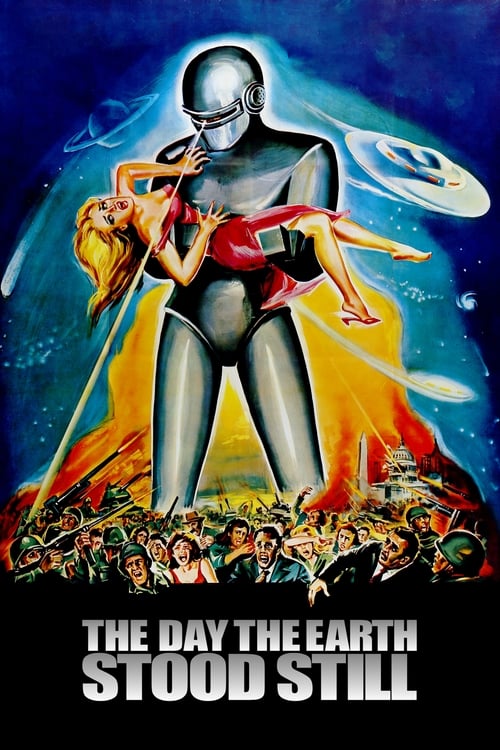
The Day the Earth Stood Still (1951)
Directed by Robert Wise
No — The Day the Earth Stood Still is not woke, scoring 0 out of 100 on our wokeness meter.
The Day the Earth Stood Still arrives from 1951 with a flying saucer on the National Mall and a warning about the nuclear age.
Consciousness Markers
Klaatu delivers an explicit ultimatum to humanity about choosing peace or obliteration, and the film is structured as a moralistic Cold War warning.
The cast is entirely white and reflects the racial casting norms of 1951 Hollywood, with no deliberate inclusive or diverse casting agenda.
There are no LGBTQ+ characters, themes, or subtext in the film.
Helen Benson is a significant female character, but the film does not advance a feminist critique or agenda.
The film does not engage with racial inequality, racial identity, or racial justice themes.
Environmental concerns or climate change are entirely absent from the story.
The film's warning is about nuclear war and human aggression, not capitalism or economic inequality.
There is no body positivity theme or challenge to conventional body standards.
Neurodivergence is not represented or discussed in the film.
The film is not a historical revisionist work; it uses a contemporary Cold War setting for allegorical science fiction.
Why it received this score
The Day the Earth Stood Still arrives from 1951 with a flying saucer on the National Mall and a warning about the nuclear age. Robert Wise directs with documentary plainness, and Bernard Herrmann supplies a score of theremins and organs that still sounds like nothing else. The film has been preserved by the Library of Congress and appears on assorted best-of lists. It has earned its standing.
Klaatu, played by Michael Rennie, walks among ordinary Americans in a borrowed suit. He visits the Lincoln Memorial and Arlington. He solves a professor's blackboard equations. The cast is white, per the casting conventions of its era, and the story makes no comment on this. Helen Benson is a widow with a son and a jealous suitor, and she is competent and central, but the film is not arguing anything about women. There is no engagement with race, no environmental anxiety, no economic critique, no interest in bodies or brains or identities. The villain is human aggression, full stop. The film's fears are atomic and geopolitical, and they are stated plainly.
Where the picture does lean forward is in its closing sermon. Klaatu gathers scientists, explains that other worlds have handed absolute power to invincible robots, and delivers a choice: peace or obliteration. The moral is announced, restated, and underlined. Variety at the time noted the moralistic wordiness. It is a lecture, delivered by a visitor with a spaceship, and it lands with the weight of a pulpit. That is the film's temperament, and it has aged better than most sermons of its decade.
Analysis generated by our Consciousness Algorithm


Synopsis
An alien and a robot land on Earth after World War II and tell mankind to be peaceful or face destruction.
Questions about The Day the Earth Stood Still
Is The Day the Earth Stood Still woke?
No — The Day the Earth Stood Still is not woke, scoring 0 out of 100 on our wokeness meter. That earns it a verdict of Ultra Based.
Does The Day the Earth Stood Still have any woke elements?
1 of the 10 markers register at 30 or above, led by Lecture Energy (60). On Lecture Energy: Klaatu delivers an explicit ultimatum to humanity about choosing peace or obliteration, and the film is structured as a moralistic Cold War warning.
How does The Day the Earth Stood Still compare to other 1951 movies?
It ranks #8 of the 8 films from 1951 we've scored; their average is 8. The wokest is Ace in the Hole (38).
How is the Woke Score calculated?
An AI-assisted process researches the film and its reception, scores it 0–100 on ten markers, then combines those into one 0–100 Woke Score. It measures a specific set of 2020s cultural themes, not film quality.