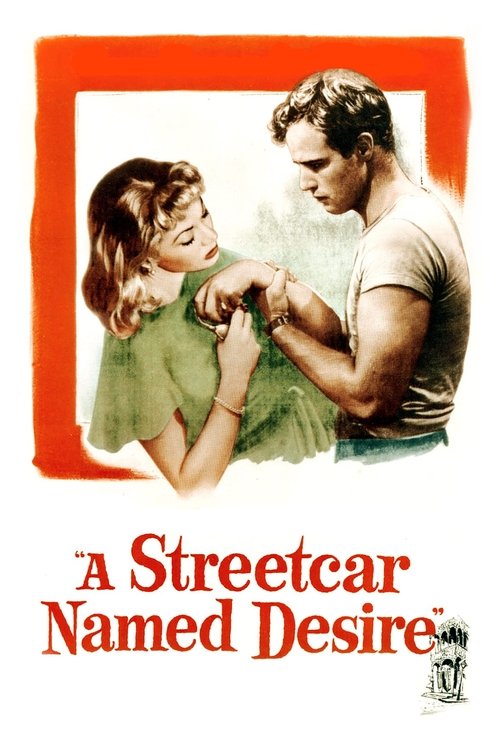
A Streetcar Named Desire (1951)
Directed by Elia Kazan
No · Ultra Based
How we score movies →Consciousness Markers
The film depicts class conflict between genteel Southern aristocracy and working-class Polish-American materialism, though without prescriptive ideology. Stanley's crude capitalism is presented as ascendant.
The cast reflects the play's original composition without deliberate diversity considerations. Kim Hunter and Karl Malden are supporting players in a narrative centered on white Southern characters.
The film treats Southern history implicitly as backdrop to personal drama. No conscious reframing of historical narratives occurs, though the Old South's decline is evident.
The film is set in New Orleans and features working-class characters of various backgrounds, but makes no conscious effort to address racial dynamics or systemic inequality.
The film contains coded homosexual subtext regarding Blanche's ex-husband, but this is never made explicit or celebrated. The film treats same-sex desire as tragic and shameful.
The film presents misogyny as a natural fact of life. Blanche's victimization by male violence and desire is not interrogated or critiqued by the narrative itself.
Climate change is entirely absent from the narrative. The film's environmental setting serves only as atmospheric backdrop.
Female bodies are presented as objects of male desire and judgment. Blanche's aging body becomes a site of humiliation and loss.
Blanche's mental illness is depicted as personal tragedy and moral weakness rather than neurodivergence to be understood or accommodated.
The film trusts its audience to draw conclusions from observed human behavior. No character delivers moral instruction or ideological explanation.


Synopsis
A disturbed, aging Southern belle moves in with her sister for solace — but being face-to-face with her brutish brother-in-law accelerates her downward spiral.
Why it received this score
A Streetcar Named Desire emerges from an era when cinema had not yet discovered the language of contemporary progressive consciousness. Elia Kazan's 1951 adaptation of Tennessee Williams presents desire, class anxiety, and mental illness as the raw materials of human tragedy, not as opportunities for cultural instruction. The film's treatment of its female characters reflects the era's casual brutality toward women: Blanche's sexual autonomy is punished, her mental fragility is weaponized against her, and her suffering serves the narrative without apology or moral corrective. This is not wokeness. This is the honest documentation of a patriarchal order functioning as intended.
What makes the film remarkable is precisely its refusal to editorializes its own cruelty. Marlon Brando's Stanley Kowalski is a working-class man driven by appetite and rage, and the film neither condemns his class nor celebrates it. Vivien Leigh's Blanche is trapped between the collapsing Southern gentility of her past and the brutal materialism of the present, and her final descent into institutionalization carries no therapeutic message, no suggestion that she might be understood or redeemed by the system that destroys her. The film predates the impulse to retrofit old tragedies with new moral frameworks.
By the metrics of contemporary cultural consciousness, this film scores almost negligibly. There is no representation crusade here, no celebration of identity, no acknowledgment that the world could be otherwise. Stanley's violence toward women is presented as a fact of life, not a problem to be solved through narrative intervention. In a strange way, this absolute lack of contemporary sensibility is precisely what makes the film endure: it captures a moment when cinema could still depict human suffering without insisting on its meaning.
Analysis generated by our Consciousness Algorithm
Critic Reviews
“You could make a good case that no performance had more influence on modern film acting styles than Brando's work as Stanley Kowalski, Tennessee Williams' rough, smelly, sexually charged hero.”
“Elia Kazan’s direction is often stagy, and the sets and the arrangement of actors are frequently too transparently “worked out,” but who cares when you’re looking at two of the greatest performances ever put on film and listening to some of the finest dialogue ever written by an American?”
“Kazan’s direction simmers when it needs to boil, placing all its chips on the battered decor and ethereal lighting, leaving you to wonder what fun Hitchcock or Preminger would have with the sexually pulsating, pressure-cooker backdrop gifted to them in the source material.”