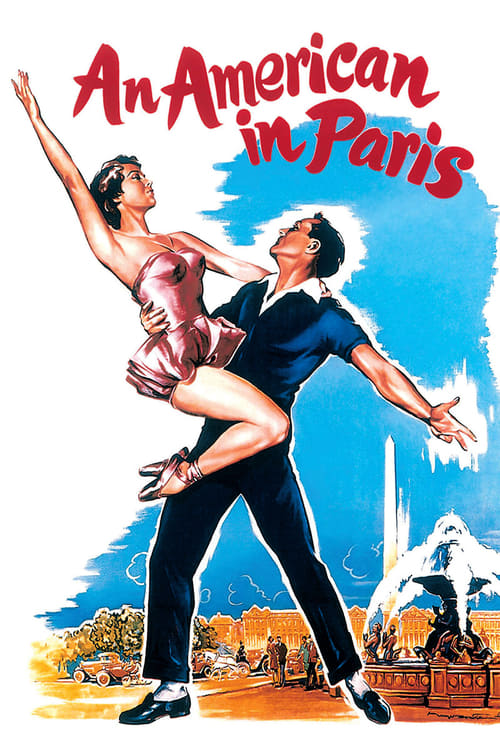
An American in Paris (1951)
Directed by Vincente Minnelli
No · Ultra Based
How we score movies →Consciousness Markers
The film employs standard 1951 Hollywood casting practices with white American and European leads. Leslie Caron's presence as a French woman in a lead role is notable for the era, but the role itself is defined primarily through romantic availability rather than agency or complexity.
Female characters serve primarily as romantic objects or obstacles. Milo Roberts is wealthy and initially appears powerful, but her arc culminates in rejection when Jerry chooses the younger woman, reinforcing conventional gender hierarchies.
The film contains no engagement with race or racial dynamics. The cast is uniformly white, and Paris is presented as an exotic playground without any acknowledgment of colonial or racial contexts.
While the protagonist is a struggling artist, the film ultimately validates capitalist success and romantic attachment to wealth. The resolution involves Jerry winning the affection of a wealthy patron and the romantic heroine, suggesting that artistic merit and personal charm lead to material security.
The film contains minimal preachy content. The occasional references to art and culture are presented as romantic backdrop rather than educational messaging, though the film's celebration of artistic genius carries subtle implications about taste and refinement.
No LGBTQ+ themes or characters are present in the film. The narrative is entirely heteronormative, focused on romantic pursuit between men and women.
Climate concerns are entirely absent from the film's world. The narrative shows no awareness of environmental issues or sustainability.
Body positivity frameworks do not appear in the film. The aesthetic ideal presented is the conventional Hollywood standard of the 1950s, and the film contains no commentary on body diversity or acceptance.
No representation of neurodivergent characters or engagement with neurodiversity themes is present in the film.
The film presents no alternative historical narratives or revisionist interpretations of history. It functions as pure escapist entertainment without historical engagement.


Synopsis
Jerry Mulligan is an exuberant American expatriate in Paris trying to make a reputation as a painter. His friend Adam is a struggling concert pianist who's a long time associate of a famous French singer, Henri Baurel. A lonely society woman, Milo Roberts, takes Jerry under her wing and supports him, but is interested in more than his art.
Why it received this score
An American in Paris stands as a towering achievement of post-war Hollywood musical cinema, a film so committed to pure aesthetic pleasure that it seems almost quaint to subject it to contemporary cultural analysis. The narrative concerns itself with the romantic entanglements of a young American painter navigating Paris society, and the film's ideological content is precisely as deep as one might expect from a 1951 MGM musical: the celebration of artistic aspiration, the romance of foreign travel, and the ultimate triumph of true love over mercenary advantage. The film contains no apparent engagement with social justice frameworks, progressive politics, or any of the cultural markers that have come to define contemporary progressive sensibilities.
The casting reflects the Hollywood norms of its era, with an American lead and a young French actress (Leslie Caron in her film debut) in the romantic lead role. Gender dynamics follow the conventions of the period: the female characters are objects of romantic pursuit rather than agents with autonomous goals, and the wealthy widow character (Nina Foch) functions primarily as an obstacle to the protagonist's happiness. The film's treatment of Paris and French culture is pure exoticization, a fantasy of continental sophistication designed to appeal to American audiences. There is no interrogation of power structures, no acknowledgment of France's colonial legacy, and certainly no attention to the material conditions of anyone outside the film's narrow circle of artists and society people.
The film's legacy rests entirely on its technical mastery and the genius of its choreography, not on any cultural consciousness. It won the Academy Award for Best Picture over A Streetcar Named Desire and A Place in the Sun, a decision that now appears as a testament to the Academy's preference for spectacle over substance. Viewed through the lens of contemporary cultural analysis, the film registers as essentially inert on matters of social awareness, which is not a criticism of the film itself but rather an observation about the historical distance between 1951 and the present moment.
Analysis generated by our Consciousness Algorithm
Critic Reviews
“One of the most imaginative musical confections turned out by Hollywood in years...Kelly is the picture’s top star and rates every inch of his billing. His diversified dancing is great as ever and his thesping is standout. But he reveals new talents in this one with his choreography. ”
“The songs are all Gershwin Brothers standards; Kelly's choreography is breathtaking; the original screenplay by playwright Alan Jay Lerner is alternately witty and touching; and Minnelli's direction feels buoyantly assured. ”
“Kelly is superb as dancer and comedian, but a little less than that as a singer of Gershwin songs. Leslie Caron, who dances like an angel, is no beauty, according to Hollywood standards, but she is endowed with great grace and personal charm. She is an exquisite dancer. An American in Paris, in short, is definitely a picture to see.”
“Nice period detail, a few cute situations, one half-interesting character and three laughs, that’s the pickle this picture puts itself in.”