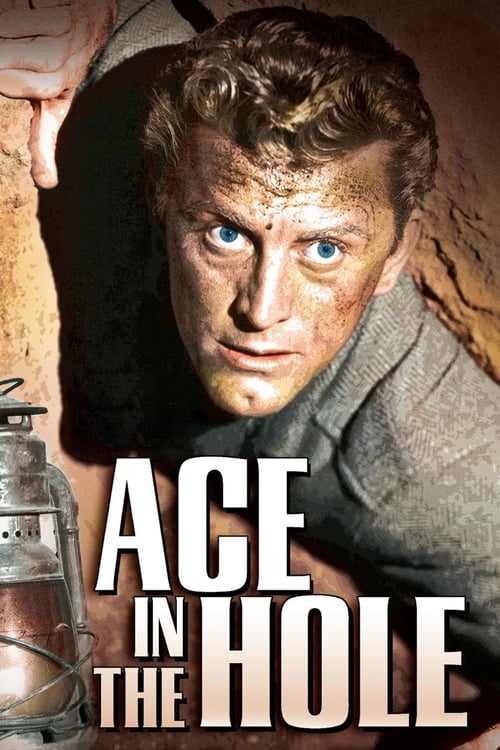
Ace in the Hole (1951)
Directed by Billy Wilder
No — Ace in the Hole is not especially woke, scoring 38 out of 100 on our wokeness meter.
Billy Wilder's Ace in the Hole arrived in 1951 to a public with no framework for it and critics who mostly recoiled.
Consciousness Markers
The film satirizes the profit-driven media circus that forms around Leo's entrapment, showing how a reporter, sheriff, and local businesses exploit a tragedy for money and career advancement.
The film delivers a cynical moral lesson about journalistic ethics and mob mentality, culminating in the ironic 'Tell The Truth' sign, but its satire is more show-than-tell than modern preachy lecture.
The cast is entirely white with no meaningful representation of minorities, and the film does not engage with casting diversity.
No LGBTQ+ characters or themes appear in the film.
Jan Sterling's Lorraine is a complex female character with her own motives, but the film does not advance a feminist agenda or critique patriarchy.
The film does not address racial issues or include racial consciousness as a theme.
No environmental or climate-related themes are present.
No body positivity themes or diverse body representation.
No neurodivergent characters or themes.
While inspired by real cave-in media events, the film is a fictional satire and does not revise or reinterpret historical narratives.
Why it received this score
Billy Wilder's Ace in the Hole arrived in 1951 to a public with no framework for it and critics who mostly recoiled. Kirk Douglas plays Chuck Tatum, a reporter of flexible conscience who finds a man trapped in a New Mexico cave and decides the man is worth more trapped than free. The rescue stretches from twelve hours to a week. A carnival rises on the sand. A ferris wheel turns while a man dies underground. Wilder meant it as a rebuke, and the rebuke landed hard enough that Paramount renamed the picture The Big Carnival and the audience stayed home.
On the ledger of contemporary social consciousness, the film is nearly empty. The cast is uniformly white, the women are written as opportunists with sharp elbows, and no character pauses to interrogate a power structure. The film does carry a cold contempt for the profit motive, and it carries that contempt well. Tatum sells a man's slow death to a New York editor for a thousand dollars a day. The sheriff trades exclusive access for a guaranteed reelection. Lorraine, the trapped man's wife, stays for the cash and the fur stole, which is pressed on her like a bribe. Everyone at the site is selling something, including the man who was selling rattlesnake hunts before the cave-in ever happened. This is not a critique of capitalism in the modern sense. It is a critique of appetite, which is older and less fashionable.
The moral arrives, as morals do, on a sign. Tatum dies beneath an embroidered "Tell The Truth," and the irony is thick enough to lean on. Wilder shows the lesson instead of shouting it, which spares the picture the sermonizing that has since become standard practice. The result is a sour, efficient machine. It has no interest in improving anyone. That restraint is the most admirable thing about it, and the reason it still cuts while louder films have gone soft in the middle. A relic, then, but a sharp one, filed accordingly under avarice and left there to rust in the desert sun. The carnival packs up. The crowd goes home. Nobody learns anything, which is the joke Wilder refuses to explain.
No contemporary markers of identity, ecology, or representation apply. Two categories stir faintly: a sour indictment of profit-driven exploitation, and a moral delivered through action instead of a lecture. Both remain modest. The film is a product of its era, and it wears that era without apology. The classification stands. We move on to the next specimen.
{"thematic_tags": []}
Analysis generated by our Consciousness Algorithm
Part of


Synopsis
An arrogant reporter exploits a story about a man trapped in a cave to revitalize his career.
Questions about Ace in the Hole
Is Ace in the Hole woke?
No — Ace in the Hole is not especially woke, scoring 38 out of 100 on our wokeness meter. That earns it a verdict of Based.
Does Ace in the Hole have any woke elements?
1 of the 10 markers register at 30 or above, led by Eat the Rich (45). On Eat the Rich: The film satirizes the profit-driven media circus that forms around Leo's entrapment, showing how a reporter, sheriff, and local businesses exploit a tragedy for money and career advancement.
How does Ace in the Hole compare to other 1951 movies?
It is the wokest of the 8 films from 1951 we've scored; their average is 8.
How is the Woke Score calculated?
An AI-assisted process researches the film and its reception, scores it 0–100 on ten markers, then combines those into one 0–100 Woke Score. It measures a specific set of 2020s cultural themes, not film quality.