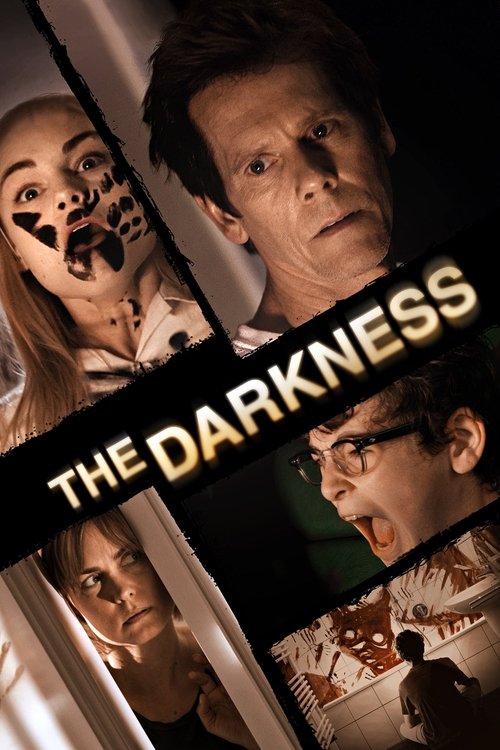
The Darkness (2016)
Directed by Greg McLean
No — The Darkness is not woke, scoring 15 out of 100 on our wokeness meter.
The Darkness arrives from Blumhouse with a 3 percent on Rotten Tomatoes and the weary dignity of a film that knows exactly what it is.
Consciousness Markers
The autistic son Mikey is a central character, and his condition is narratively framed as the reason he is unafraid and ultimately the one who banishes the demons, giving him a functional significance.
The cast is demographically varied (Ming-Na Wen, Alma Martinez as a Latina spiritual healer, Ilza Rosario Ponko), but these are natural genre roles with no commentary on representation itself.
Native American (Anasazi) folklore is used as occult set-dressing for the demon mythology, with a Latina healer figure, but the film makes no racial critique or social commentary.
The mother and daughter are sketched as a depressed drinker and a bulimic teen, but this is horror-trope characterization rather than any feminist statement or gender-power critique.
The film delivers its folklore exposition matter-of-factly through a Google search scene, with no preachy sermonizing.
No LGBTQ+ characters, themes, or subtext whatsoever.
No environmental or climate-crisis themes present.
No economic critique, class commentary, or anti-wealth messaging.
The daughter's bulimia is depicted as a symptom of demonic influence and a source of family drama, not as a body-acceptance or body-positive statement.
Native folklore is invoked as supernatural lore, not to revise or reinterpret historical narratives.
Why it received this score
The Darkness arrives from Blumhouse with a 3 percent on Rotten Tomatoes and the weary dignity of a film that knows exactly what it is. A family drives to the Grand Canyon, a small autistic boy pockets some cursed rocks from a kiva, and the household spends ninety minutes being menaced by a crow, a snake, and a coyote of no fixed address. Kevin Bacon does the heavy lifting. The house does the rest.
The most substantive element here is young Mikey, whose autism is not decoration but plot machinery. He is unafraid of the demons, which makes him the only person who can return the stones and end the event. That is a genuine narrative function, and it earns the film its largest measure of modern sensibility. Elsewhere the ledger is thinner. A Latina healer named Teresa and her granddaughter arrive to smudge the premises, and Anasazi folklore supplies the demon taxonomy, though the film treats both as atmosphere. Nobody reflects on what any of it means.
The daughter's bulimia and the mother's drinking are presented as symptoms of possession, not as occasions for commentary. Casting is diverse in the ordinary way of a working ensemble, with Ming-Na Wen and Alma Martinez on hand, but nothing in the script asks us to notice. There is a Google search scene that explains the mythology in flat, unadorned sentences, which is the closest this film comes to preaching. It is a haunted house picture assembled from parts, competently lit and entirely unremarkable, and it has no interest in instructing anyone about anything.
THEMATIC_TAGS_PLACEHOLDER
Analysis generated by our Consciousness Algorithm
Part of


Synopsis
A family returns from a Grand Canyon vacation with a supernatural presence in tow.
Questions about The Darkness
Is The Darkness woke?
No — The Darkness is not woke, scoring 15 out of 100 on our wokeness meter. That earns it a verdict of Ultra Based.
Does The Darkness have any woke elements?
1 of the 10 markers register at 30 or above, led by Neurodivergence (50). On Neurodivergence: The autistic son Mikey is a central character, and his condition is narratively framed as the reason he is unafraid and ultimately the one who banishes the demons, giving him a functional significance.
How does The Darkness compare to other 2016 movies?
It ranks #107 of the 285 films from 2016 we've scored; their average is 16. The wokest is 13th (92).
How is the Woke Score calculated?
An AI-assisted process researches the film and its reception, scores it 0–100 on ten markers, then combines those into one 0–100 Woke Score. It measures a specific set of 2020s cultural themes, not film quality.