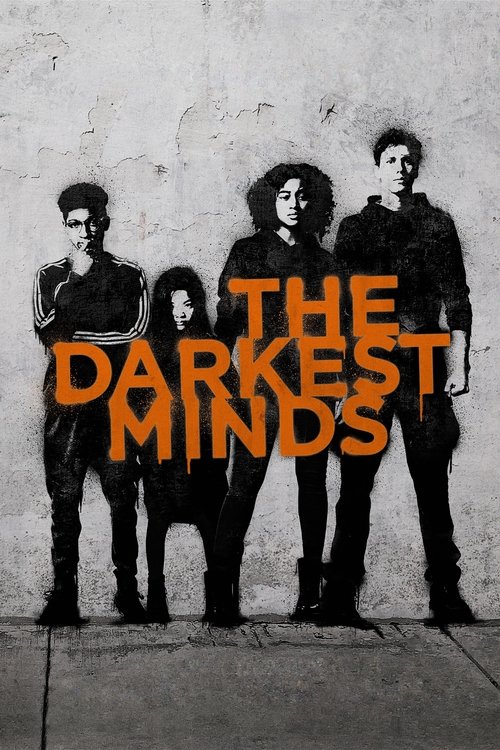
The Darkest Minds (2018)
Directed by Jennifer Yuh Nelson
No — The Darkest Minds is not woke, scoring 18 out of 100 on our wokeness meter.
The Darkest Minds arrives as a young adult dystopia assembled from spare parts, and it carries itself with the wounded dignity of a franchise that will not be getting a second installment.
Consciousness Markers
The film features a Black female lead (Amandla Stenberg) and a diverse supporting cast, including Black and Asian actors, but the diversity is not framed as a central statement.
A female protagonist and a female director provide some representation, but the story does not engage with feminist themes or critique patriarchy.
The film has a mild dystopian 'society is broken' undercurrent, but it prioritizes action and romance over preachy messaging.
No LGBTQ+ characters or themes are present in the film.
Race is not addressed or explored; the dystopian society is depicted without racial commentary.
No environmental or climate-related themes appear in the film.
The antagonist is an authoritarian government, not a capitalist system; no anti-capitalist messaging is present.
No body positivity themes or diverse body representation are present.
No neurodivergence themes or characters are present.
The film is a fictional dystopia and does not revise historical events.
Why it received this score
The Darkest Minds arrives as a young adult dystopia assembled from spare parts, and it carries itself with the wounded dignity of a franchise that will not be getting a second installment. Jennifer Yuh Nelson, making her live action debut after Kung Fu Panda, directs with competence and little urgency. The premise, a plague that kills most of America's children and leaves the survivors with color coded powers, is dutifully explained and then largely abandoned in favor of running through woods. The film grossed $41 million against a $34 million budget and was pulled from 2,679 theaters in its third weekend, the largest such retreat in recorded history. The ledger is not kind.
On the question of social consciousness, the film is a modest and somewhat conflicted specimen. Amandla Stenberg anchors the cast as Ruby, and the supporting players include Skylan Brooks, Miya Cech and Golden Brooks, an ensemble that reflects the demographics of its intended audience without ever announcing itself as a statement. Race goes unmentioned in the internment camps, which is either a quiet grace or an oversight depending on the viewer's patience. The government that hunts these children is authoritarian, not corporate, so the economic critique never materializes. There is no queer presence, no environmental lament, no engagement with bodily difference, no attention to neurodivergence. The film is a dystopia with a narrow imagination.
What remains is a female protagonist and a female director, both worth a nod, and neither amounting to an argument. Ruby's powers are treated as a curse of intimacy, a girl who cannot touch the boy she loves, which is romance rather than politics. Critics found the whole enterprise thin, and one reviewer suggested it played more like a manifesto than a thriller, though the manifesto in question is mostly about curfews and trust. The film gestures at a broken society and then sprints past the wreckage toward a sequel it will never receive. We are left with a competent, forgettable adaptation of a novel that a great many teenagers loved, and a classification that will not trouble anyone's conscience.
Analysis generated by our Consciousness Algorithm


Synopsis
After a disease kills 98% of America's children, the surviving 2% develop superpowers and are placed in internment camps. A 16-year-old girl escapes her camp and joins a group of other teens on the run from the government.
Questions about The Darkest Minds
Is The Darkest Minds woke?
No — The Darkest Minds is not woke, scoring 18 out of 100 on our wokeness meter. That earns it a verdict of Ultra Based.
Does The Darkest Minds have any woke elements?
1 of the 10 markers register at 30 or above, led by Representation Casting (50). On Representation Casting: The film features a Black female lead (Amandla Stenberg) and a diverse supporting cast, including Black and Asian actors, but the diversity is not framed as a central statement.
How does The Darkest Minds compare to other 2018 movies?
It ranks #115 of the 325 films from 2018 we've scored; their average is 20. The wokest is Return (92).
How is the Woke Score calculated?
An AI-assisted process researches the film and its reception, scores it 0–100 on ten markers, then combines those into one 0–100 Woke Score. It measures a specific set of 2020s cultural themes, not film quality.