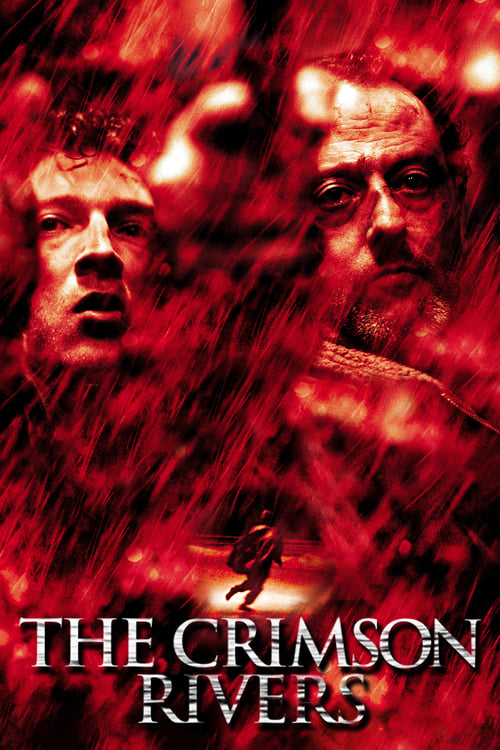
The Crimson Rivers (2000)
Directed by Mathieu Kassovitz
No — The Crimson Rivers is not woke, scoring 2 out of 100 on our wokeness meter.
Mathieu Kassovitz's The Crimson Rivers arrives from the year 2000, a period in which a French thriller could concern itself entirely with mutilated corpses, inbred Alpine academics, and the theft of a dead girl's eyes without pausing to instruct anyone on how to feel about it.
Consciousness Markers
The cast is predominantly white French actors with a few supporting minority performers, but there is no modern inclusive-casting agenda or commentary.
No LGBTQ+ characters, themes, or subtext.
Features a female glaciologist, but the film has no feminist critique or agenda; she functions as a plot device and antagonist.
Skinhead antagonists appear, but their presence is not used to examine racism or racial justice.
The glacier and mountain setting is atmospheric, not an environmental crusade.
Critiques an elitist academic eugenics program, not capitalism or wealth inequality.
No body-positivity themes or representation.
No neurodivergence themes or characters.
A fictional thriller based on a novel, with no historical revisionism.
A grim procedural thriller that does not lecture the audience on social issues.
Why it received this score
Mathieu Kassovitz's The Crimson Rivers arrives from the year 2000, a period in which a French thriller could concern itself entirely with mutilated corpses, inbred Alpine academics, and the theft of a dead girl's eyes without pausing to instruct anyone on how to feel about it. Jean Reno and Vincent Cassel stalk through the fog of Guernon, two detectives converging on a mountain university whose faculty once dreamed of breeding a master intellect. The film is grim, cold, and occasionally incomprehensible, a fact its own star has cheerfully confirmed. It lectures no one. It buries the audience in snow and glass eyes and lets them find their own way out.
There is a female glaciologist, Fanny, played with a certain frost by Nadia Farès, and she turns out to be the architect of the carnage, which is either a refreshing refusal of victimhood or merely a plot twist. The film does not stop to interrogate what it means. Skinhead antagonists desecrate a grave in the opening act, and the movie treats them as atmosphere, not as an occasion for a seminar on hatred. The villains are eugenicists, so the contempt here is aimed at an intellectual elite's fantasy of perfect bloodlines, not at markets, not at carbon, not at the body. Nobody pauses mid-investigation to affirm anyone.
What remains is craft and mood. The glacier sequences were shot on the Mer de Glace, and the cold is real. The screenplay, adapted from Jean-Christophe Grangé's novel, discards explanation in favor of dread, a trade the director apparently made on purpose. The result is a film that trusts its audience to keep up or to drown. It grossed sixty million dollars and spawned sequels, which suggests the drowning was popular. As a specimen of pre-millennial European pulp, it is almost admirably free of instruction. We are left with two policemen, a mountain, and a great deal of blood in the snow.
Analysis generated by our Consciousness Algorithm


Synopsis
Two French policemen, one investigating a grisly murder at a remote mountain college, the other working on the desecration of a young girl's grave by skinheads, are brought together by the clues from their respective cases. Soon after they start working together, more murders are committed, and the pair begin to discover just what dark secrets are behind the killings.
Questions about The Crimson Rivers
Is The Crimson Rivers woke?
No — The Crimson Rivers is not woke, scoring 2 out of 100 on our wokeness meter. That earns it a verdict of Ultra Based.
Does The Crimson Rivers have any woke elements?
No. All 10 markers score zero.
How does The Crimson Rivers compare to other 2000 movies?
It ranks #108 of the 125 films from 2000 we've scored; their average is 13. The wokest is But I'm a Cheerleader (72).
How is the Woke Score calculated?
An AI-assisted process researches the film and its reception, scores it 0–100 on ten markers, then combines those into one 0–100 Woke Score. It measures a specific set of 2020s cultural themes, not film quality.