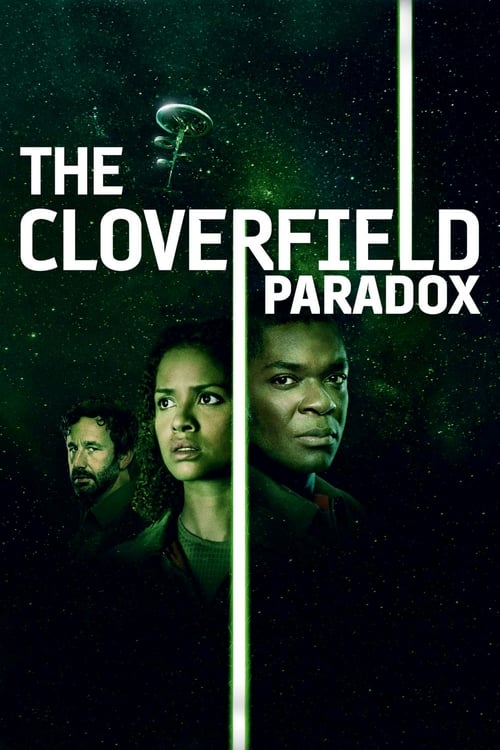
The Cloverfield Paradox (2018)
Directed by Julius Onah
No — The Cloverfield Paradox is not especially woke, scoring 20 out of 100 on our wokeness meter.
The Cloverfield Paradox arrived in 2018 by way of a Super Bowl advertisement and an immediate Netflix upload, a distribution maneuver that generated more suspense than anything inside the film itself.
Consciousness Markers
The film features a deliberately international and diverse ensemble, including a Black female lead, a Black commander, and a Chinese engineer, though the diversity is largely presented as a natural space-station crew rather than a thematic statement.
Gugu Mbatha-Raw's Ava is a capable lead engineer and central protagonist, but the film does not articulate a feminist agenda or critique gender dynamics.
There are no LGBTQ+ characters, relationships, or themes in the film.
The film includes Black cast members but does not engage with race, racism, or racial identity as a theme.
The energy crisis is a plot device to justify the particle accelerator, not an environmentalist or climate-advocacy message.
There is no critique of capitalism, wealth inequality, or corporate power in the film.
The film does not address body image, body diversity, or body-positivity themes.
No neurodivergent characters or themes are present.
The film is a science-fiction horror story and does not revise or reinterpret historical events.
The film does not pause for social or political lectures; its exposition is plot-driven sci-fi mechanics.
Why it received this score
The Cloverfield Paradox arrived in 2018 by way of a Super Bowl advertisement and an immediate Netflix upload, a distribution maneuver that generated more suspense than anything inside the film itself. A crew of international scientists aboard a space station fire up a particle accelerator to solve Earth's energy crisis, and the machine flings them into a parallel dimension where the planet has vanished. What follows involves a severed arm that writes messages, a man whose eyes move on their own, and a worm colony with strong opinions about its host. The energy crisis exists to justify the machinery and nothing more. Nobody lectures us about carbon or consumption.
The ensemble is genuinely international, and the lead engineer is played by Gugu Mbatha-Raw with a competence the script barely deserves. A Black commander and a Chinese engineer round out the roster. The film treats this as the ordinary composition of a space program, which is to say it never comments on any of it. There is no examination of race, no gender argument, no romantic configuration beyond the conventional. The cast is diverse. The screenplay is incurious about why that might matter.
Julius Onah directs with a straight face, and the production design is serviceable. The film's ambitions are modest and franchise-shaped: it wants to be a Twilight Zone episode wearing a Cloverfield mask, and it succeeds only at the mask. There is no sermon here, no social instruction, no moment where the characters pause to educate the audience about the correct way to live. It is a genre exercise, blood and physics and a monster at the end. For a viewer who has spent years being lectured by science fiction about the state of the world, the silence is nearly restful. Nearly. (Thematic tags: sequel.)
Analysis generated by our Consciousness Algorithm
Part of


Synopsis
Orbiting above a planet on the brink of war, scientists test a device to solve an energy crisis and end up face-to-face with a dark alternate reality.
Questions about The Cloverfield Paradox
Is The Cloverfield Paradox woke?
No — The Cloverfield Paradox is not especially woke, scoring 20 out of 100 on our wokeness meter. That earns it a verdict of Based.
Does The Cloverfield Paradox have any woke elements?
1 of the 10 markers register at 30 or above, led by Representation Casting (40). On Representation Casting: The film features a deliberately international and diverse ensemble, including a Black female lead, a Black commander, and a Chinese engineer, though the diversity is largely presented as a natural space-station crew rather than a thematic statement.
How does The Cloverfield Paradox compare to other 2018 movies?
It ranks #107 of the 325 films from 2018 we've scored; their average is 20. The wokest is Return (92).
How is the Woke Score calculated?
An AI-assisted process researches the film and its reception, scores it 0–100 on ten markers, then combines those into one 0–100 Woke Score. It measures a specific set of 2020s cultural themes, not film quality.