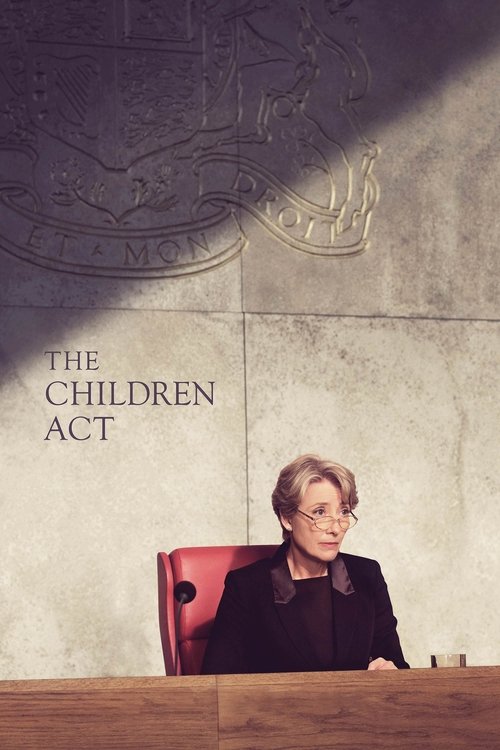
The Children Act (2018)
Directed by Richard Eyre
No — The Children Act is not woke, scoring 8 out of 100 on our wokeness meter.
The Children Act arrives from an older tradition, the sort of sober adult drama that once filled cinemas and now mostly migrates to streaming with little fanfare.
Consciousness Markers
Fiona Maye is a powerful, competent judge navigating a high-stakes professional and personal crisis, though the film does not push a radical feminist agenda.
The cast is well-populated with established actors, but the central figures are not used to push specific modern representation narratives.
While the film involves complex legal arguments, it prioritizes character drama and ethical ambiguity over didactic instruction.
There are no explicit LGBTQ+ themes or characters central to the plot or subplots.
The film does not engage with issues of race, systemic racism, or racial identity.
There is no mention of environmentalism or climate change within the narrative.
The conflict is centered on law and ethics, not economic disparity or corporate power.
The film does not address body image or challenge conventional standards of beauty.
There is no evidence of neurodivergent characters or themes in the film.
The film deals with contemporary legal and ethical dilemmas, not historical revisionism.
Why it received this score
The Children Act arrives from an older tradition, the sort of sober adult drama that once filled cinemas and now mostly migrates to streaming with little fanfare. Richard Eyre directs Ian McEwan's adaptation of his own novel with a steady hand, and Emma Thompson plays Fiona Maye, a High Court judge in the Family Division, with a control that borders on the surgical. A seventeen-year-old Jehovah's Witness with leukemia refuses a blood transfusion. The law says his welfare is paramount. The film watches the machinery of judgment grind, and it watches the woman operating it come apart at home. That is the whole of its ambition, and it is enough.
The cultural accounting here is thin. Fiona holds real professional authority, and the film grants her competence without ceremony, which registers as a faint signal on the modern sensitivity scale and nothing more. No argument is mounted about her gender. The Henry family's faith is treated as a genuine conviction, not a foil for secular scolding. Race never enters the frame. Neither does climate, nor the rapacity of capital, nor the politics of the body, nor the vocabulary of neurodivergence. These absences are not failures. They are simply the film's chosen territory.
Ethical ambiguity remains, and it is handled with a restraint that keeps the sermonizing at bay. The film refuses to tell us what to think about Adam's choice, or Fiona's kiss, or the marriage she has neglected. The final act, in which the boy dies and the judge weeps into her husband's hand, offers no lesson and no consolation. We are left with the uncomfortable proposition that the law can save a life and still leave everyone involved stranded. For a viewer accustomed to cinema that explains itself, this is bracing. For the purposes of classification, it is a film that mostly declines to participate.
Analysis generated by our Consciousness Algorithm


Synopsis
In the midst of a marital crisis, a High Court judge must decide if she should order a life-saving blood transfusion for a teen with cancer despite his family's refusal to accept medical treatment for religious reasons.
Questions about The Children Act
Is The Children Act woke?
No — The Children Act is not woke, scoring 8 out of 100 on our wokeness meter. That earns it a verdict of Ultra Based.
Does The Children Act have any woke elements?
Very few. None of the 10 markers reaches 30, the level where a marker counts as present; the highest is Feminist Agenda at 20.
How does The Children Act compare to other 2018 movies?
It ranks #217 of the 325 films from 2018 we've scored; their average is 20. The wokest is Return (92).
How is the Woke Score calculated?
An AI-assisted process researches the film and its reception, scores it 0–100 on ten markers, then combines those into one 0–100 Woke Score. It measures a specific set of 2020s cultural themes, not film quality.