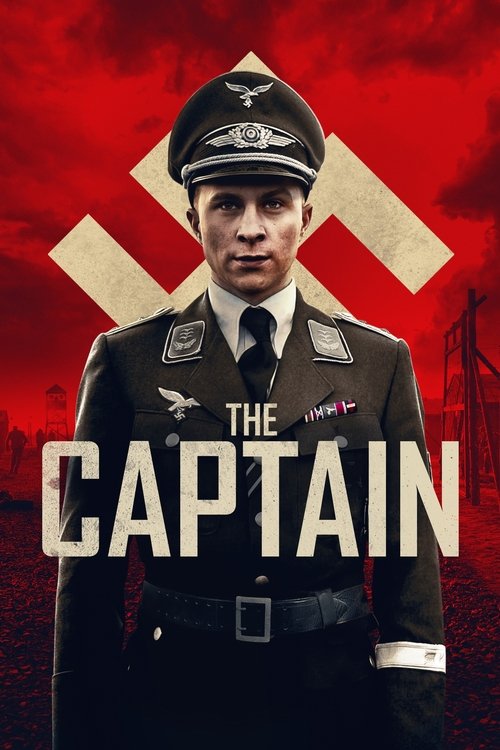
The Captain (2018)
Directed by Robert Schwentke
No — The Captain is not woke, scoring 0 out of 100 on our wokeness meter.
Robert Schwentke's The Captain (Der Hauptmann) arrives in black and white, which is the correct choice for a film about a deserter who finds a Luftwaffe captain's uniform in an abandoned car and learns that a stolen coat is sufficient credentials to command men.
Consciousness Markers
The film includes a didactic modern-day coda and makes pointed statements about human nature and repeating history, giving it some lecture energy.
The cast is entirely white and predominantly male, reflecting the historical German military setting without any deliberate diverse casting.
There are no LGBTQ+ characters, relationships, or themes in the film.
The film does not advance a feminist agenda; women are largely absent and the narrative focuses on male soldiers and power.
The film depicts Nazi atrocities but does not engage with modern racial consciousness or racial justice themes.
There are no climate change or environmental themes in the film.
The film critiques authoritarianism and human cruelty, but not capitalism or wealth inequality in an eat-the-rich sense.
There is no body positivity messaging or focus on body image issues.
No characters are depicted with neurodivergence, nor are neurodivergent themes explored.
The film is a historically grounded account of Willi Herold, not a revisionist reimagining of history through a modern progressive lens.
Why it received this score
Robert Schwentke's The Captain (Der Hauptmann) arrives in black and white, which is the correct choice for a film about a deserter who finds a Luftwaffe captain's uniform in an abandoned car and learns that a stolen coat is sufficient credentials to command men. Willi Herold marches through the collapsing Reich of April 1945, collects stragglers, and eventually presides over the execution of deserters at an Emsland camp. Max Hubacher plays him with a blank, hungry quality that never asks for sympathy. The film is grim, well made, and entirely unconcerned with the cultural preoccupations of the decade in which it was released.
The cast is white, male, and German, because the Wehrmacht was. Women appear at the margins and vanish. There is no romance, no tender coming-of-age arc for a marginalized figure, no redemptive counterweight. The film's critique lands on authoritarianism and the human appetite for a uniform, which is not the same thing as a critique of capital, and it does not pretend otherwise. Audiences hunting for contemporary moral instruction in the usual places will find the cupboards bare, and the film seems content to let them stay that way.
Where the picture does raise a finger, it does so at the end. The closing credits run over footage of Herold and his men driving a modern Mercedes through present-day Görlitz, harassing pedestrians, while text informs us that he and his accomplices were executed after the war. It is a pointed gesture about continuity, and it lands with the subtlety of a raised eyebrow. A small measure of sermon, delivered silently, over a car. The rest is history, and history, as presented here, does not flatter anyone.
Analysis generated by our Consciousness Algorithm


Synopsis
Germany, 1945. Soldier Willi Herold, a deserter of the German army, stumbles into a uniform of a Nazi captain abandoned during the last and desperate weeks of the Third Reich. Newly emboldened by the allure of a suit that he has stolen only to stay warm, Willi discovers that many Germans will follow the leader, whoever he is.
Questions about The Captain
Is The Captain woke?
No — The Captain is not woke, scoring 0 out of 100 on our wokeness meter. That earns it a verdict of Ultra Based.
Does The Captain have any woke elements?
Very few. None of the 10 markers reaches 30, the level where a marker counts as present; the highest is Lecture Energy at 20.
How does The Captain compare to other 2018 movies?
It ranks #291 of the 325 films from 2018 we've scored; their average is 20. The wokest is Return (92).
How is the Woke Score calculated?
An AI-assisted process researches the film and its reception, scores it 0–100 on ten markers, then combines those into one 0–100 Woke Score. It measures a specific set of 2020s cultural themes, not film quality.