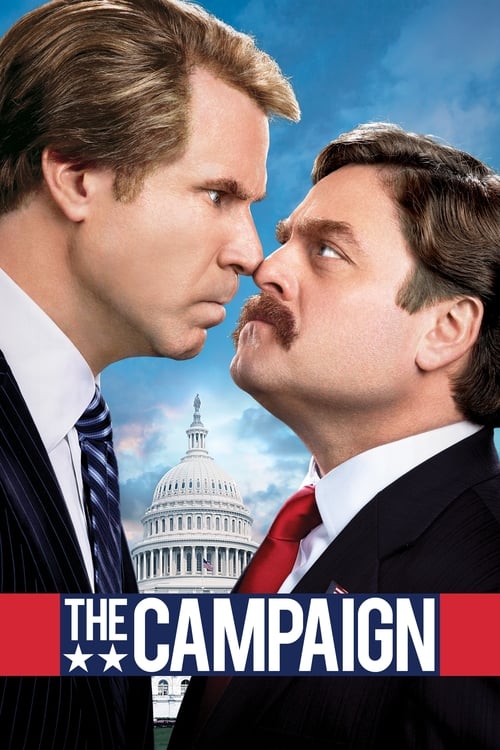
The Campaign (2012)
Directed by Jay Roach
No — The Campaign is not especially woke, scoring 24 out of 100 on our wokeness meter.
The Campaign presents a familiar landscape of political ambition and systemic rot, dressed in the polished sheen of a 2012 studio comedy.
Consciousness Markers
The film's central target is corporate money in politics: the Koch-brother stand-ins (the Motch brothers) buy a congressman, rig voting machines, and plan to import Chinese labor, with Citizens United named explicitly at the end.
The satire carries a clear message about money corrupting elections, and the finale has Marty pledge honesty and refuse billionaire donations, but it is delivered through gags rather than sermonizing.
The cast is overwhelmingly white, with Karen Maruyama in a minor domestic role; no deliberate diverse-casting effort is evident in this 2012 studio comedy.
The 'Al Qaeda' attack ad mocking Marty's mustache and the Chinese 'insourcing' subplot touch on ethnic imagery, but purely as punchlines rather than racial commentary.
No LGBTQ characters or themes appear; Marty's effeminate mannerisms are mined for laughs rather than presented as identity.
Women are largely props to the men's scandals — the affair, the leaked sex tape, the paid-off wife — with no feminist framing whatsoever.
No environmental or climate content of any kind.
No body-positivity themes; physical comedy is aimed at mocking appearances rather than celebrating them.
No neurodivergent characters or themes; Marty's oddness is played as sheltered naivety, not a condition.
A fictional satire with no historical revisionism, though it does open with a factually wrong Ross Perot quote.
Why it received this score
The Campaign presents a familiar landscape of political ambition and systemic rot, dressed in the polished sheen of a 2012 studio comedy. We observe two rival candidates vying for a congressional seat, a battle defined not by ideology, but by who can best navigate the treacherous waters of corporate funding. The film’s most successful endeavor is its aggressive, if broad, attack on the influence of immense wealth in electoral cycles. The revelation that the election's integrity was compromised by powerful interests operating under the umbrella of Citizens United delivers a clear message regarding the commodification of the public square.
The progressive sensibilities of the picture remain firmly tethered to financial critique, stopping short of any deeper cultural engagement. While the film employs ethnic and racial imagery to generate a few memorable gags, the commentary remains strictly a punchline mechanism, offering no genuine racial introspection. The cast, though featuring high-profile names, does little to challenge the existing demographics of the political machine it seeks to satirize. Women, meanwhile, function primarily as plot catalysts or victims of the male machinations, leaving no room for meaningful feminist framing within the narrative structure.
It is a film concerned with the mechanics of power, a cynical but perhaps inevitable examination of how money bends democratic structures. The humor is derived from the absurdity of the candidates' personal failures rather than a genuine commitment to modern social awareness. The satire functions as a well-executed, though ultimately conventional, commentary on political expediency. We are left with a slick reminder that even when the systems are rigged, the structure of the critique itself is rather predictable.
Analysis generated by our Consciousness Algorithm
Part of


Synopsis
Two rival politicians compete to win an election to represent their small North Carolina congressional district in the United States House of Representatives.
Questions about The Campaign
Is The Campaign woke?
No — The Campaign is not especially woke, scoring 24 out of 100 on our wokeness meter. That earns it a verdict of Based.
Does The Campaign have any woke elements?
2 of the 10 markers register at 30 or above, led by Eat the Rich (70) and Lecture Energy (30). On Eat the Rich: The film's central target is corporate money in politics: the Koch-brother stand-ins (the Motch brothers) buy a congressman, rig voting machines, and plan to import Chinese labor, with Citizens United named explicitly at the end.
How does The Campaign compare to other 2012 movies?
It ranks #34 of the 230 films from 2012 we've scored; their average is 12. The wokest is Killing Them Softly (92).
How is the Woke Score calculated?
An AI-assisted process researches the film and its reception, scores it 0–100 on ten markers, then combines those into one 0–100 Woke Score. It measures a specific set of 2020s cultural themes, not film quality.